Bitcoin Post-Quantum Plan: What Coinbase Wants Developers To Weigh
Coinbase's October 13 blog post sets out what it wants from a Bitcoin post-quantum upgrade, from BIP-360 and hybrid keys to the risks of stateful signatures.

In this article+
Coinbase has put a long technical wish list in front of Bitcoin developers. Its October 13, 2026 blog post, written by Shashank Agrawal, covers how a Bitcoin post-quantum migration could work. The company says it holds about 5% of all bitcoin in existence and wants its custody needs counted. It calls the piece "an input to an open discussion, not a set of instructions or a final Coinbase position."
What Coinbase wants from a Bitcoin post-quantum upgrade
The first request is timing. Coinbase says work should begin well before anyone announces a quantum computer able to break today's signatures, which the post abbreviates as CRQC. Its reasoning is that consensus changes and ecosystem migrations can take years.
The second is flexibility. The post argues for an output type that lets one or more post-quantum signature systems be added, swapped or combined without a redesign. It names BIP-360, a proposal called P2MR, and P2TRv2 as designs that appear to offer that room.
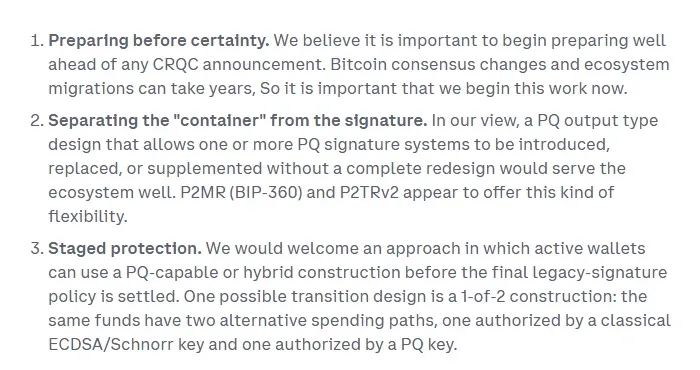
The five high-level points in Coinbase's post, as they appear on its blog. Source: Coinbase blog.
The third is a staged path. Coinbase would welcome a hybrid setup. The same funds could be spent two ways, with a classical ECDSA or Schnorr key or with a post-quantum key. Active users would gain protection before Bitcoin settles what happens to old signatures.
The state problem for Bitcoin post-quantum signatures
Some hash-based signature schemes are smaller and faster when they track state, meaning a record of which one-time keys were used. Coinbase calls that risky. Reusing state can lead to immediate forgery, the post says.
For people who hold their own keys, a lost or outdated backup could cause an accidental reuse. For an exchange, the problem is operational. Large exchanges like Coinbase run several independent servers in different zones to sign quickly. A stateful scheme would need an exclusive lock on each key while a signature is made. The company asks that any stateful option come with a stateless fallback, which suits a Bitcoin post-quantum design used by custodians.
Old coins and the open question
The post treats legacy funds as their own governance and engineering problem. It lists outputs with permanently exposed public keys, reused keys, dormant coins, lost keys, and Satoshi-era holdings. It also lists the chance of covert quantum theft before the public learns that such a machine exists.
On rescue ideas, Coinbase wants each proposal to show the rescue path itself resists a quantum attacker. It adds that the debate over abandoned coins can continue alongside the technical work and need not delay it.
Signature candidates and custody
Coinbase would like Bitcoin's evaluation to cover ML-DSA, SLH-DSA and FN-DSA once it is standardized, plus compact candidates. It singles out SHRINCS, a hash-based draft that pairs a stateful path with a stateless fallback, as a good fit for the test set. The company also wants at least one scheme that works with multiparty computation signing, which it says large organizations use against key theft.
The top of the post, with its author and October 13 date. Source: Coinbase blog.
Nothing in the post is a formal proposal for a protocol change, and Coinbase says as much. It is a statement of priorities from one of the largest custodians in the world. The document works as a map of what a big holder will need before a Bitcoin post-quantum design can serve institutions.
Written by
Writer and editor at Times of Crypto Era. Covers Bitcoin, DeFi, and market structure.
View full profile →Related News

SATS Preferred Stock: Strive Plans 15% Sale, 18-Month Reserve
Strive plans to sell 5,000,000 shares of 15% SATS preferred stock with an 18-month dividend reserve of 22.50 dollars a share, per its October 13 SEC filing.

Coinbase Premium Gap Hits -$107, Mostly A USDT Price Effect
The Coinbase premium gap fell to -$107, but a dollar-adjusted check shows almost all of it comes from Tether trading near $0.9987. See the numbers and method.

Bitcoin Options CPI: Deribit Prices A 2% Move On Wednesday
Bitcoin options CPI read: Deribit prices roughly a 2% move into Wednesday's report. See the forward volatility math, recent daily moves and the quicktake.