CFTC Crypto Rules: Who Could Lend To Retail Traders
The CFTC asked for comment on rules for retail crypto bought with loans. Here is who could lend, who would hold the coins and how losses would be handled.

In this article+
CFTC crypto rules for retail trading on borrowed money took a first step on October 5, when the agency published an advance notice seeking comment. The document calls the target "crypto asset transactions," or CTXs, meaning retail crypto purchases made with a loan or margin. Comments are due 60 days after the notice appears in the Federal Register. It is a request for views, not a proposed rule.
Why Retail Crypto Loans Land At The CFTC
The Dodd-Frank Act of 2010 required retail commodity deals offered with a loan, margin or other financing to be treated as if they were futures. Dealing in them off-exchange is unlawful unless they run on a registered venue called a designated contract market. The notice says industry feedback shows crypto's differences from futures have frustrated that rule's purpose.
The fix on the table is a new, optional exchange category called a crypto asset market, or CAM. It would list only crypto and follow tailored core principles. The design calls for every trade to pass through a futures commission merchant, or FCM, the broker type that already handles customer money in futures. Chairman Michael Selig said the American people "deserve clarity, certainty, and consumer protections" in crypto markets.
Lenders And Custody Under The Proposed Crypto Market
Under the CFTC crypto rules sketched here, lending would be tightly limited. Financing could come only from an FCM or from a depository bank that an FCM sponsors. Each lending arrangement would be written into the exchange's rulebook, covering fees, margin and liquidation procedures. A sponsoring FCM would need a written promise that the bank follows FCM rules for the loans.
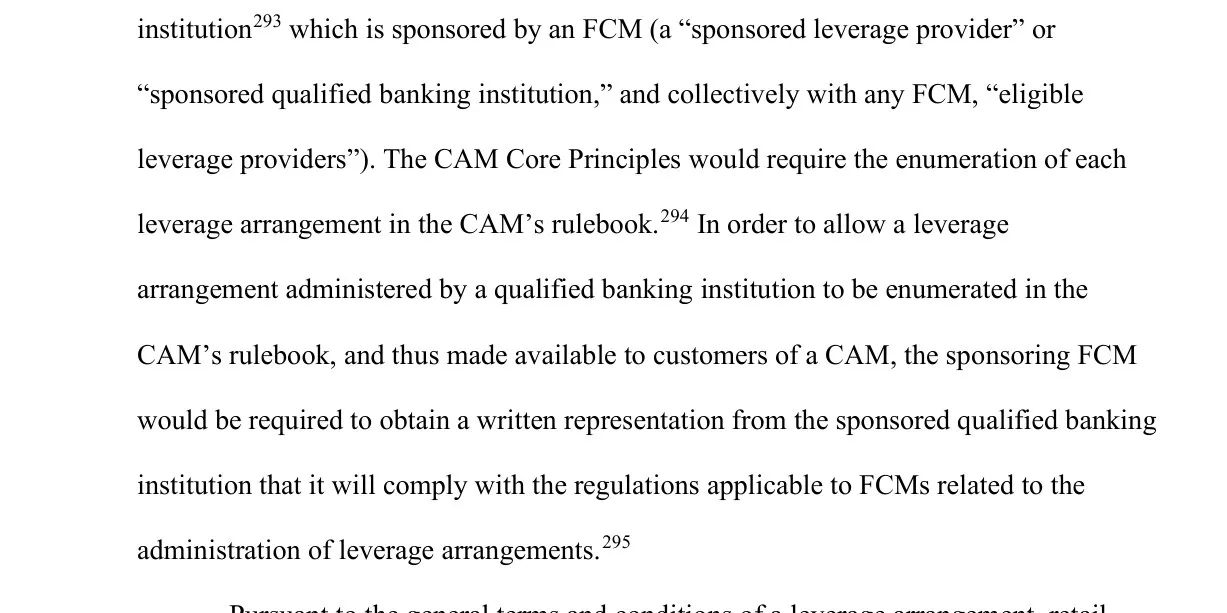
The CFTC notice defines who may offer financing.
Purchased coins would sit with the FCM. The lender could take a security interest in the customer's account holding them, or in other collateral. A footnote adds a catch: under current FCM rules, a creditor cannot hold a security interest in assets in an FCM's segregated account.
That tension feeds the segregation questions. Should FCMs be allowed to re-lend customer crypto, known as rehypothecation? Could that leave an FCM short of segregated funds? Another question covers how fully paid positions are protected if an FCM fails. Futures brokers gained room on tokenized assets in a September 24 FAQ update, and the SEC took up custody in an October 1 proposal.
Loss Handling, Margin And Proof Of Reserve
Losses draw the most open-ended questions. A clearinghouse could back financed trades with a limited guarantee, and the CFTC asks whether that would be enough. It also asks whether losses should ever be mutualized, meaning spread across participants. On margin, it weighs today's setup, where clearinghouses set the levels, against more detailed requirements set by the agency. One question asks whether a coin should need a minimum market cap and daily volume to count as collateral.
It also asks whether platforms should tell customers how an insolvency would affect their assets. Exchanges typically hold customer property in omnibus accounts. Some commission outside audits attesting that reserves cover all customer liabilities, known as proof of reserves. The CFTC asks which of those practices it should weigh, including blockchain-based ones.
Chainlink's Reaction And Where Oracles Appear
Chainlink said on October 5 that it is encouraged by the CFTC's work toward clear rules for digital asset markets. Its post names "oracles and proof of reserve" and says it looks forward to working with Selig and the Commission.
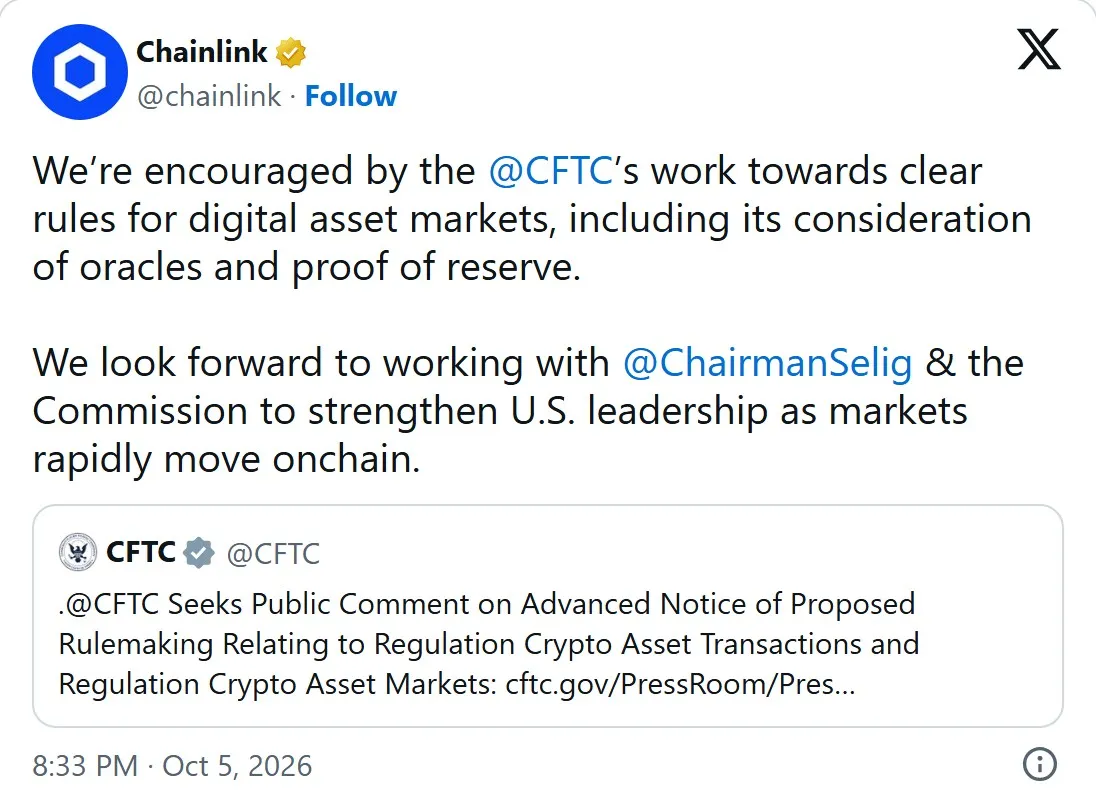
Chainlink's post on X after the CFTC release.
Oracles appear in two questions. One asks how an exchange should bring in prices from other venues and names pricing oracles as an example tool. The other asks whether the rules should address pricing oracle failures, alongside blockchain congestion and forks.
Comments on the CFTC crypto rules must be in writing, and the agency says it will post them on Regulations.gov.
Written by
Amina Wanjiru covers crypto regulation and policy for Times of Crypto Era. The reporting follows SEC, CFTC and Federal Register actions, plus rules from regulators in the UK, EU and Asia, with a focus on what a new rule changes in practice.
View full profile →Related News

Unhosted Wallet Rule Withdrawn: FinCEN Drops Mixer Proposal Too
FinCEN is withdrawing its 2020 unhosted wallet rule and its 2023 crypto mixer proposal. Here is what each would have required and why they were pulled.

National Trust Bank Charters: ICBA Sues OCC Over Crypto Access
Community bankers sued the OCC on October 2 over national trust bank charters for crypto firms. Here is what the complaint says and what the OCC argues.

Crypto Custody Rules: SEC Proposes Path For Advisers And Funds
The SEC proposed new crypto custody rules on October 1. Here is how advisers and funds could self-custody or use state trust companies, and what comes next.