Open USD Supply Hits $730M In Week One, 67% On Tempo
Open USD supply hit $733.7M in week one, with 67% on Tempo. Contract reads show one wallet holding 40% there while 24-hour volume is only about $602K.

In this article+
Open USD supply reached about $734 million across four chains in its first week, based on contract reads taken on October 8, 2026. DefiLlama ranks OUSD 17th among dollar stablecoins by supply, just above Aave's GHO. Two-thirds of the total sits on Tempo, and a handful of wallets hold most of it.
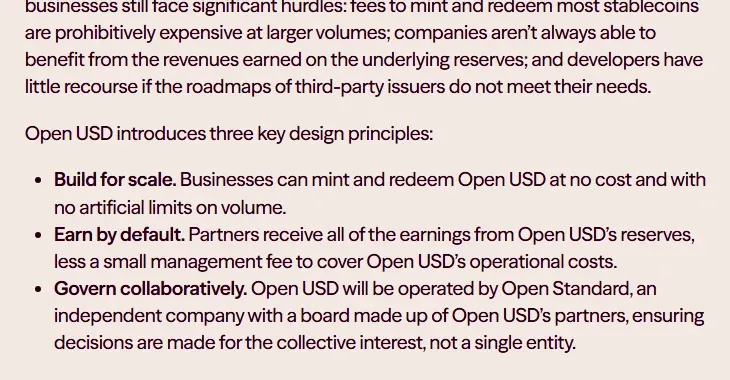
Open Standard's launch post, listing the three design principles behind the coin.
Where the Open USD supply sits
Reading each token contract directly gives $492.9 million on Tempo, $105.0 million on Ethereum, $69.6 million on Solana and $66.3 million on Base. Those add up to $733.7 million, which matches CoinGecko's circulating figure. Tempo's share works out to 67%.
DefiLlama's daily series shows how it got there. September 30 closed near $454 million, with $424 million of that on Tempo and $10 million on each other chain. Then October 2 added roughly $50 million apiece on Ethereum, Solana and Base. Ethereum picked up another $30 million on October 6 and about $11 million a day later.
Outside Tempo, supply grew from $30 million to about $241 million in eight days. Kraken's listing notice for OUSD is dated the same October 2, at 15:37 UTC.
Tempo's holder list is top heavy
On Tempo's explorer the token page lists 382 holders and a supply cap of 1,000,000,001 OUSD. The token contract dates to April 21, 2026, months before launch. Its transfer policy is a blocklist, and the page says token admins can replace that policy.
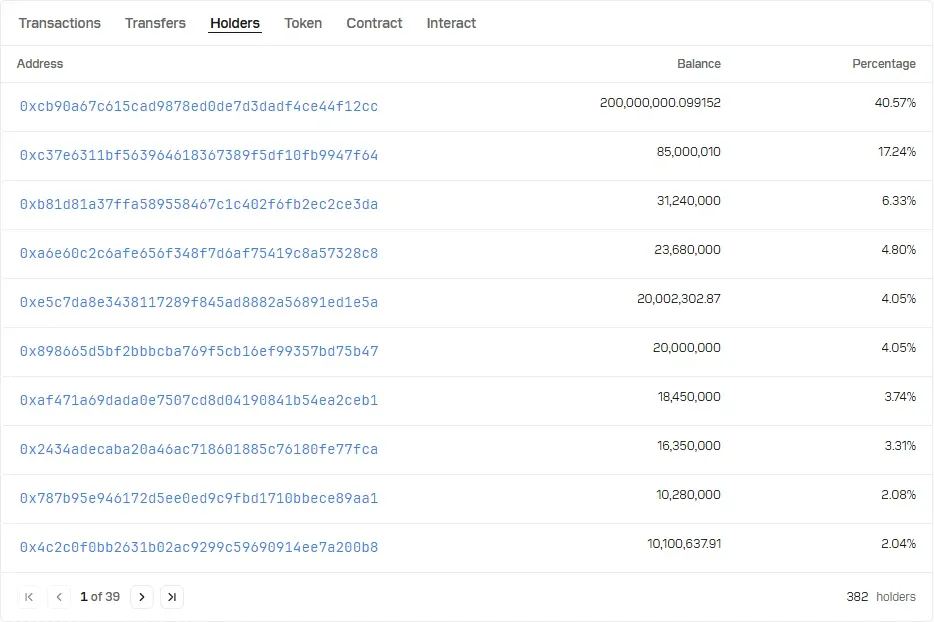
Tempo explorer's holders tab for OUSD, ranked by balance.
One wallet holds 200 million OUSD, or 40.57% of Tempo's supply. The second holds 85 million, and the two together control about 58%. The top ten hold roughly 88%.
Wallets carry no labels on the explorer, so this report names no owners. Large round balances read more like partner or issuer inventory than customer deposits, though the page cannot confirm that. If they are inventory, the Open USD supply figure says more about commitments than about demand.
Almost no trading yet
Trading is thin. CoinGecko lists around $602,000 of volume over 24 hours, set against $733 million outstanding, and the price sits at $0.998. A coin can look this idle in its first week when most holders received it instead of buying it.
The launch post helps explain it. It says more than 140 businesses signed up ahead of launch, a list that includes Visa, Stripe, Mastercard, Coinbase and BlackRock. Partners are meant to use Open USD inside their own products, a different job from trading it.
Design explains part of the quiet too. Open Standard's launch post says businesses can mint and redeem at no cost and with no volume limits. It also says partners receive all earnings from the reserves, less a small management fee. That structure rewards holding supply on a balance sheet, which does not need to trade.
Compare it with the coins above it in the rankings. USDGO sits at about $1.3 billion and USDf near $1.66 billion, so the current Open USD supply is a start rather than a lead. USDf itself rose 37% in a week, which shows how quickly these tables can reshuffle.
Supply comes from contract reads and DefiLlama's chain series, and prices from CoinGecko, all on October 8. This is a snapshot of a young token, and it makes no call on whether OUSD will grow.
Written by
Faith Njeri covers DeFi protocols, exploits and onchain security for Times of Crypto Era. Project post-mortems and governance proposals are read in full, and each incident is traced back to the team's own disclosure.
View full profile →Related News

First Digital SPAC Deal: $250M Value, FDUSD Supply Down 92%
First Digital SPAC deal values the FDUSD issuer at $250M, but supply sits near $325M, down 92% from its peak. Binance holds a 12M-share warrant in the filing.

AVAX One Debt Falls To $970K As Share Count Jumps 36%
AVAX One debt fell by $14.9M in Q3, but shares outstanding rose 36% to 9.99M. Filings show 12.2M AVAX, with most of the tokens locked up through 2035.

xStocks Monad Contracts: 12 Live, Small Beside Solana
xStocks has 12 live token contracts on Monad, with supply a few percent of Solana's, while Robinhood listed MON on October 6.