Solana's First Binding Onchain Vote Closes, Network Slots Drop To 300ms
Solana validators passed the network's first binding onchain vote this week, formalizing a Constitution and a slower issuance schedule while the network's own explorer shows slot times already near the new 300 millisecond target.

In this article+
Solana just did something it had never done before. Validators cast a binding onchain vote this week, and the result already shows up in the network's own live data.
A Vote That Actually Sticks
Solana's own account posted its weekly recap on August 30, confirming validators passed the network's first Constitution alongside a policy called Double Disinflation. Both votes were binding, not symbolic.
The Constitution formalizes how governance decisions get made from here on. Double Disinflation cuts the pace at which new SOL enters circulation, tightening the long-term supply schedule. Solana called it the first binding onchain governance vote in the network's history.
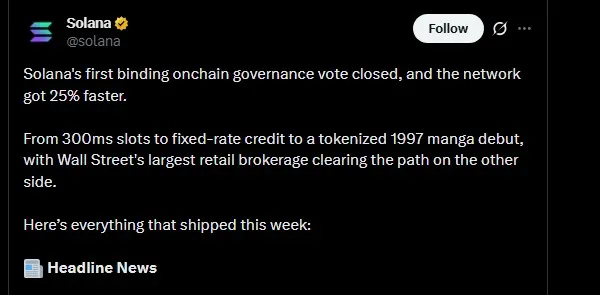
Solana's post, screenshotted August 30, 2026.
The Network Got Faster Too
Solana said its target slot time dropped to 300 milliseconds, a 25% cut achieved in just eight days. That is an unusually easy claim to check, since Solana's public Explorer publishes live slot times for anyone to see.
Checking that Explorer directly on August 30 showed a one-minute average slot time of 319 milliseconds, with the one-hour average sitting at 318 milliseconds. That is a live production number pulled straight from the chain, not a figure sitting on a marketing page.
A faster slot time means blocks close sooner and transactions confirm quicker. For a chain already processing thousands of transactions per second, shaving milliseconds off block production compounds across a full day of trading, payments, and app activity.
Money Followed The Announcement
Solana said cumulative Solana ETF inflows hit a record $1.22 billion this year, including a single-day high of $60 million. The network also flagged that Bitwise's Solana Staking ETF crossed $1 billion in assets under management, a milestone reached in ten months.
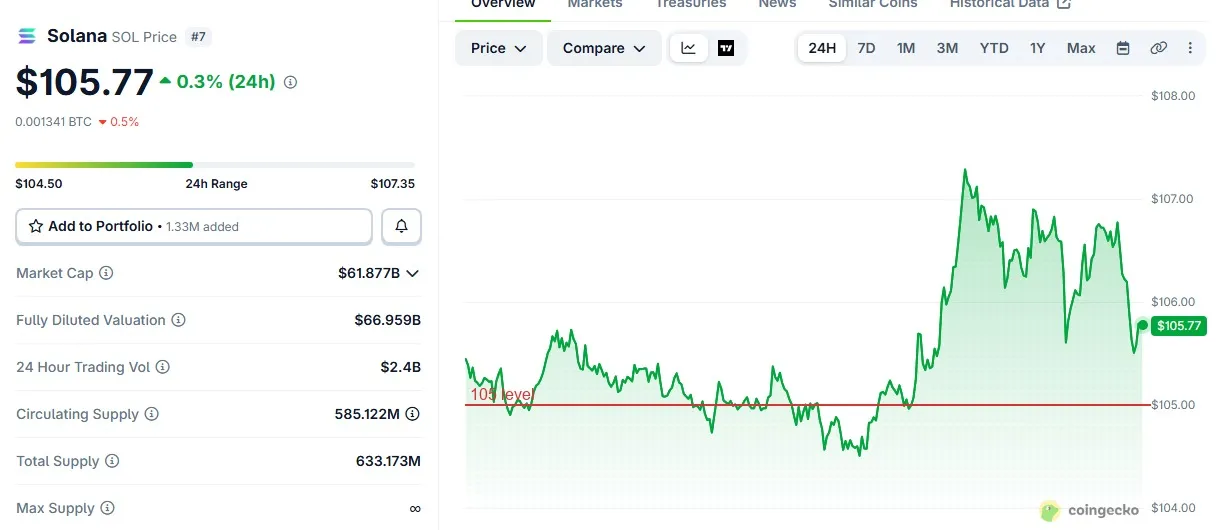
CoinGecko's live chart, showing SOL holding above the $105 level before pushing toward $107 intraday on August 30, 2026.
That market data lines up with a network gaining momentum. SOL traded at $105.77 on CoinGecko, up roughly 45% over the trailing 30 days, holding the $105 support zone through the session. A move like that usually needs more than one headline behind it.
Why The Governance Vote Matters More Than The Price
Plenty of chains promise faster blocks. Fewer chains hand the decision to validators and let the vote actually bind the outcome. Solana's Constitution vote sets a precedent other layer-1 networks will likely get asked about going forward.
Double Disinflation working alongside a formal governance structure also signals something to allocators watching supply schedules closely. A network that can credibly commit to slower issuance, and prove it through a binding vote rather than a developer promise, reads differently to a treasury desk than an informal roadmap update.
None of this guarantees SOL keeps climbing. Leverage, options positioning, and broader risk sentiment still move price more than a single governance vote does. But the throughput and issuance changes are structural, not promotional, and they showed up on Solana's own public ledger before they showed up in a press release.
Investing in cryptocurrency assets carries substantial risk, including the potential loss of principal, and prices can move sharply within a single trading session.
Written by
Mwenda is a skilled crypto journalist and expert in blockchain technology, digital assets, and decentralized finance. He has a talent for translating complex concepts into engaging, informative content. With a deep understanding of the industry, Mwenda delivers accurate analysis that appeals to beginners and seasoned enthusiasts.
View full profile →Related News

Solana ETF Outflows Hit $25M In Five Straight Sessions
Solana ETF outflows totaled $25.0M across five sessions of the week of Oct 5, per Farside, as SOL fell 10%. See which funds lost money and the price context.

Samsung Wallet to Send USDC on Solana to 82M US Galaxy Devices
Samsung Wallet will add USDC remittances on Solana in late October 2026, with Coinbase Prime as custodian. Here is what is known and what is still missing.

Solana DEX Volume Still Leads, But Is Down 50% From 2025
Solana has topped DEX volume for eight quarters, but Q3 2026 is about half of Q3 2025 and its market share slipped, per DefiLlama.