Aave V4 Caps Rise On Arc And Ethereum As USDC Draw Cap Fills
Aave V4 caps rise in ten changes on Arc and Ethereum, with the USDC draw cap fully used on Maple. See the new limits, utilization and interest-rate tweaks.

In this article+
Aave V4 caps are being raised in a batch of ten changes on Arc and Ethereum, and most of the new limits are about double the old ones. LlamaRisk, the risk steward, posted the list on October 9, 2026, in the Aave governance forum. Two limits are fully or nearly full today. The other changes make room for deposits and borrowing that already sit around half of their limits.
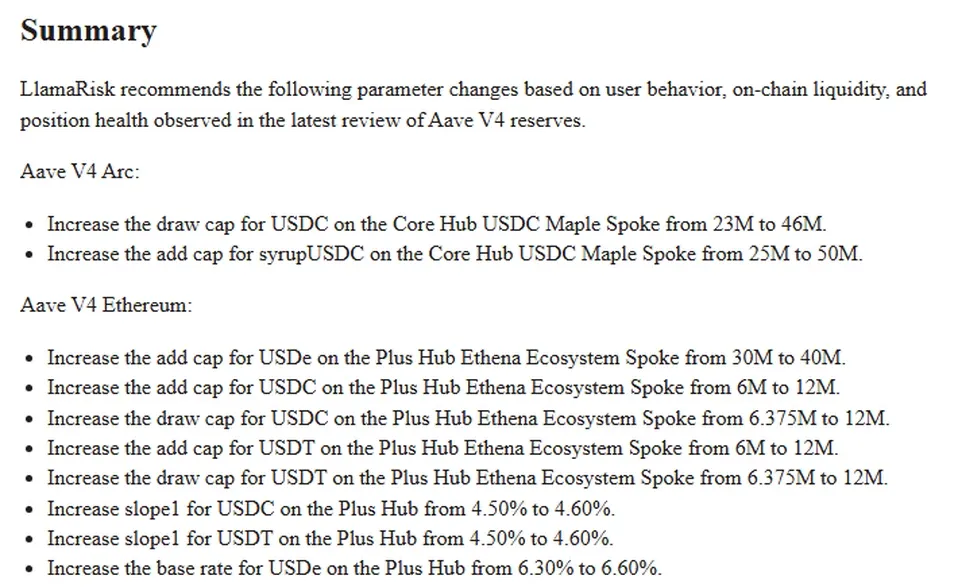
The summary of Aave V4 cap and interest-rate changes from LlamaRisk's October 9 post.
Two changes on Arc, eight on Ethereum
The post splits the work cleanly. Arc gets two cap increases, one for USDC drawing and one for syrupUSDC adding. Ethereum gets five cap increases on the Ethena Ecosystem Spoke plus three interest rate edits on the Plus Hub. After the change the biggest limits would run $40 million to $50 million, and USDC and USDT on Ethereum would each get $12 million.
Aave V4 Arc Core Hub: the full draw cap
On the Arc Core Hub, USDC borrowing through the Maple spoke has used its whole $23 million draw cap. LlamaRisk proposes raising it to $46 million. The add cap for syrupUSDC on the same spoke is 87.8% used and would go from $25 million to $50 million.
The hub itself is not stretched. It holds $143.45 million of USDC added and $83.82 million drawn, a utilization of 58.4% against an optimal ratio of 90%. About $59.6 million of USDC liquidity is available.
Two positions hold roughly 97% of the syrupUSDC reserve, and their health factors sit at 1.02 and 1.01. All debt among those suppliers is USDC, so their health tracks syrupUSDC's price against USDC.
Aave V4 Plus Hub and its Ethena spoke
On Ethereum, the Ethena Ecosystem Spoke gets the bulk of the changes. USDe supply is 87.2% of its $30 million add cap, with $26.16 million added. The cap would rise to $40 million. Twelve of the top twenty suppliers have debt, and their health factors run from 1.00 to 1.41 with a median near 1.02.
USDC and USDT caps on that spoke would each double to $12 million, for both adding and drawing. LlamaRisk says this makes room for native liquidity deposits and reduces reliance on credit lines, which dominate borrowing now.
Rate tweaks behind the Aave V4 caps
Alongside the Aave V4 caps, the Plus Hub's USDC and USDT slope 1 would go from 4.50% to 4.60%. At current utilization the USDC borrow rate moves from 4.17% to 4.27%, and USDT from 4.35% to 4.45%. Hub utilization sits at 85.3% for USDC and 88.9% for USDT, against an optimal point of 92%.
USDe gets a bigger nudge. Its base rate rises from 6.30% to 6.60% to align with V3, which lifts the whole curve by 0.30 percentage points. USDe utilization on the Plus Hub is 0.04%, with 10,272 tokens drawn against 26.19 million added.
The post notes the Aave V4 caps and rate edits go live through the Risk Steward process, and LlamaRisk discloses that it is funded in part by the Aave DAO. For the V3 side of the same review, see TOCE's report on the PT-AUSD supply cap. This article summarizes a public governance post and is not investment advice.
Written by
Amina Wanjiru covers crypto regulation and policy for Times of Crypto Era. The reporting follows SEC, CFTC and Federal Register actions, plus rules from regulators in the UK, EU and Asia, with a focus on what a new rule changes in practice.
View full profile →Related News

Arbitrum RAD Budget Held For Q4 As ARB Rally Is Averaged Out
The Arbitrum RAD budget stays unchanged for Q4 as OpCo uses a 3-month ARB average. See payout caps, the final MSS report and a 1,700 ETH treasury proposal.

Balancer Fork Vote Reopens As The Wind-Down Clock Runs To Oct 30
The Balancer fork vote BIP-932 runs October 9 to 13 after the DAO approved a wind-down. See how the first fork failed, the October 30 deadline and TVL.

Spark October 22 Spell Seeks 100M sUSDS Bridge And WETH Rate Cut
The Spark October 22 spell proposes bridging 100M sUSDS to Arbitrum, cutting the WETH slope 2 to 30% and funding grants. See the vote timeline and rate changes.