Balancer Fork Vote Reopens As The Wind-Down Clock Runs To Oct 30
The Balancer fork vote BIP-932 runs October 9 to 13 after the DAO approved a wind-down. See how the first fork failed, the October 30 deadline and TVL.

In this article+
A second Balancer fork vote is open, even though the DAO has already voted to wind the protocol down. The Balancer fork vote, BIP-932, started on October 9, 2026 and runs to October 13, according to Snapshot. MAXYZ, the proposer, has dropped the grant request that sank its first attempt.
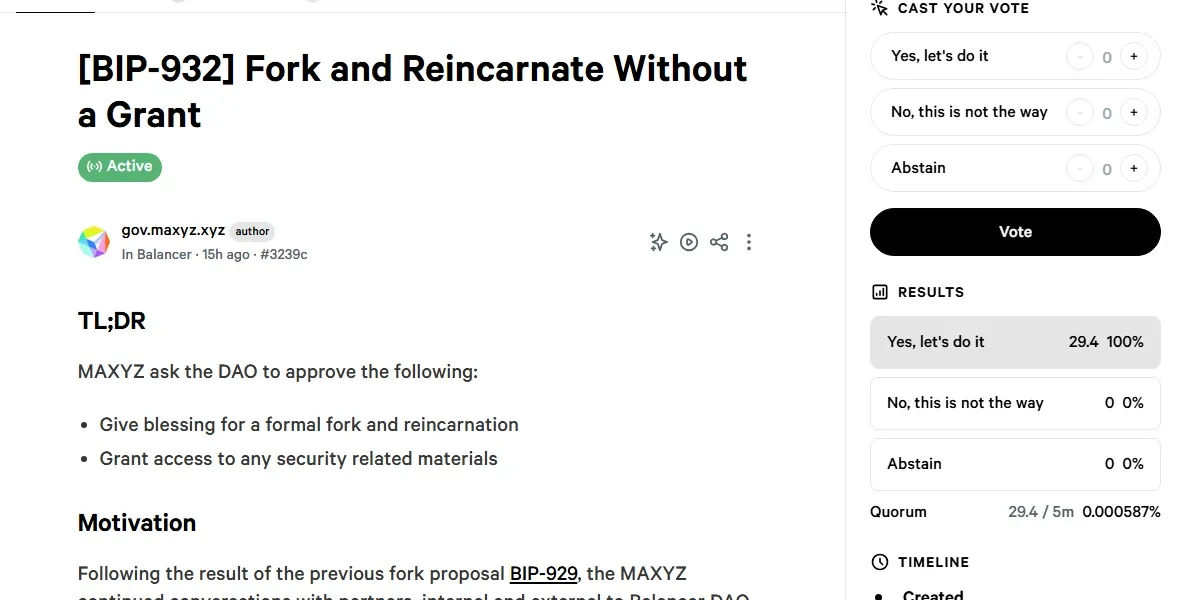
The BIP-932 page on Snapshot. The page shows times in the viewer's local zone.
What the Balancer fork vote asks for
MAXYZ wants the DAO's blessing for a formal fork and reincarnation of Balancer. It also asks for access to security materials, including the internal security-docs repository and the Immunefi account. The fork would be independent of Balancer Labs and the DAO. No trademarks, branding or logos would transfer, and the new entity would have nothing to do with the BAL token.
The costs would be covered by MAXYZ itself. Quorum is 5 million votes. The Snapshot page showed 29.4 yes votes from two voters when TOCE read it on October 10.
How the first Balancer fork vote failed
MAXYZ's pitch in BIP-929 was a "tokenized stock exchange" built on Balancer's multi-asset pools. Its illustrative math assumed 10% of a $750 billion daily exchange volume moving onchain. Add a one basis point fee and a 1% share, and the result is $27.4 million a year. MAXYZ called that 75 times Balancer's revenue today. Those numbers are the proposer's assumptions, not results.
BIP-929 asked for the same fork plus a pre-seed of the remaining non-circulating BAL, about 6 million tokens or roughly $690,000 at the time. It closed on September 29 with 5.21 million votes in favor and 12.11 million against, from 51 voters. In return the fork would have given the treasury 10% of its token supply if it ever launched one.
The Balancer wind-down timetable still stands
The same week, BIP-928 passed. Its two Yes options drew 12.18 million and 4.91 million votes, against 139,573 for No, from 42 voters. Under it, pools move to withdrawals only on October 30, 2026. Contributor notice runs to October 31, and partner-requested v3 pools stay live until November 30.
The treasury is put at no less than $9 million, with the first redemption round opening at the end of May 2027. The vote also approved a $150,000 wind-down budget from November 1, a $30,000 later line and a $220,000 reserve.
Smaller items on the same ballot
BIP-933 would let the DAO multisig recover 10,286.81 USDC of unclaimed fees from the inactive Timeless VeBalGrant. It needs four claim calls, because the grant has more than 60 weeks of rewards and the distributor settles at most 20 weeks per call.
DefiLlama shows Balancer's combined TVL at $45.5 million, down from $60.6 million thirty days ago. V3 holds $20.2 million, V2 $19.4 million and V1 $5.9 million.
For another governance filing from this week, see TOCE's report on the Spark October 22 spell. This summarizes public proposals and is not investment advice.
Loading…
Written by
Samiran is a well-known crypto writer and founder of Pressefy and News Coverage Agency, and a contributor at Hackernoon. He covers the crypto and blockchain industry with a focus on emerging projects, market trends, and the business side of Web3.
View full profile →Related News

Arbitrum RAD Budget Held For Q4 As ARB Rally Is Averaged Out
The Arbitrum RAD budget stays unchanged for Q4 as OpCo uses a 3-month ARB average. See payout caps, the final MSS report and a 1,700 ETH treasury proposal.

Aave V4 Caps Rise On Arc And Ethereum As USDC Draw Cap Fills
Aave V4 caps rise in ten changes on Arc and Ethereum, with the USDC draw cap fully used on Maple. See the new limits, utilization and interest-rate tweaks.

Spark October 22 Spell Seeks 100M sUSDS Bridge And WETH Rate Cut
The Spark October 22 spell proposes bridging 100M sUSDS to Arbitrum, cutting the WETH slope 2 to 30% and funding grants. See the vote timeline and rate changes.