AIFC Court Injunction Bars Six Crypto Platforms, Coinbase Included
An AIFC Court injunction bars six crypto platforms, Coinbase among them, from serving the Astana financial centre. The judge limited it to AIFC users only.

In this article+
A court in Kazakhstan has ordered six crypto platforms to stop serving users in one specific place. The AIFC Court injunction is dated September 15, but the regulator only announced it on October 20. Headlines have called it a block on Coinbase and five others. The judge's own wording is narrower than that.
Who the AIFC Court injunction covers
Astana's financial centre has its own regulator, the Astana Financial Services Authority, and it is the claimant. Justice Sir Stephen Richards gave it a default judgment in case AIFC-C/CFI/2026/0010. The defendants were the operators of BingX, Bitcoin.com, Huobi Global (HTX), BitMart, Coinbase, LBank and WEEX. His judgment says none of them filed an acknowledgment of service or a defence.
LBank dropped out three days later. A variation order dated September 18 removed it after the operator told the court it had taken steps to address the regulator's concerns. Six platforms remain under the AIFC Court injunction.
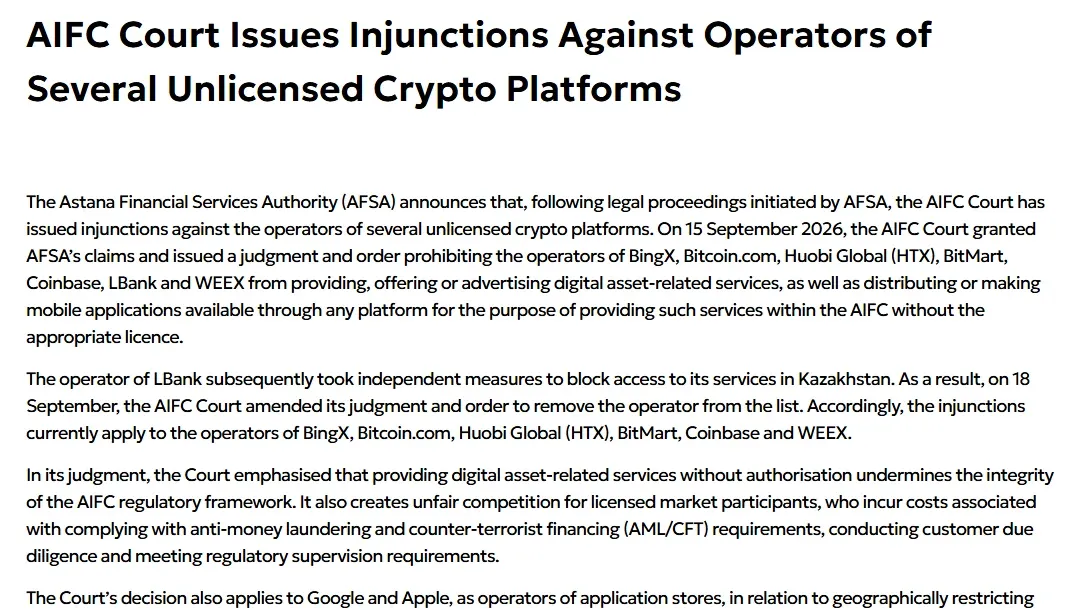
The regulator's announcement of the injunctions. Source: AFSA, AIFC Court issues injunctions.
Why the AIFC Court injunction stops at the border
The claim form, dated February 25, asked for a ban reaching users across Kazakhstan. The judge cut that back. A January 2026 amendment to the Law on Digital Assets took effect on May 1. He read it as giving the wider licensing role to the National Bank of Kazakhstan. AFSA can act only on activity inside the AIFC.
So the order restrains the operators from offering digital asset services in the AIFC or to users located there. It also bars them from distributing apps for that purpose. Nothing in the text bans the platforms across the whole country. The judge left the regulator free to come back if it can make a reasoned case for wider terms.
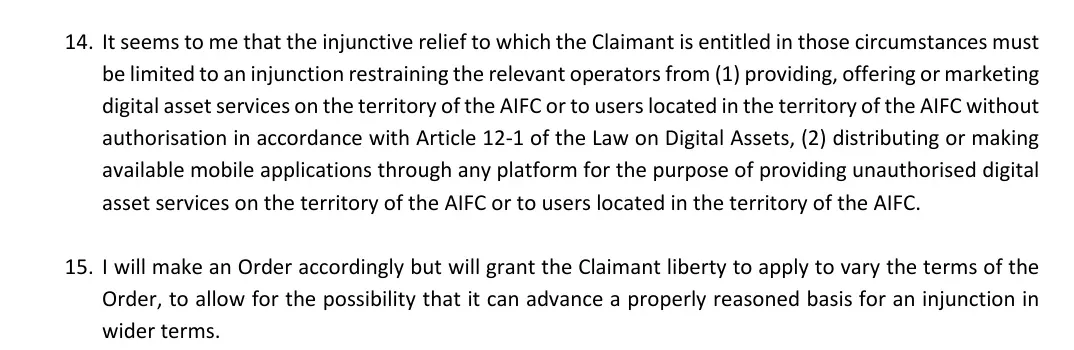
Paragraph 14 of the September 15 judgment, which limits the injunction to the AIFC. Source: AIFC Court default judgment and order.
Google, Apple and the paperwork
Google and Apple are named as app store operators. Once they are served, the order binds both companies as though they had joined the case. Either one can still ask the court to change it. The regulator says the orders will go to Google Play and the Apple App Store so that access to the listed platforms can be restricted.
The six also owe costs. The court put the figure at KZT 1,995,479.95, split between legal work and court fees, and made the operators jointly liable.
What the regulator says it has done
The release describes a long run-up. AFSA says it sent written warnings to more than 20 platforms in 2025 and went to court in early 2026. Twelve operators later received notices of discontinuance after their responses, the judgment records, which is why the list shrank before the default judgment.
Nine platforms restricted their apps in Kazakhstan on their own, according to the regulator. Another seven said they intend to apply for an AFSA licence. AFSA adds that it has coordinated with the National Bank since May, because that body handles digital assets nationwide. A public register on its website lists licensed firms. The regulator warns users that unlicensed platforms operate without supervision.
Outside Astana, the AIFC Court injunction changes little. It applies to the financial centre, a defined zone inside the country.
Loading…
Written by
Brian Otieno reports on Bitcoin and Ethereum markets, spot ETF flows and derivatives data for Times of Crypto Era. Every figure in the pieces is checked against the live source before publishing.
View full profile →Related News

Regulation Crypto Assets Comments: Nasdaq, ICBA And HPC Letters
SEC Regulation Crypto Assets comments closed October 20. Nasdaq, ICBA, Hyperliquid Policy Center and Public Citizen filed letters with sharply different asks.

ASIC Digital Asset Rules Consultation Runs Until November 27
The ASIC digital asset rules draft opened on October 15. Platforms and custody firms have until November 27 to respond, and the new laws start April 8, 2027.

VanEck Lido ETF Withdrawal Comes 363 Days After The S-1
VanEck asked the SEC on October 14 to withdraw its Lido staked ether trust after 363 days. The VanEck Lido ETF letter, what it says and what it does not say.