Alpenglow Upgrade Date Set: Solana Epoch 1064 On October 21
Solana's Alpenglow upgrade goes live in epoch 1064 on October 21 at about 15:00 UTC. What validators, developers and users must do before then, per Solana.

In this article+
Solana has set a mainnet date for its next consensus upgrade. The Solana Foundation's Alpenglow page, updated this month, puts mainnet activation in epoch 1064, which begins around 15:00 UTC on Wednesday, October 21. The Alpenglow upgrade aims for finality in roughly 150 milliseconds. Today it takes about 12.8 seconds.

The activation line on the Solana Foundation's Alpenglow page. Source: Solana Foundation.
What the Alpenglow upgrade changes for users
For ordinary users, the page says nothing changes. Signing, sending and approving a transaction work as before. Only the wait for certainty shrinks.
Underneath, Alpenglow replaces TowerBFT, the voting layer that makes a block final once votes stack up over 32 slots. Validators will instead send votes straight to each other and bundle them into certificates. A block can finalize in one round when 80% of stake votes. Otherwise a second round with a 60% threshold decides it. The design is built to keep working with a fifth of stake malicious and another fifth offline.
That 150 milliseconds is a finality figure and says nothing about how fast blocks are produced. The page notes that block time was cut separately, from 400 to 200 milliseconds, in four stages finished this month. TOCE tracked that change earlier in Solana slot times falling to 218ms.
Chain data fits the date. Solana's public RPC reported epoch 1057 on October 14, with slots arriving about every 0.22 seconds. Counting forward seven epochs puts epoch 1064 around October 21, in line with the Foundation's timing.
Validator checklist for the Alpenglow upgrade
Operators have two jobs ahead of the Alpenglow upgrade, and the page lists them in this order. First, run an Agave-based client: Agave, Jito-Solana or Harmonic Salsa, on a release built on Agave 4.3.0. Firedancer and Frankendancer are not supported during the migration.
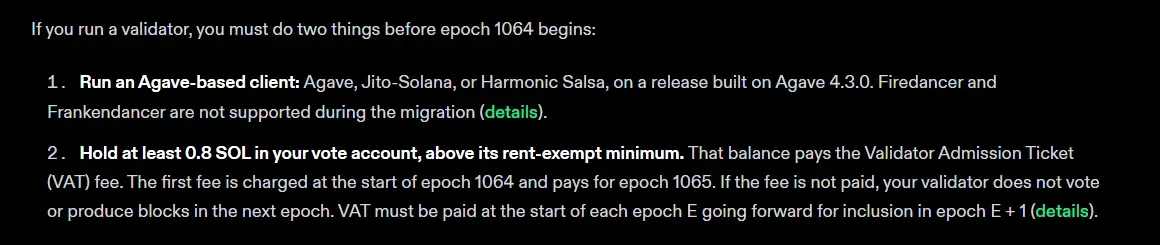
The two validator requirements, as listed on the Solana Foundation page. Source: Solana Foundation.
Second, keep at least 0.8 SOL above the rent-exempt minimum in the vote account. That balance pays the new Validator Admission Ticket, a flat fee of 0.8 SOL per epoch that is burned. The first charge comes at the start of epoch 1064 and covers epoch 1065.
A validator that cannot pay misses the next epoch entirely. It does not vote or produce blocks, and it forgoes the rewards. The fee replaces the roughly 1 SOL per epoch that voting costs today in vote transaction fees. Those fees disappear because votes are no longer transactions.
Developer changes in blocks and votes
Developers who only send transactions and read account state have nothing to migrate for the Alpenglow upgrade. Anyone who indexes blocks does. Vote transactions leave blocks, so transaction counts and TPS dashboards will drop sharply without any fall in real activity.
A slot can also carry more than one candidate block. Each candidate is a separate bank, and Agave 4.3 adds a bank_id field to every Geyser event so pipelines can tell them apart. The confirmed and finalized commitment levels become the same thing after activation.
Proof of History no longer paces block production, so tick entries leave the shred stream. Programs that read Clock.unix_timestamp should recheck assumptions, because the timestamp has a new source. A new RPC call, getAgGenesisCert, returns null until a cluster has migrated.
Where each network stands
The page lists the feature gate status. Testnet and devnet are active, with devnet switching on at 19:30 UTC on September 25. Mainnet is shown as not activated. A second phase, called Rotor, would replace Turbine for block propagation and has no date yet.
Written by
Daniel Kiprop covers exchanges, listings, stablecoins and institutional crypto moves for Times of Crypto Era. Stories start from company filings and official announcements, not secondary coverage.
View full profile →Related News

Solana Slot Time Falls To 218ms In Chain Data, Down From 268ms
Solana slot time fell from 268.5 ms to about 218 ms per slot at epoch 1053, based on public explorer timestamps. See the epoch math and how to check it.

PUMP Price Analysis: Two Failed Sweeps Led To An 11.7% Drop
PUMP price analysis after an 11.7% drop on Oct 12: two failed pushes above $0.005762, three bearish gaps, and two scenarios with clear 4-hour triggers.

Solana ETF Outflows Hit $25M In Five Straight Sessions
Solana ETF outflows totaled $25.0M across five sessions of the week of Oct 5, per Farside, as SOL fell 10%. See which funds lost money and the price context.