BIS Chief Tells Jackson Hole: Stablecoins Are Not Real Money
BIS general manager Pablo Hernandez de Cos told the Jackson Hole symposium that stablecoins do not credibly function as money at scale, backing tokenized bank deposits instead.

In this article+
What The BIS Chief Said
Coin Bureau's X account flagged a comment this week that cuts against crypto's favorite growth story. The Bank for International Settlements says stablecoins do not work as real money at scale.
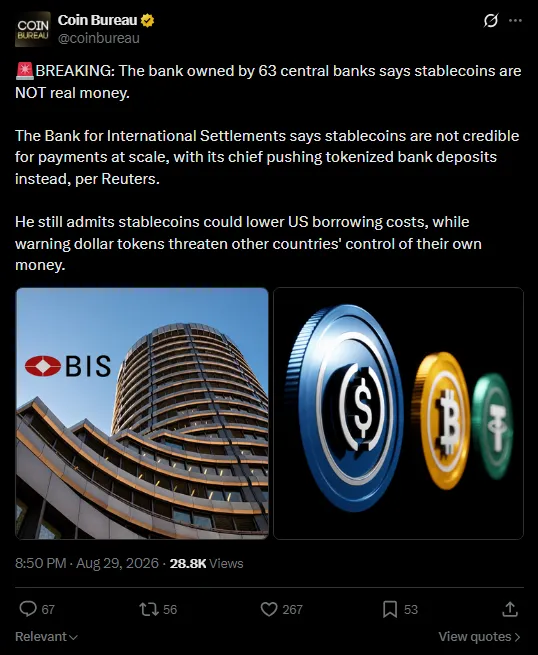
Coin Bureau's post on the BIS stablecoin comments, screenshotted Aug 29, 2026.
Pablo Hernandez de Cos, general manager of the BIS, said so directly at the U.S. Federal Reserve's Jackson Hole Economic Policy Symposium in Wyoming on August 28. Reuters reported his remarks in full.
Reuters' report on Pablo Hernandez de Cos's Jackson Hole remarks, screenshotted Aug 29, 2026.
De Cos argued that tokenized bank deposits, not stablecoins, should carry the bulk of everyday payments. He said the two instruments could coexist, but stablecoins should stick to more specialized roles.
The scale he is talking about is real money. CoinGecko puts the total stablecoin market at $290.6 billion, with Tether's USDT alone accounting for $183.4 billion of that and USDC adding another $74 billion.

Total stablecoin market capitalization on CoinGecko, screenshotted Aug 29, 2026.
The Singleness Of Money Problem
His core complaint centers on a concept economists call the singleness of money. Customers cannot move between different stablecoins without selling one and buying another at a cost, he said. That breaks a basic principle. A dollar should be worth exactly a dollar no matter which product holds it.
Tokenized deposits avoid that problem because they settle through central bank accounts in the background, preserving that singleness. A BIS bulletin from economists Rodney Garratt and Hyun Song Shin laid out the same theoretical case years earlier. Bearer-style tokens like stablecoins can drift from par, while account-based tokenized deposits do not.
De Cos raised more than one objection. Stablecoin platforms are not genuinely interoperable across providers, he said, and money-laundering controls are difficult to apply consistently across them.
He also flagged a geopolitical angle. Growing adoption of dollar-pegged stablecoins has raised concern in some countries about monetary sovereignty, he said. Ordinary borrowers piling into dollar stablecoins outside the U.S. could weaken local monetary policy and tie domestic conditions more closely to American policy.
Where Bessent And The BIS Disagree
Not every part of his message cut against stablecoins. De Cos acknowledged they could lower sovereign borrowing costs, echoing an argument U.S. Treasury Secretary Scott Bessent has made publicly.
But he warned bank funding costs could rise as deposits shift out of lenders. Ordinary borrowers could end up paying more for loans elsewhere as a result.
That tension between de Cos and Bessent is not new. Bessent has called stablecoins a “digital revolution.” He argues they could cement the dollar's spot as the world's top reserve currency. That, he says, would create fresh demand for trillions of dollars in Treasuries. De Cos is not dismissing that upside, just arguing the current instrument is not built to carry it at scale.
Tokenized deposits are not free of problems either. De Cos said they still need to solve real issues around interoperability and governance. Legal questions tied to settlement remain unresolved too, he said, before they can fully step into that role.
What Comes Next
The remarks land as regulators worldwide keep sorting out where stablecoins fit. De Cos is also a candidate to replace Christine Lagarde as European Central Bank President next year. His read on tokenized money carries weight well beyond this one speech.
That BIS bulletin also makes a positive case for tokenized deposits beyond just stability. Because they run on programmable ledgers, the authors wrote, tokenized deposits can support contingent execution and composability. That lets transactions trigger automatically once agreed conditions are met, something a bearer-style stablecoin cannot easily replicate while staying pegged to par.
For now, the BIS's position is clear. Stablecoins can serve a purpose, just not the one their most bullish backers keep pitching for the payment system as a whole.
Loading…
Written by
Writer and editor at Times of Crypto Era. Covers Bitcoin, DeFi, and market structure.
View full profile →Related News

CFTC Event Contracts Proposal Puts Sports Bets Under Swap Rules
The CFTC event contracts proposal would class sports, politics and weather bets as swaps while casino wagers stay out. See the rules, comment steps and volume.

Mashinsky Ban: New York Secures Up To $35M From Ex-Celsius CEO
The Mashinsky ban is permanent in New York, and the ex-Celsius CEO faces up to $35M in conditional payments. See what the attorney general's deal requires.

Cantor Fitzgerald Tether Letter: Blumenthal Sets October 23 Deadline
Cantor Fitzgerald Tether letter from Sen. Blumenthal makes 13 requests with an Oct 23 deadline. See what the letter asks, what it claims and who sent it.