Bitcoin Difficulty Adjustment: +5.92% To Highest Since March
The Bitcoin difficulty adjustment at block 971,712 raised difficulty 5.92% to 140.58T, the highest since March, after a 2,016-block period ran 13.2 days.

In this article+
Bitcoin mining just got almost 6% harder. The reset came at block 971,712 on October 16, a little after 12:37 UTC. Difficulty went from 132.72 trillion to 140.58 trillion, and that Bitcoin difficulty adjustment is the biggest of the last five.
The last time it sat this high was in March. A drop of about 7% around March 21 took it down from there. The year's peak remains well above, near 156 trillion in late October 2025.
Why the Bitcoin difficulty adjustment was 5.92%
Every 2,016 blocks the network looks back at how long that batch took. Ten minutes a block is the aim, so two weeks is the target. If the batch finished early, difficulty rises. If it dragged, it falls.
This batch finished early. It opened with block 969,696 on October 3 (07:16 UTC) and closed with block 971,711 on October 16 (12:29 UTC). The gap came to 13.2 days, nearly a full day under plan, with blocks averaging 9.45 minutes. Divide 14 by 13.22 and out pops 5.92%. That division is ours, but anyone can look up the two timestamps and run it.
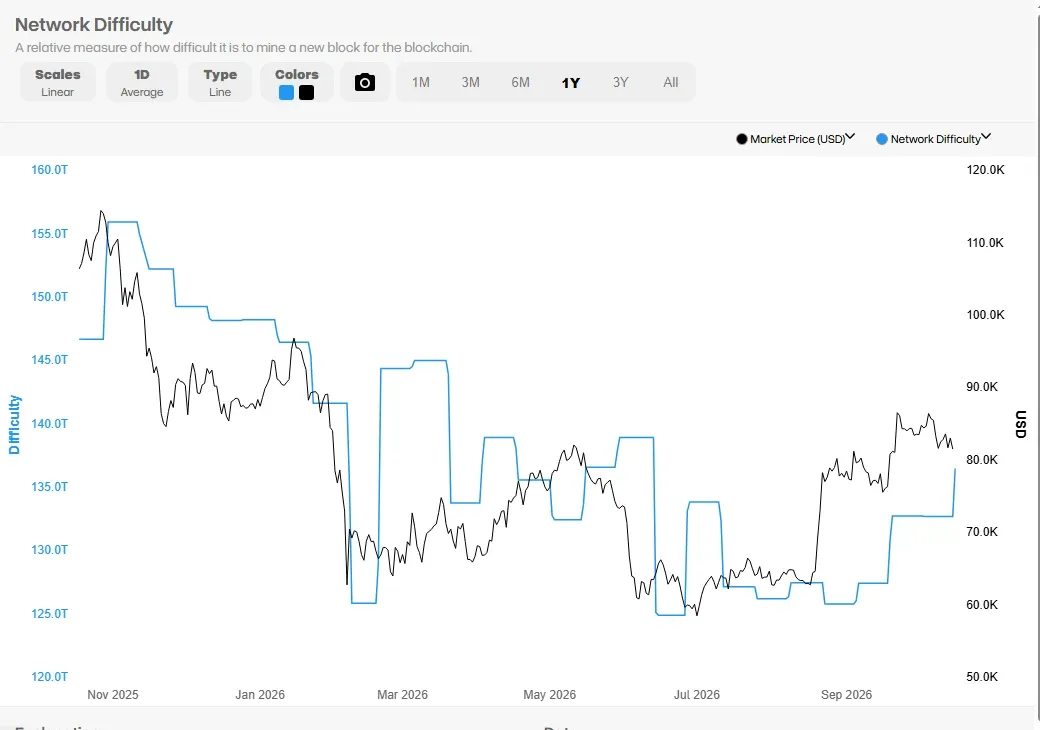
Network difficulty over one year. The chart averages each day, so the newest step looks smaller than the exact 140.58 trillion. Source: Blockchain.com.
The practical effect is easy to state. A miner whose machines stayed the same now expects about 5.6% fewer blocks from them, since one divided by 1.0592 is 0.944. That is plain proportion and says nothing about any single company.
The last five resets in order
Blockstream's block data gives the exact steps. August 23 brought a 1.31% fall. Then September 5 added 1.31% and September 19 added 4.16%. October 3 was flat, off by 0.03%.
October 16 is the largest of the five. It also leaves difficulty roughly 12% above its August 23 level of 125.81 trillion.
Hash rate has been climbing
Faster blocks usually mean more machines hashing. The Blockchain.com hash rate chart shows the estimate rising since late September. The daily figure for October 14 was 1,062 exahashes per second. Averaged over seven days, the figure is about 1,010, against 980 a week earlier.
The all-time high in that series is about 1,305, from October 24, 2025. Keep in mind that hash rate is inferred from how fast blocks arrive. It is an estimate and it bounces a lot from day to day.
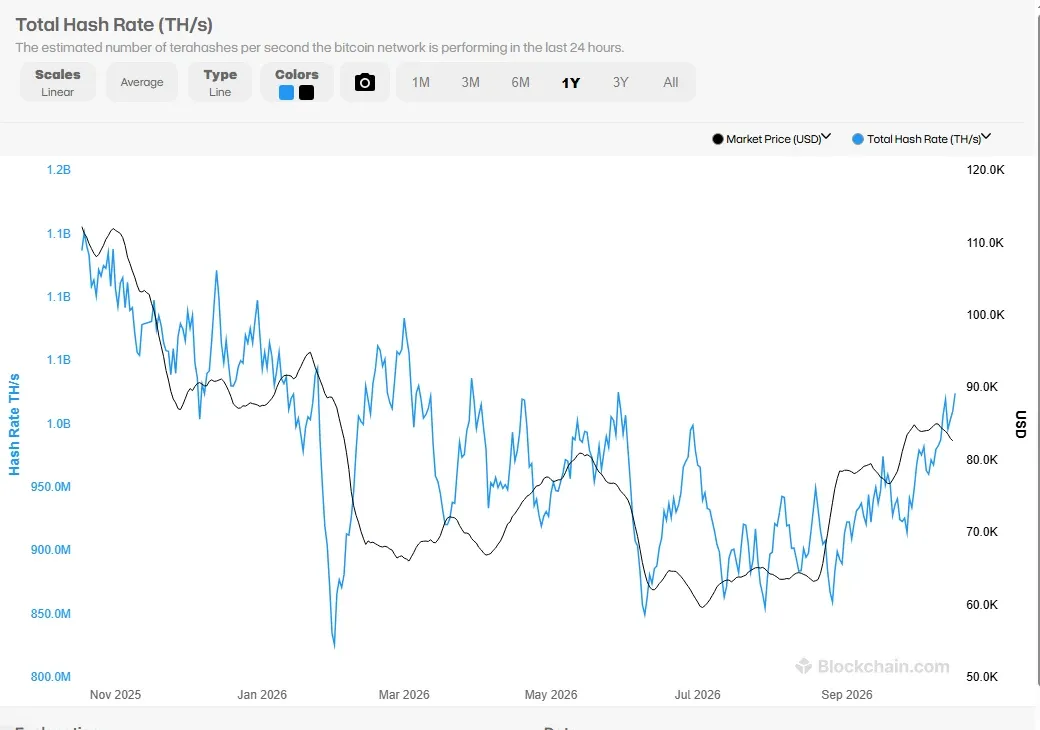
Estimated total hash rate over one year. Source: Blockchain.com.
What the next Bitcoin difficulty adjustment needs
The next Bitcoin difficulty adjustment is due at block 973,728. As of block 971,882, found on October 17 at 16:12 UTC, 1,846 blocks were left. At a clean ten minutes each, that is just under 13 days.
Since the reset, 170 blocks have arrived in 27.6 hours. That works out to 9.73 minutes a block, still a touch quick. If that held, the next step would be up again. But a stretch that short is noisy, and the full two weeks still has to play out.
Difficulty only sets how hard mining is. This article reports network data and is not advice on buying or selling bitcoin.
Written by
Mwenda is a skilled crypto journalist and expert in blockchain technology, digital assets, and decentralized finance. He has a talent for translating complex concepts into engaging, informative content. With a deep understanding of the industry, Mwenda delivers accurate analysis that appeals to beginners and seasoned enthusiasts.
View full profile →Related News

Cipher Digital Convertible Notes: $850M At 0% Due 2032
Cipher Digital convertible notes: $850M at 0% due 2032, converting at $15.31 a share, with an $89.7M capped call and a $165.9M exchange of older notes.

SATS Preferred Offering Prices At $90, Raising About $630M
The SATS preferred offering priced at $90 a share on Oct 15, with 7,000,000 shares sold, 2,000,000 more than planned. Strive expects gross proceeds near $630M.

Stacks Bitcoin Staking Passes 735 BTC As Bond 2 Sells Out
Stacks Bitcoin Staking drew 505 BTC in Bonding Period 2, about 735 BTC in total, Stacks Labs says. STX staked rose from 392M after PoX-5 to 493M, up over 25%.