FINMA Bitcoin ETF Approval Waives A Diversification Rule For Retail
FINMA Bitcoin ETF approval on October 20 covers Switzerland's first retail fund holding Bitcoin directly, with a diversification exemption and custody rules.

In this article+
Switzerland now has a retail fund that holds Bitcoin directly. Swiss regulator FINMA announced the FINMA Bitcoin ETF approval on October 20. It calls the product the first exchange-traded retail fund to invest straight in the asset. The announcement leaves out the fund's name and its provider. What it does spell out is the legal route the fund took and the rules it had to bend.
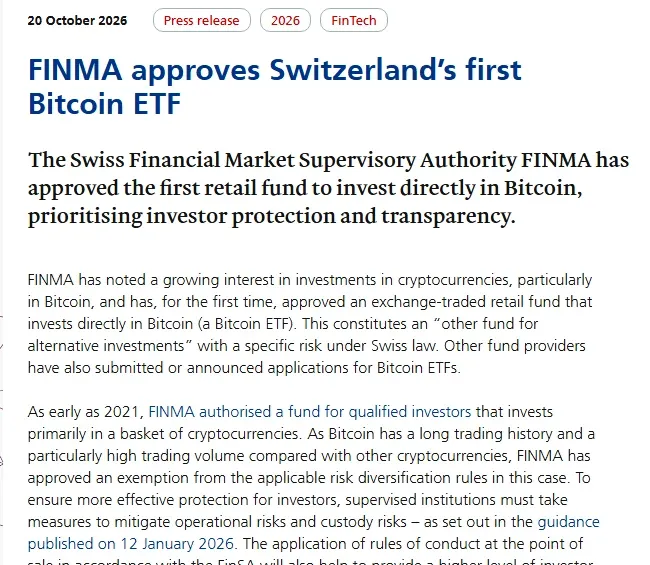
FINMA's October 20 press release on the approval. Source: FINMA press release.
How the fund is classified
Under Swiss law the product counts as an "other fund for alternative investments", a category FINMA describes as carrying a specific risk. It is not a standard securities fund. The regulator also notes that other fund providers have submitted applications or announced plans for Bitcoin ETFs, so this may not stay a one-off.
Switzerland had crypto fund precedent already. FINMA says it authorised a fund for qualified investors back in 2021 that invests mainly in a basket of cryptocurrencies. The new product differs on two counts. It holds one asset, and it is open to ordinary retail investors.
The diversification exemption
Funds normally have to spread their holdings. FINMA approved an exemption from the applicable risk diversification rules in this case. It gives its reasons in the release: Bitcoin has a long trading history, and its trading volume is particularly high next to other cryptocurrencies. FINMA presents the exemption as a decision for this case.
Custody and conduct conditions for the FINMA Bitcoin ETF approval
The approval comes with strings. FINMA says supervised institutions must take measures against operational and custody risks, as laid out in guidance it published on January 12, 2026. Guidance 01/2026 on custody of cryptobased assets is where those risks are set out. Cyberattacks and poor protection of private keys head the list. Another worry is a third-party custodian going insolvent, because the coins may then not stay separate from its own assets.
For funds, the guidance says direct crypto holdings generally have to sit with a Swiss custodian bank. A custodian can hand safekeeping to a third party only if that party faces equivalent prudential supervision and equivalent bankruptcy protection exists. Investors must be told about the risks of such transfers in the prospectus and the basic information sheet.
Selling the fund also falls under the Swiss Financial Services Act. FINMA says its point-of-sale conduct rules give buyers more protection than they would get from buying cryptocurrency directly. Fund documents have to highlight and explain the risks clearly.
FINMA's own warning
The regulator is blunt about the downside. It says investments in Bitcoin, even through an approved ETF, stay highly risky. Volatility means the money invested may lose a lot of its value. Investors should weigh that when deciding how much to put in.
Firms that sell crypto-based products are told to follow the conduct rules to the letter. Clients must get plain warnings about volatility and about losing money, and each sale needs a suitability check. For readers, the FINMA Bitcoin ETF approval widens access to Bitcoin in Switzerland without making the asset any less volatile.
Written by
Samiran is a well-known crypto writer and founder of Pressefy and News Coverage Agency, and a contributor at Hackernoon. He covers the crypto and blockchain industry with a focus on emerging projects, market trends, and the business side of Web3.
View full profile →Related News

AIFC Court Injunction Bars Six Crypto Platforms, Coinbase Included
An AIFC Court injunction bars six crypto platforms, Coinbase among them, from serving the Astana financial centre. The judge limited it to AIFC users only.

Regulation Crypto Assets Comments: Nasdaq, ICBA And HPC Letters
SEC Regulation Crypto Assets comments closed October 20. Nasdaq, ICBA, Hyperliquid Policy Center and Public Citizen filed letters with sharply different asks.

ASIC Digital Asset Rules Consultation Runs Until November 27
The ASIC digital asset rules draft opened on October 15. Platforms and custody firms have until November 27 to respond, and the new laws start April 8, 2027.