SEC Proposes Regulation Crypto Assets For Token Sales
The SEC has proposed Regulation Crypto Assets, a new rule creating two registration exemptions for crypto token offerings and a conditional safe harbor from securities law.

In this article+
The Securities and Exchange Commission proposed a new rule on August 18 called Regulation Crypto Assets. The plan lays out a fit-for-purpose offering regime for certain investment contracts tied to crypto assets. It skips forcing every token sale through the same rules built for stocks and bonds.
It builds on the Commission's March 2026 interpretation. That's the one that first spelled out how federal securities law touches crypto assets and the transactions built around them. Put together, the two moves are meant to clear a path for domestic crypto fundraising while keeping investor protections baked in.
Two Ways To Raise Money
The proposal carves out two exemptions from registration under the Securities Act of 1933. The first is a one-time exemption, good for offerings up to $5 million over a four-year stretch.
The second is bigger and ongoing. Up to $75 million every 12 months, though issuers using it take on more. Financial statements and continuing reporting duties come attached, on top of the narrative disclosures both exemptions already require.
Neither exemption is a free pass. Both require issuers to hand investors principles-based narrative disclosures before money changes hands. Think plain-language explanations of the project and its risks, not a boilerplate legal filing nobody reads.
Today, most crypto issuers either register a full securities offering or skip the U.S. market entirely. This proposal is meant to give them a middle path that doesn't exist yet.
Screenshot below, straight off the SEC's own press release page, release number 2026-76.
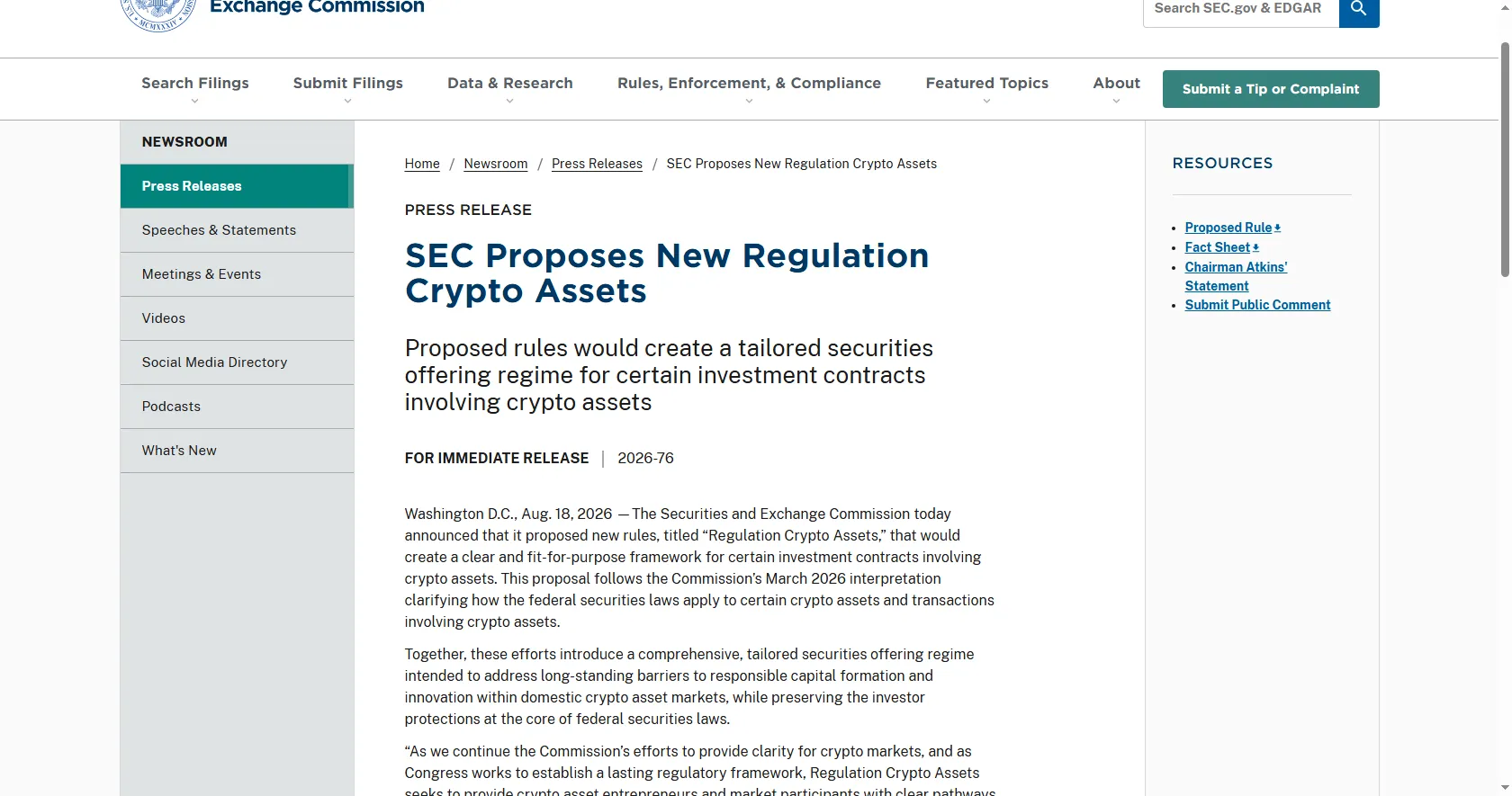
U.S. Securities and Exchange Commission, press release 2026-76, screenshotted August 28, 2026.
A Safe Harbor From The Word "Security"
There's a conditional safe harbor tucked into the proposal too. If a crypto asset meets its conditions, it would fall outside the "investment contract" branch of what counts as a security. That covers both the 1933 Act and the Securities Exchange Act of 1934.
The rule would also preempt state securities registration and qualification requirements for offerings made under a Regulation Crypto Assets exemption. Some secondary-market trades built on top of them get the same treatment. One federal standard instead of fifty state ones, at least for the offerings that qualify.
That preemption piece matters more than it sounds. A token issuer registering under a state-by-state patchwork today can face fifty separate filings, fifty separate fee schedules, fifty separate review timelines. Collapsing that down to one federal lane is arguably the more consequential half of this proposal. The exemption dollar caps are what's grabbing the headlines though.
Atkins Calls It Onshoring
SEC Chairman Paul S. Atkins framed the proposal as part of a bigger strategy. "Regulation Crypto Assets seeks to provide crypto asset entrepreneurs and market participants with clear pathways to raise capital under the federal securities laws," he said, tying it back to the Commission's earlier interpretive guidance.
Atkins also pointed to a safe harbor angle worth noting on its own. Once an issuer has finished or permanently dropped the managerial work it promised under an investment contract, that safe harbor kicks in. His full remarks are posted as a separate statement on SEC.gov.
Sixty Days To Weigh In
None of this is final yet. Public comments stay open for 60 days once the proposing release actually publishes in the Federal Register. Anyone can weigh in through the SEC's comment portal.
The full text runs long. The Commission's own proposed rule filing and its shorter fact sheet both lay out the mechanics in more detail than a press release can carry. Anyone who wants the fine print has until the comment window closes to dig in.
Loading…
Written by
Writer and editor at Times of Crypto Era. Covers Bitcoin, DeFi, and market structure.
View full profile →Related News

CFTC Event Contracts Proposal Puts Sports Bets Under Swap Rules
The CFTC event contracts proposal would class sports, politics and weather bets as swaps while casino wagers stay out. See the rules, comment steps and volume.

Mashinsky Ban: New York Secures Up To $35M From Ex-Celsius CEO
The Mashinsky ban is permanent in New York, and the ex-Celsius CEO faces up to $35M in conditional payments. See what the attorney general's deal requires.

Cantor Fitzgerald Tether Letter: Blumenthal Sets October 23 Deadline
Cantor Fitzgerald Tether letter from Sen. Blumenthal makes 13 requests with an Oct 23 deadline. See what the letter asks, what it claims and who sent it.