Thailand Crypto ETFs Get Final Rules, Effective October 16
Thailand crypto ETFs get final rules from the SEC, effective Oct 16, with Bitcoin and Ethereum first. See the 80% exposure test, custody and margin limits.

In this article+
Thailand crypto ETFs now have final rules. The country's SEC issued 11 notifications on October 8, 2026, and they take effect on October 16, according to its Press Release No. 216/2026. Bitcoin and Ethereum are the only eligible assets at the start.
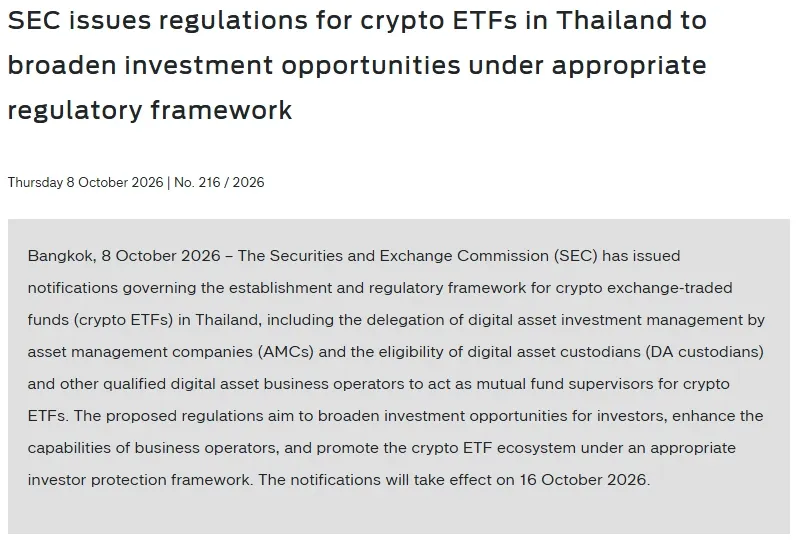
The SEC Thailand release announcing the crypto ETF framework, dated October 8, 2026.
What the Thailand crypto ETFs rules require
Five of the 11 come from the Capital Market Supervisory Board, among them notification No. Tor Nor. 19/2569 on setting up funds and No. 20/2569 on fund investment. Together they set out how Thailand crypto ETFs may be built, held and sold.
Each fund must be passive and track the price of one crypto asset. It has to hold an average net exposure of at least 80% of its net asset value to that asset across each accounting year. The SEC says it will decide which assets qualify based on liquidity, market acceptance, network security and investor protection.
Custody is limited to custodians regulated by the SEC. Units will list and trade only on the Stock Exchange of Thailand. Regulators may allow a foreign custodian later if it judges that necessary, but not now.
Asset managers must prove they are ready in people, systems and service providers before they launch. Outsourcing digital asset management is allowed only to a licensed digital asset fund manager, and that is the single route.
Protections for retail buyers
Buyers will see education on how the product works and what risks come with it, and must confirm they understand those risks before trading. Brokers have to push sensible asset allocation and warn against concentrating money in digital assets.
Margin loans for buying crypto ETFs are banned. The SEC ties that to its approach for direct crypto trading, where lending to buy crypto is also not permitted.
Who can supervise and who can invest
Digital asset custodians and other qualified operators can apply to act as mutual fund supervisors for crypto ETFs. They may supervise only crypto ETFs, and they must show financial standing, staff and operating systems. A sub-custodian is allowed, but any digital asset custody must be handled by a licensed custodian.
Funds also get access. Mutual funds and private funds could previously buy only foreign crypto ETFs. They may now hold Thai ones as well, within the investment limits already in force for each fund type.
What the Thailand crypto ETFs rules do not say
October 16 is the date the notifications take effect. Nothing in the release says any fund will list that day, and no issuer is named. Trading can begin only after an asset manager meets the readiness tests and gets a fund approved.
The SEC also closed a side door for now. During the initial phase it will not allow depositary receipts that reference foreign crypto ETFs. Securities firms also cannot help clients who are neither institutional nor ultra-high-net-worth investors buy foreign crypto ETFs. In the SEC's words, the aim is to build up local product development and operator capability.
Public hearings ran from April to May on the principles and from August to September on the draft notifications. Most respondents backed both, the SEC says. None of this is investment advice. Readers weighing Thailand crypto ETFs should watch for the first approved fund and the SET listing notice.
Loading…
Written by
Amina Wanjiru covers crypto regulation and policy for Times of Crypto Era. The reporting follows SEC, CFTC and Federal Register actions, plus rules from regulators in the UK, EU and Asia, with a focus on what a new rule changes in practice.
View full profile →Related News

Tether Kazakhstan MoU Studies a Tenge Stablecoin, Issues Nothing
Tether Kazakhstan MoU with the central bank covers a tenge stablecoin study and tokenization pilots. It names no chain, date or reserve rules. Read the details.

IRS Staking Safe Harbor: Rev. Proc. 2026-20 Replaces 2025-31
IRS staking safe harbor update: Rev. Proc. 2026-20 changes SEC wording, custodian rules, slashing cover and sets a six-month window for crypto trusts.

Roman Storm Case: DOJ Cites Sterlingov To Back Venue
A three-page government letter filed October 5, 2026 asks Judge Failla to find venue proper on two counts, citing the D.C. Circuit's Sterlingov decision. Here is what it asks and what it does not.