IRS Staking Safe Harbor: Rev. Proc. 2026-20 Replaces 2025-31
IRS staking safe harbor update: Rev. Proc. 2026-20 changes SEC wording, custodian rules, slashing cover and sets a six-month window for crypto trusts.

In this article+
Crypto trusts that stake coins woke up to a changed rulebook on October 6, 2026. Cointelegraph flagged the guidance on X the same day, and the 21-page Revenue Procedure is on irs.gov. It replaces Rev. Proc. 2025-31 from last November 10 and rewrites the IRS staking safe harbor. Several old conditions are gone or loosened.
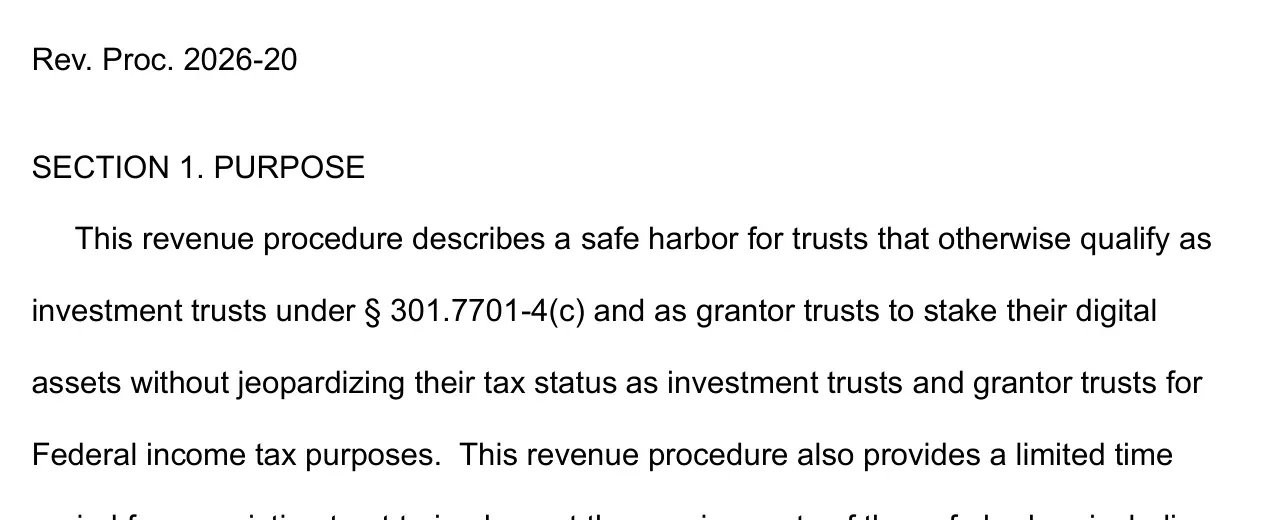
Section 1 of the IRS document says it supersedes the 2025 version.
Why the IRS reopened its staking safe harbor
Section 2 says Treasury and the IRS received requests for more clarity after the first version and lists eight topics. Among them are the protocols covered, the use of several custodians, the extent of slashing protection and the treatment of staking rewards. A trust that stakes can keep its status as an investment trust and a grantor trust for federal income tax. Holders are then treated as owning their share of the assets directly. The IRS staking safe harbor keeps the same goal as the 2025 text.
Safe harbor swaps SEC approval for an effective registration
In 2025 the text asked that a trust's staking disclosure be "reviewed and approved by the SEC," and that wording is gone. New item 1 asks that the disclosure sit in an effective registration statement, subject to the SEC's continued oversight. Sponsors can point to a public filing for that. Exchange listing is still required. So is a fit with the SEC staff statement on protocol staking from May 29, 2025.
Custodians, slashing and quarterly payouts
Custody can now sit with one or more custodians. Slashing cover got narrower too. In 2025 the trust's assets had to be indemnified from slashing caused by staking providers. New item 13 limits the indemnity to events "reasonably within the staking provider's control or ability to protect against."
Payouts have a fresh deadline. Under item 14, staking rewards, net of trust expenses, must reach holders within 60 days of the quarter's end. The clock runs from the calendar quarter in which the trust gains control of the rewards. Before, the text only said "no less frequently than quarterly." A trust may also sell coins for cash to make cash distributions. The old sale language covered only expenses and redemptions.
Borrowing was one of the eight topics. A contingent liquidity arrangement is the backup source of cash or coins a trust may line up. Item 12 now leaves out any deal the trust treats as borrowing digital assets for tax purposes.
Six months to meet the safe harbor
Trusts already running get some breathing room. Under section 6.03 they have until six months after October 6, 2026, to amend the trust agreement, change procedures or do both. Status as an investment trust and grantor trust survives that work. Nine months was the first version's allowance, counted from November 10, 2025. A trust that follows the 2025 safe harbor may keep relying on it for up to six months after October 6. After that, no trust may rely on Rev. Proc. 2025-31.
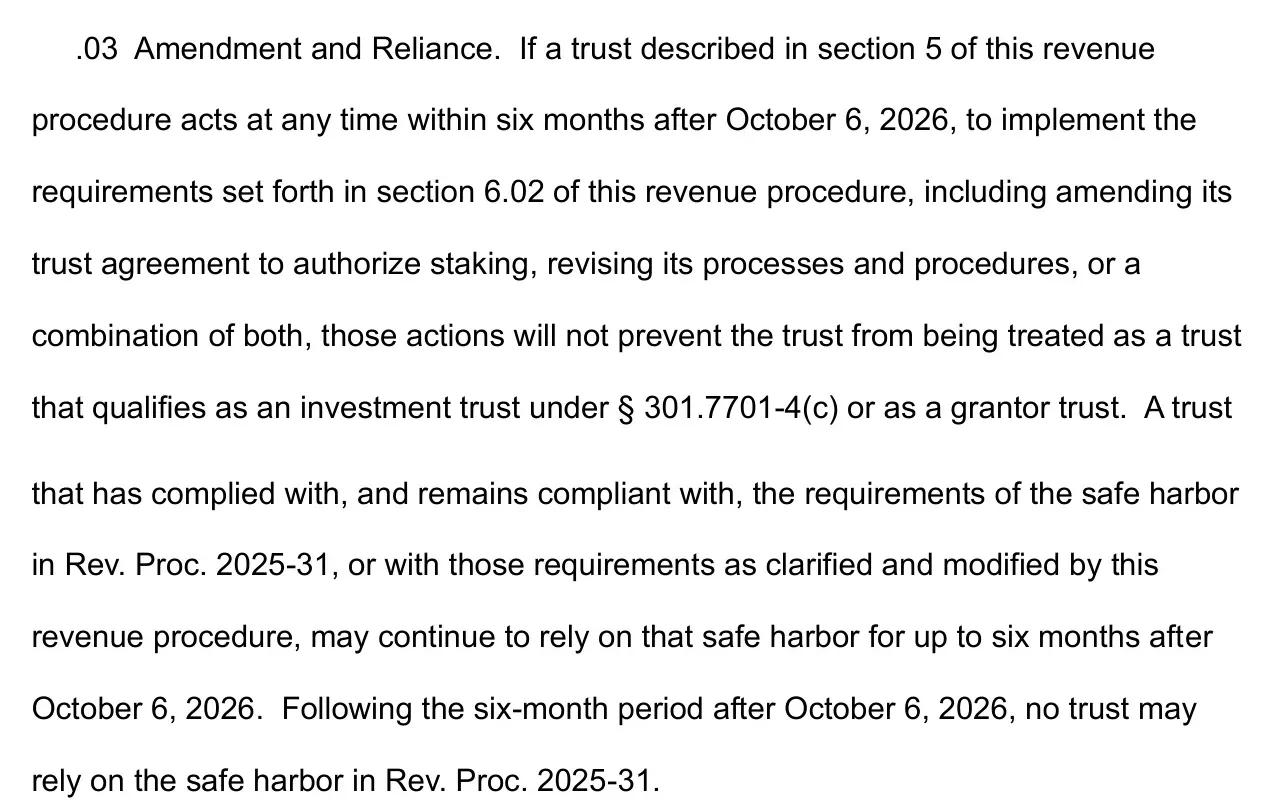
The reliance period is in section 6.03.
Questions the staking safe harbor leaves open
Section 7 repeats a limit from 2025. No one should infer how a trust outside the safe harbor would be treated. It does not say whether staking income counts as effectively connected income or unrelated business taxable income, and it leaves forks and airdrops alone.
Staking inside funds is already live, as in our report on 21Shares paying staking rewards on five crypto ETFs. The IRS text names no fund and no coin. Under the IRS staking safe harbor, trust counsel will have to map each fund's documents against the 14 items in section 6.02. The procedure applies to tax years ending on or after October 6, 2026.
Loading…
Written by
Amina Wanjiru covers crypto regulation and policy for Times of Crypto Era. The reporting follows SEC, CFTC and Federal Register actions, plus rules from regulators in the UK, EU and Asia, with a focus on what a new rule changes in practice.
View full profile →Related News

Roman Storm Case: DOJ Cites Sterlingov To Back Venue
A three-page government letter filed October 5, 2026 asks Judge Failla to find venue proper on two counts, citing the D.C. Circuit's Sterlingov decision. Here is what it asks and what it does not.

CFTC Crypto Rules: Who Could Lend To Retail Traders
The CFTC asked for comment on rules for retail crypto bought with loans. Here is who could lend, who would hold the coins and how losses would be handled.

Unhosted Wallet Rule Withdrawn: FinCEN Drops Mixer Proposal Too
FinCEN is withdrawing its 2020 unhosted wallet rule and its 2023 crypto mixer proposal. Here is what each would have required and why they were pulled.