Uniswap Fees Pass $6B As V4 Earns Two Thirds Of The Last 30 Days
Uniswap fees reached $6.077B in total on DefiLlama. V4 now earns most of them, September nearly tied the record day, and daily fees have fallen to about $2M.

In this article+
Uniswap has now earned $6.077 billion in cumulative fees across its three versions, according to DefiLlama. The Uniswap fees total crossed $6 billion after a September that almost matched the protocol's single best day on record. Since then the daily numbers have cooled to about $2 million.
The version that earns most of the money has changed, too. V4, which only started posting fees in February 2025, produced about two thirds of the fees over the last 30 days.
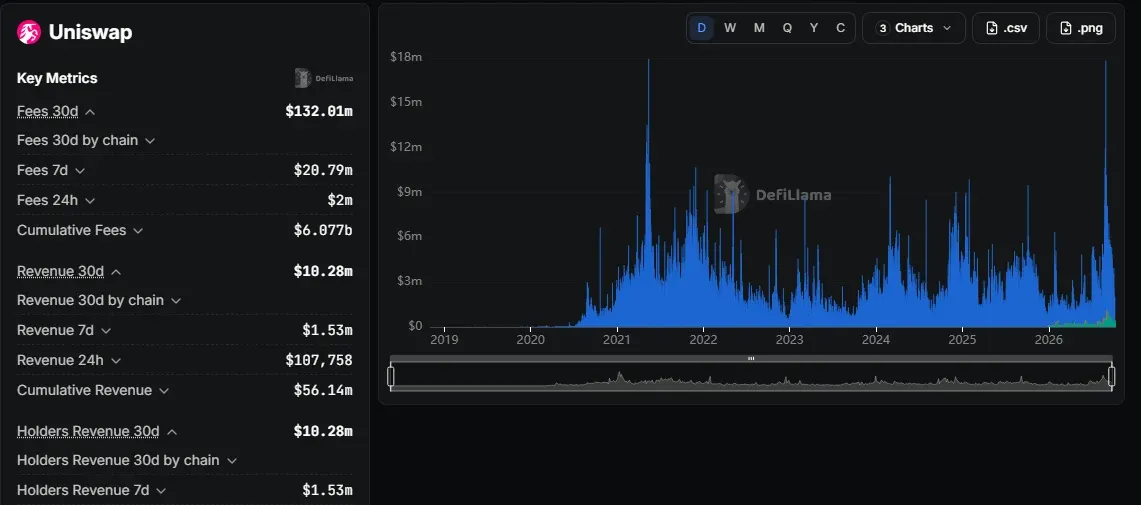
The DefiLlama fees page for Uniswap lists $132.01 million in fees over 30 days, $20.79 million over seven days and $6.077 billion cumulative. Its revenue lines are far smaller.
Uniswap fees by version
DefiLlama tracks Uniswap as three separate versions. V3 is the biggest over time at $3.709 billion, V2 follows at $1.838 billion, and V4 has collected $524 million so far. Together they make up the $6.07 billion headline that circulated this week.
The last 30 days of Uniswap fees look very different. V4 contributed $84.8 million, V3 $42.9 million and V2 $4.4 million. In September alone V4 took in about $134 million, against $64 million for V3 and $5.8 million for V2.
Six months ago the picture was reversed. In March, V3 earned $25.2 million and V4 earned $15.6 million. V4 passed V3 in the monthly numbers in August and then pulled well clear.
One record day, then a fade in Uniswap fees
Nothing this year came close to September 4, which brought in $17.86 million. The only day on record that was higher, by a hair, was May 19, 2021, at $17.9 million. The days around the 2026 peak were big as well, with five of them landing between $10 million and $12 million.
All of that added up to $204.4 million for September, roughly five times what March delivered. The slide since then has been steep. October opened near $3.4 million a day on average. By October 9 to 11 each day landed between $2.0 million and $2.6 million.
Zoom out and the year has had two steps up. March through June hovered near the $45 million mark each month. Then July brought more than double that, August held the new level, and September doubled once more. V4's share of those fees climbed from about 30% in July to roughly two thirds in September.
The latest seven days add up to $20.79 million, which is a little over a tenth of September's total. That is the cooling in plain numbers.
Fees versus revenue
The fee number is not the same as the protocol's take. DefiLlama lists 30-day revenue of $10.28 million against $132.01 million of fees, which is about 8%. Cumulative revenue stands at $56.14 million, next to the $6.077 billion of lifetime Uniswap fees.
That gap matters when reading the $6 billion headline. It measures what traders paid in swap fees over the years. The revenue line on the same page is the better guide to what the protocol itself books. Every figure here sits on that single public page.
The dashboard was read on October 12, 2026, and DefiLlama may revise past days later on. Treat this as a data summary, not investment advice.
Written by
Amina Wanjiru covers crypto regulation and policy for Times of Crypto Era. The reporting follows SEC, CFTC and Federal Register actions, plus rules from regulators in the UK, EU and Asia, with a focus on what a new rule changes in practice.
View full profile →Related News

Ethena Fees Milestone: $1.06B Lifetime, But Monthly Fees Have Slowed
Ethena fees milestone check: DefiLlama shows $1.061B lifetime fees, crossed July 2, 2026, while monthly fees fell from $54.7M in August 2025 to $15.9M.

AVAX Price Analysis: Range Holds At $11 Below A $12.01 Ceiling
AVAX price analysis on Binance data: three weekly closes near $11, a $12.01 ceiling, a $9.76 floor, an open 4h gap and two scenarios with clear 4h triggers.

Compound V4 Update: Institutional Market Passed $60M In Deposits
This Compound V4 update reports $60M in Institutional Market deposits, $18M in USDC loans, a six-person engineering team and open COMP reward claims for users.