Aave Risk Stewards Cut USDtb Cap 67% And Close LDO Deposits
LlamaRisk's October 13 post cuts the Aave USDtb cap 67%, closes LDO deposits with a cap of 1 and lifts USDC caps on Monad. Aave risk steward changes explained.

In this article+
Aave is shutting the door on new LDO deposits by setting the token's supply cap to one. It is one line in a longer list of Aave risk steward changes, laid out in a LlamaRisk post on the Aave forum dated October 13, 2026. LDO already has a loan-to-value of zero on Aave V3 Core. New positions get no borrowing power from it, and borrowing LDO is disabled. The cap of 1 finishes the job, while existing suppliers can still withdraw.
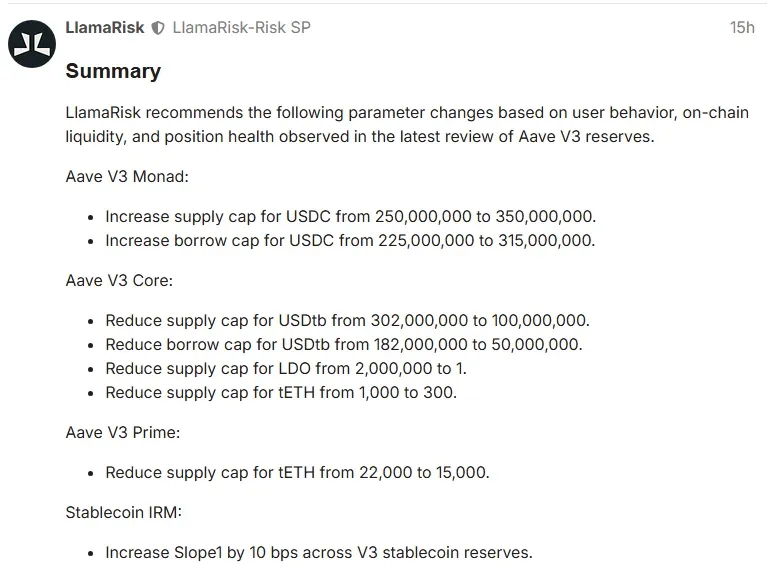
The list of recommended changes at the top of the LlamaRisk post. Source: Aave governance forum.
Caps cut on Aave V3 Core and Prime
The largest reduction hits USDtb on Aave V3 Core. The supply cap falls from 302 million to 100 million and the borrow cap from 182 million to 50 million. LlamaRisk says the reserve sits at only 4.3% of its supply cap and 5.8% of its borrow cap. Supply has dropped about 17% over 30 days, and the asset is not enabled as collateral.
Two reserves for tETH also shrink. On Core the supply cap goes from 1,000 to 300, which would put the reserve at about 95.6% utilization after the change. On Prime it goes from 22,000 to 15,000, a level slightly below the 15,189 now supplied. The post says those positions sit in E-Mode as collateral against wstETH debt, in a looped structure, and are highly concentrated.
USDC room grows on Monad
Not every Aave risk steward change tightens a limit. On Aave V3 Monad the USDC supply cap goes from 250 million to 350 million, and the borrow cap from 225 million to 315 million. The reserve stands at 90.0% of its supply cap and 93.5% of its borrow cap today. After the change those would drop to about 64.3% and 66.8%.
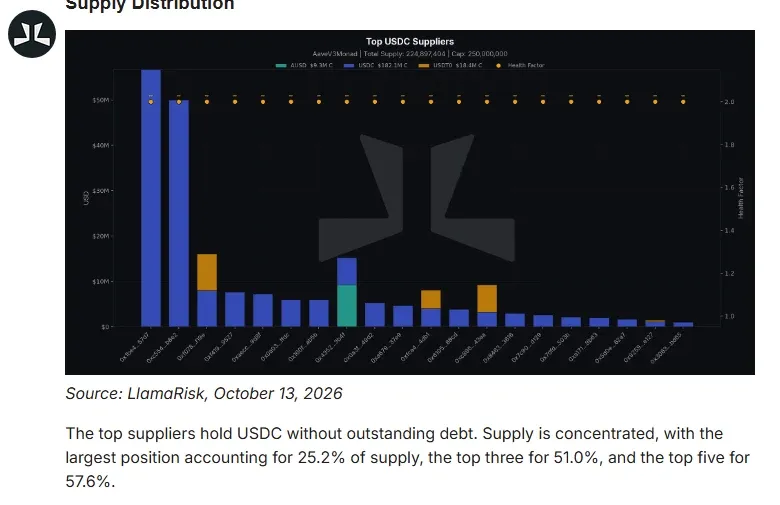
LlamaRisk's chart of the top USDC suppliers on Aave V3 Monad. Source: Aave governance forum.
Supply there is concentrated. The largest position holds 25.2% of the supply, the top three hold 51.0%, and the top five hold 57.6%. LlamaRisk adds that the biggest suppliers carry no debt. On the borrowing side, health factors for the top USDC borrowers run from 1.01 to 1.05. Their collateral is all stablecoin-denominated, with USDe and syrupUSDC the largest by value.
A small rate nudge across stablecoins
The last change touches interest rates. LlamaRisk raises the first slope of the rate curve by 10 basis points, from 4.40% to 4.50%, on stablecoin reserves across Aave V3. USDC on Aave V3 Base gets 5 basis points, from 4.70% to 4.75%. The post puts aggregate debt in these reserves at about 5.82 billion dollars, with most running close to their optimal utilization.
The second slope and the optimal point stay put. The rate above that point therefore rises by the same amount, which keeps the incentive to repay or supply during a squeeze. On Aave V3 Core, for example, the USDC borrow rate moves from 4.38% to 4.48%.
LlamaRisk says it will carry these updates out through the Risk Steward process, so the post describes no separate vote for the Aave risk steward package. The firm also discloses that the DAO funds part of its work. Any reader can compare the new caps with the live Aave reserves once the changes take effect.
Loading…
Written by
Faith Njeri covers DeFi protocols, exploits and onchain security for Times of Crypto Era. Project post-mortems and governance proposals are read in full, and each incident is traced back to the team's own disclosure.
View full profile →Related News

Balancer BEETS Burn Proposal Would Destroy 10M Tokens The DAO Holds
A forum draft asks Balancer's DAO to burn its 10 million BEETS on Sonic. The Balancer BEETS burn would remove nearly 4% of supply. Details and on-chain check.

GNS Price Analysis: A 40x Volume Spike Takes GNS To $0.858
GNS price analysis: Gains Network's token hit 0.858 on October 13 on 40 times normal volume, then pulled back into a gap. Key levels and two scenarios.

APT Price Analysis: A Spike To $0.9655 Reversed 18% In Two Days
APT price analysis: the token spiked to 0.9655 on October 11, then fell about 18% in two days. See the gaps, order block and levels that now matter for APT.