Bitcoin Slips Below $80K As Fed Chair Warsh Turns Hawkish
Bitcoin fell below $80,000 after Fed Chair Kevin Warsh's hawkish Jackson Hole speech pushed September rate-hike odds to 60% and snapped a nine-day bitcoin ETF inflow streak.

In this article+
Bitcoin dropped below $80,000 this week after new Federal Reserve Chair Kevin Warsh delivered his first Jackson Hole keynote on August 28. Traders did not like what they heard.
The Hawkish Pivot
Warsh told the audience that summer's softer inflation prints had not convinced him underlying price pressure had actually cooled. Policymakers need to see inflation return to 2% “clearly and at sufficient speed,” he said, adding “otherwise, we have work to do.”
He never called that forward guidance. The rates market called it for him anyway.
Odds of a quarter-point hike at the September 15-16 Fed meeting jumped to 59.7% by late morning, up from 35.4% on Thursday. That is per Benzinga's own report citing CME Group's FedWatch tool. The two-year Treasury yield rose nine basis points to 4.32%, a one-month high.
The bond market read it as a classic bear flattener. Short-term yields spiked while the 30-year held flat at 5.19% and the 10-year rose less than four basis points to 4.71%. That is a sign traders expect the hikes to actually work this time.
Bitcoin And Gold React
Bitcoin and gold took the direct hit. Spot gold fell 1.7% to roughly $4,526 an ounce that day. Bitcoin slid from above $80,000 earlier in the week to around $78,100.

Benzinga's report on Fed Chair Kevin Warsh's hawkish Jackson Hole speech, screenshotted Aug 29, 2026. Source: benzinga.com
CoinGecko's live price feed showed BTC trading at $78,092.08 at time of writing, up 0.3% over 24 hours after bouncing off a $77,284.52 low. Market cap sits at $1.567 trillion, with Bitcoin's share of the total crypto market at 57.6%.
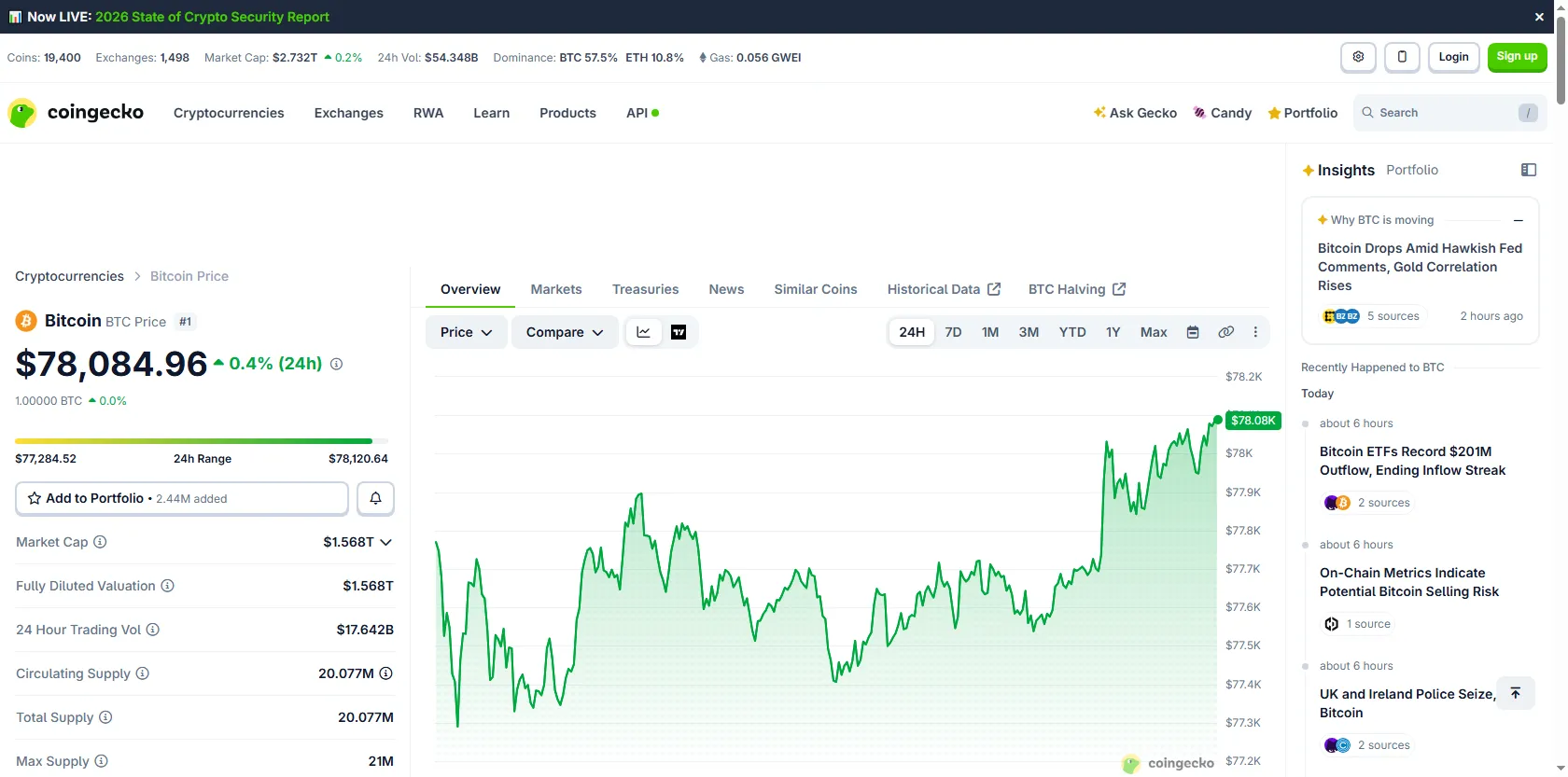
Bitcoin's live price and market data on CoinGecko, screenshotted Aug 29, 2026.
The ETF Flow Reversal
The pullback also snapped a nine-day bitcoin ETF buying streak. Farside Investors' own flow table shows the group of U.S. spot bitcoin ETFs posted a $201.9 million net outflow on August 28, ending a run that pulled in more than $3 billion since August 17.
A day earlier, on August 27, the same funds took in $242.3 million. Blackrock's IBIT led with $277.6 million, even as Fidelity's FBTC shed $83.6 million and Grayscale's GBTC gave up $27.2 million.
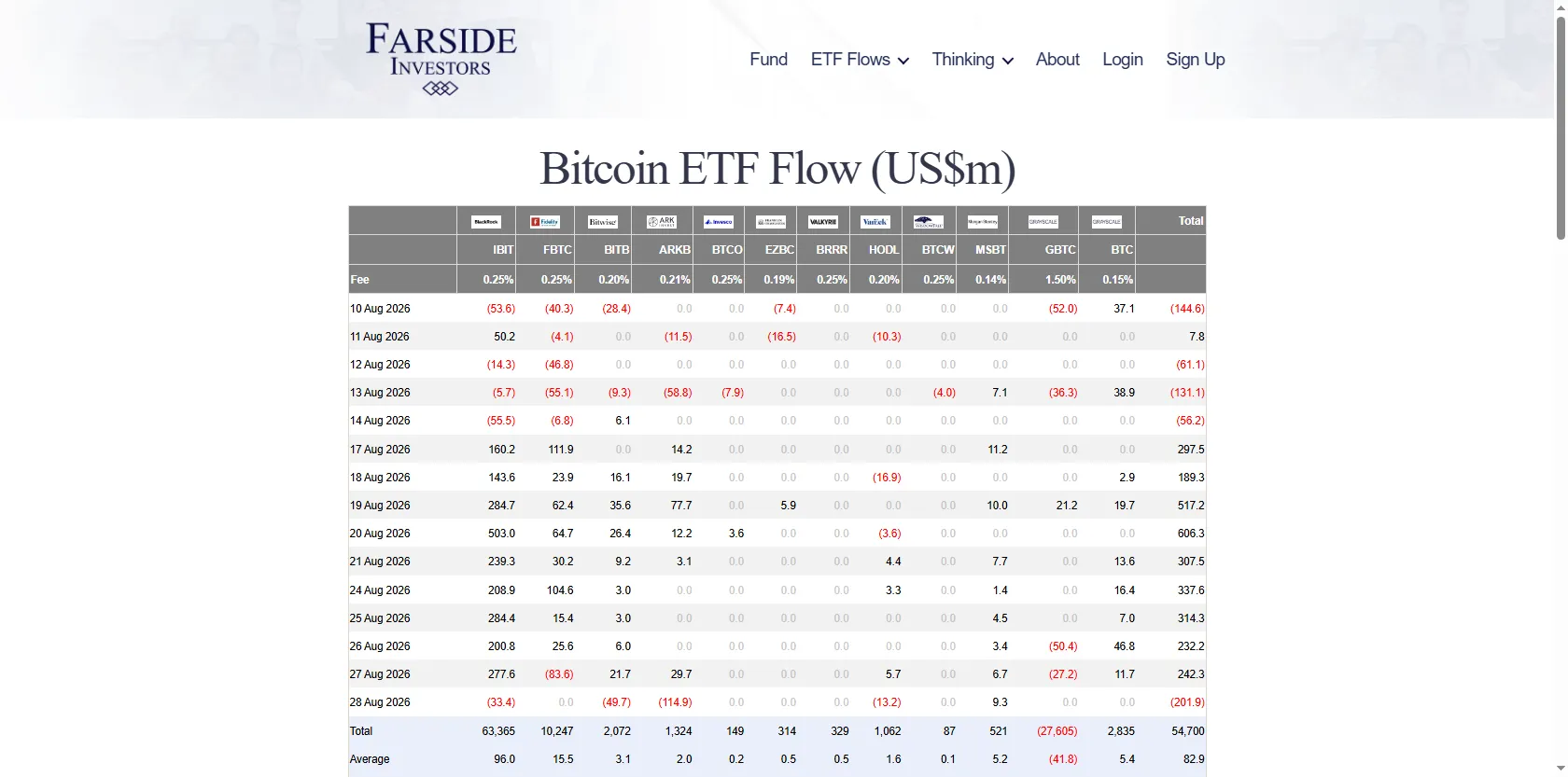
Bitcoin ETF daily flow table on Farside Investors, screenshotted Aug 29, 2026, showing the Aug 28 outflow.
Ether ETFs bucked the trend entirely. The same Farside data shows ether funds pulling in fresh money for a tenth straight day. That run added roughly $2.6 billion in August alone, their strongest inflow week since October.
This is not bitcoin's first hard reversal this year. Back in May, the same group of ETFs logged a nine-day, $2.8 billion outflow streak while bitcoin slid from about $80,000 to $73,000. August's single-day exit is far smaller by comparison.
Not Every Signal Points Down
CoinGecko's own market insights flagged large bitcoin holders accumulating to multi-month highs even as the ETF streak broke. A thick liquidity wall also sits between $81,000 and $83,000, one that would need real buying pressure to clear. On-chain trackers have flagged rising selling risk on two separate metrics too, so the picture is genuinely mixed rather than one-directional.
Prediction markets are split too. Kalshi's bitcoin contracts are showing divergent outcomes for where price lands by year-end, reflecting how unsettled the outlook became after one hawkish speech.
Bitcoin remains up about 1% over the past week despite Thursday's outflow, so Warsh's comments look more like a reset than a reversal for now. Whether that holds depends on whether the next FOMC meeting confirms the market's new 60% hike odds or walks them back.
This article is for informational purposes only and does not constitute financial advice. Cryptocurrency prices are volatile and past performance does not guarantee future results.
Written by
Mwenda is a skilled crypto journalist and expert in blockchain technology, digital assets, and decentralized finance. He has a talent for translating complex concepts into engaging, informative content. With a deep understanding of the industry, Mwenda delivers accurate analysis that appeals to beginners and seasoned enthusiasts.
View full profile →Related News

Bitcoin Whale Holdings Climb Above 3M BTC While Demand Lags
Bitcoin whale holdings climbed back above 3M BTC per CryptoQuant while apparent demand stays negative. See the charts, the supply in loss signal and caveats.

ETF Outflows Hit $1.2B For Bitcoin And Ether In One Week
ETF outflows reached $1.22B across bitcoin and ether funds in the week of Oct 5, with ether down nine sessions straight. See which funds lost most, day by day.

Bitcoin Funding Rate Turned Negative On Binance, Then Flipped Back
Bitcoin funding rate on Binance went negative Oct 5 to 8 but was not a nine-month low, per Binance's own history. See the prints, open interest and price.