Bitget Block In Thailand Starts Dec 5 After SEC Criminal Complaint
Bitget block in Thailand starts December 5 after the SEC filed a criminal complaint against the operator and one promoter for running without a licence.
Thailand's securities regulator has set a Bitget block for December 5. The filing came on November 5. It targets BG Limited, the company behind the exchange, and the SEC also asked the government to block Bitget's website and app.
The SEC's release carries the number 241/2026 and makes a plain claim. Between 2022 and 2025, it says, Bitget ran an exchange business here with no licence, helped along by one supporter. No charges exist yet, because a complaint is only the first step.
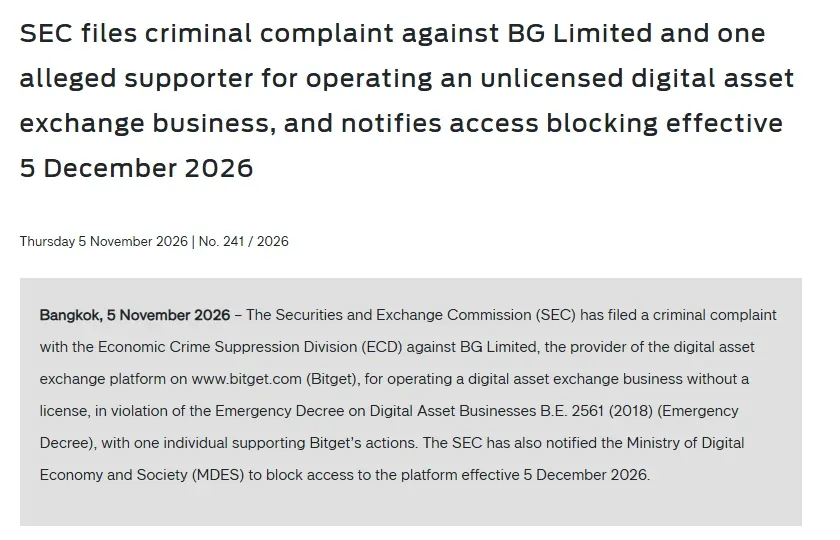
The regulator's English-language notice. Source: SEC Thailand, News No. 241/2026.
Bitget block: what the SEC says happened
According to the regulator, Bitget provided a trading system and charged fees for it. The site also had a Thai-language version with an option to show equivalent values in baht. Under Thai law that counts as running an exchange business, which needs a licence.
The SEC lists three channels it says Bitget used to promote itself in Thai. They are a "Bitget Thailand" account on X, a "BGB Thai Holder" group on Telegram and a "bitgetthailand" account on TikTok. The SEC says this conduct falls under the Emergency Decree on Digital Asset Businesses of 2018. It cites Section 26 for the missing licence and Section 66 for the offence.
One named promoter
The second target is Kritsana Kritsananuwat. The SEC says he publicised Bitget through a Facebook page called "Srisiam" and a YouTube channel of the same name. In its view that made the platform more widely known and raised the number of people interested in using it.
His case is treated as assisting an unlicensed exchange. For him the SEC adds Section 86 of the Criminal Code to the same Section 66 offence. Both defendants now sit with the Economic Crime Suppression Division.
How the December 5 block works
The Bitget block does not wait for a court. The SEC passed details of bitget.com, other Bitget domains and the app to the Ministry of Digital Economy and Society. A 2025 royal decree lets the ministry order access to unlicensed platforms cut. From December 5, the public will not be able to reach Bitget.
Thailand has used this route before. A May 2025 notice named Bybit, 1000x, CoinEx, OKX and XT.COM, with restrictions starting June 28, 2025. The same decree was cited then, and the SEC had filed criminal complaints against those platforms too.
The SEC's own news page shows a second block already close. A separate reminder there tells investors to act on assets held at a platform called VCEX before access ends on November 7.
What users are told to do
The SEC tells Bitget users to consider acting on their assets before the Bitget block takes effect. It warns that customers of unlicensed operators are not protected under Thai law and face fraud and money laundering risks. Licensed operators are listed on the SEC website and in its Check First app, and tips can go to hotline 1207.
After the complaint, the case passes to the police inquiry official, then to a public prosecutor, then to a court. The regulator says it will follow the proceedings and work with the agencies involved. That leaves about 30 days between the announcement and the block.
Related News
ASIC Digital Asset Rules Consultation Runs Until November 27
The ASIC digital asset rules draft opened on October 15. Platforms and custody firms have until November 27 to respond, and the new laws start April 8, 2027.
National Trust Bank Charters: ICBA Sues OCC Over Crypto Access
Community bankers sued the OCC on October 2 over national trust bank charters for crypto firms. Here is what the complaint says and what the OCC argues.
Unhosted Wallet Rule Withdrawn: FinCEN Drops Mixer Proposal Too
FinCEN is withdrawing its 2020 unhosted wallet rule and its 2023 crypto mixer proposal. Here is what each would have required and why they were pulled.
CFTC Crypto Rules: Who Could Lend To Retail Traders
The CFTC asked for comment on rules for retail crypto bought with loans. Here is who could lend, who would hold the coins and how losses would be handled.