Celestia v10 Upgrade Went Live At Block 15,116,659, Adding Fibre
The Celestia v10 upgrade activated at block 15,116,659 on October 20, adding Fibre, a validator-served data availability protocol, plus node and RPC changes.

In this article+
Celestia switched to its tenth app version in the early hours of October 20. The Celestia v10 upgrade took effect at block 15,116,659, stamped 03:45:49 UTC on Mintscan. The release behind it adds Fibre, a new data availability protocol that validators serve from their own servers.
What the Celestia v10 upgrade turned on
We checked a public Celestia RPC node instead of taking the date on trust. Block 15,116,658 still reports app version 9 in its header, and the very next block reports version 10. Block 15,121,559, checked later that morning, also reports version 10.
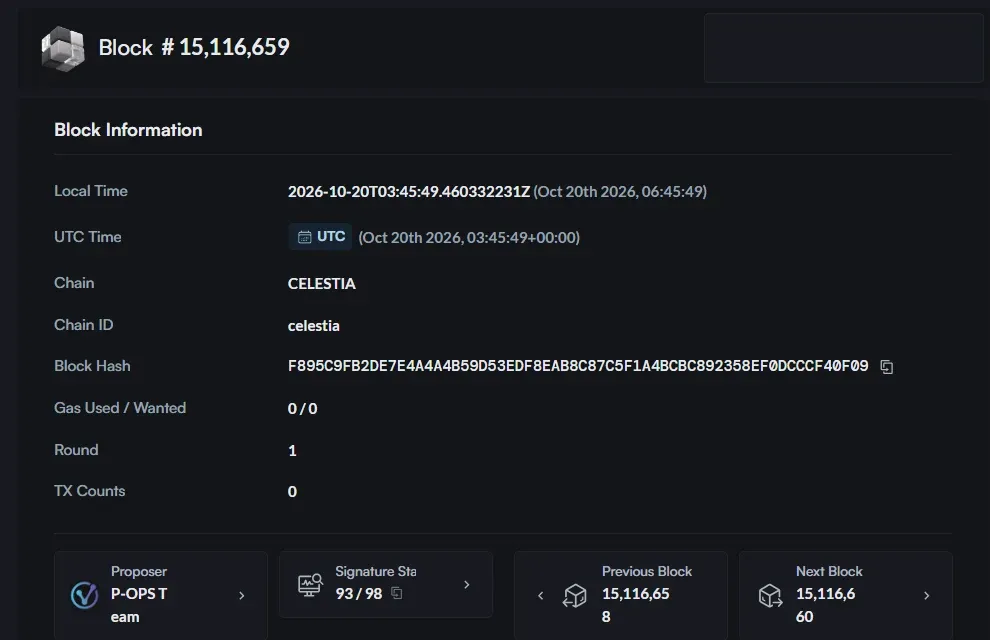
Block 15,116,659 on Mintscan, the first block under app version 10. Source: Mintscan, Celestia.
Nothing about this switch was sudden. Validators had to signal support for version 10 through the chain's signalling module. The release notes say that once five sixths of voting power signalled and an upgrade attempt succeeded, activation followed 232,616 blocks later. They put that at about seven days.
Fibre and the node changes in the Celestia v10 upgrade
Fibre is the headline feature. The release notes call it a data availability protocol served by validator-operated Fibre servers. Validators register a Fibre host address on chain. The notes advise running it on a separate machine with its own public IP, so the validator's own address stays out of view.
The Celestia v10 upgrade also changes how nodes behave. Heavy RPC calls such as block queries now sit behind a concurrency limit, set to 20 by default. The window for accepting evidence of double signing shrinks from 559,940 blocks to 404,400. That keeps it inside the unbonding period even when blocks arrive every three seconds. Pruned nodes get an optional compaction setting, and validators can try storing Fibre data in S3-compatible object storage, which the notes label experimental.
Validators who use a remote key manager got a new requirement. It must be able to sign raw bytes, because Fibre uses signatures for payment-promise endorsements and its TLS identity. The notes also cap median signing time at 10 milliseconds. Nodes log a warning when it slips past that.
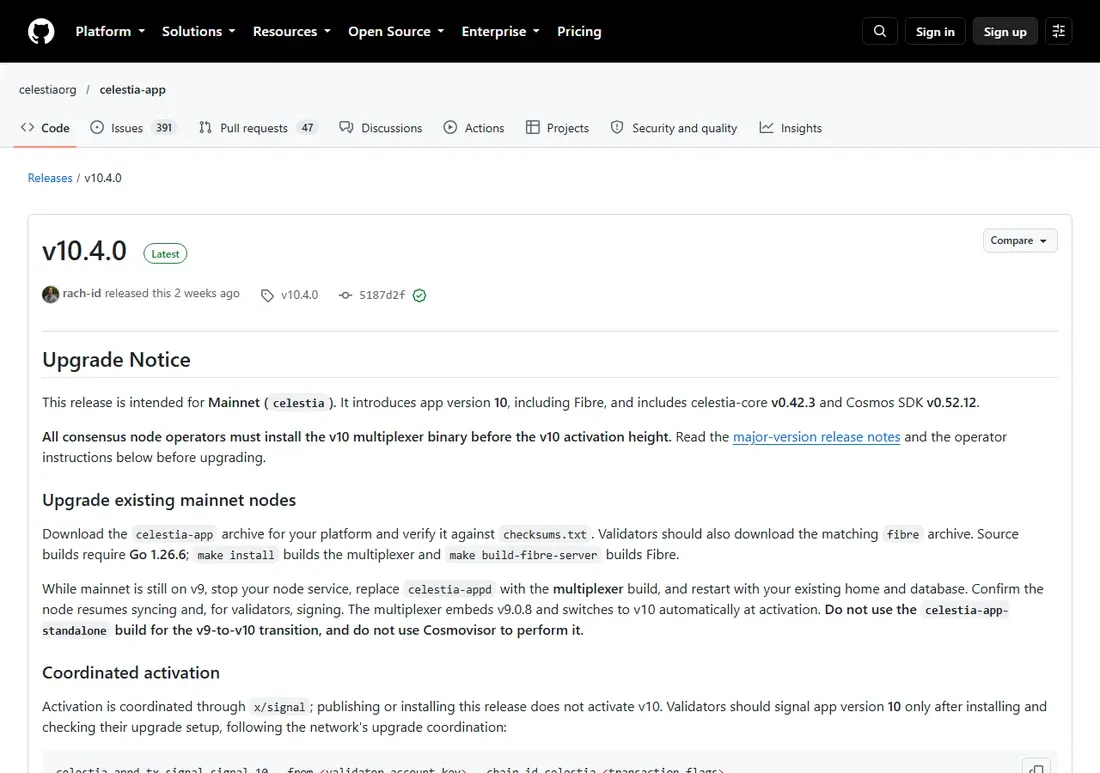
The top of the v10.4.0 release notes on GitHub. Source: celestia-app v10.4.0 release.
How exchanges handled the switch
Upbit paused TIA deposits and withdrawals from 09:00 Korea time on October 20, citing the hard fork and linking the same v10.4.0 release. Trading continued during the pause. The exchange's notice shows an update at 16:21 Korea time saying checks were complete and transfers had reopened.
Operators had a long lead time. The release notes were published on October 7, a full thirteen days before the chain switched. They told node runners to install a multiplexer build while the network was still on version 9. That build carries the old version and flips to the new one by itself at activation.
Where the TIA price stood
TIA traded between about $0.59 and $0.65 on October 19 and closed near $0.62. By the morning of October 20 it sat near $0.635. The week before had been livelier, with a spike to $0.72 on October 16. Nothing we found ties either move to the upgrade.
This article describes released software and observed chain data and offers no investment advice.
Loading…
Written by
Amina Wanjiru covers crypto regulation and policy for Times of Crypto Era. The reporting follows SEC, CFTC and Federal Register actions, plus rules from regulators in the UK, EU and Asia, with a focus on what a new rule changes in practice.
View full profile →Related News

Babylon v4.6 Upgrade Brings Security Fixes, With Details Held Back
Babylon v4.6 upgrade proposal 26 cites important security fixes and sits at 100% yes. Details wait until after the upgrade at block 4,853,800 on October 22.

Filecoin Solstice Upgrade Went Live, Ending Fil+ For New Sectors
Filecoin Solstice upgrade went live October 19 at epoch 6470279: Fil+ datacap ends, new sectors get 10x power and block rewards split into three streams.

Sei DEX Volume Hits $15.9B All-Time, But One Venue Does 99% Of It
Sei DEX volume passed $15.9B all-time, but DefiLlama shows 30-day volume of $279M, about a fifth of the July 2025 peak, with Saphyre handling 99% of it.