Federal Reserve Tokenization: Waller Flags Trust, Binance And Choice
Federal Reserve tokenization was the topic of Governor Waller's Nov 17, 2026 speech. See what he said on trust, Binance, stablecoins and central bank money.
Christopher Waller, Federal Reserve governor, gave an explanation through a speech delivered in New York at The Clearing House annual conference on November 17, 2026 of what he expects out of the federal reserve tokenization process and this includes competition, trust, and choice. The text can be viewed at the Fed website.
Federal reserve tokenization, in the governor's words
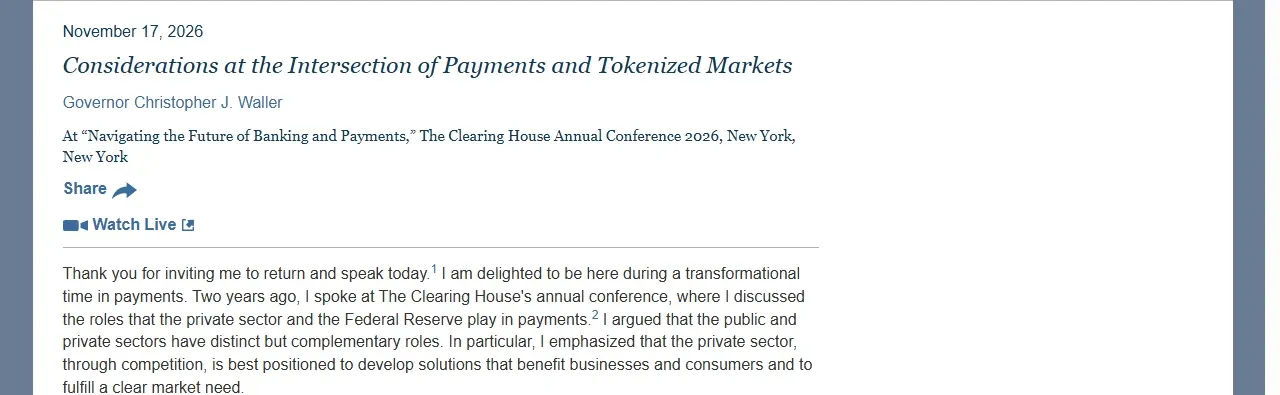
Governor Waller's speech, Considerations at the Intersection of Payments and Tokenized Markets, posted November 17, 2026. Source: Federal Reserve Board.
According to Waller, there is a coming together of blockchain technologies with existing market structures. Previously, he says, blockchains were mostly utilized for cryptocurrency transactions. Today, however, securities like stock, bond, and commodity transactions are being tokenized due to programmability.
The discussion will be structured using three central questions: how the tokenization affects the competition between old and new players, how services gain credibility, and how payments can sustain the tokenized market.
The trust section on tokenization mentions Binance
The sharpest question asked concerns the liability when criminals take advantage of the automatic execution of smart contracts. Waller also inquires how the operators shall deal with the problems like losing keys, erroneous transactions and pricing mistakes as well as the assets stuck due to failures of the chains which Waller refers to as “zombie chains”.
After posing those inquiries, Waller asserts that recent events in relation to Binance have shown some of the problems related to programmable blockchains. The note cites a Wall Street Journal report dated October 30 concerning Binance suspending transactions after a cyber heist. The speech itself gives no dollar figure.
Stablecoins, tokenized deposits and a Saturday example
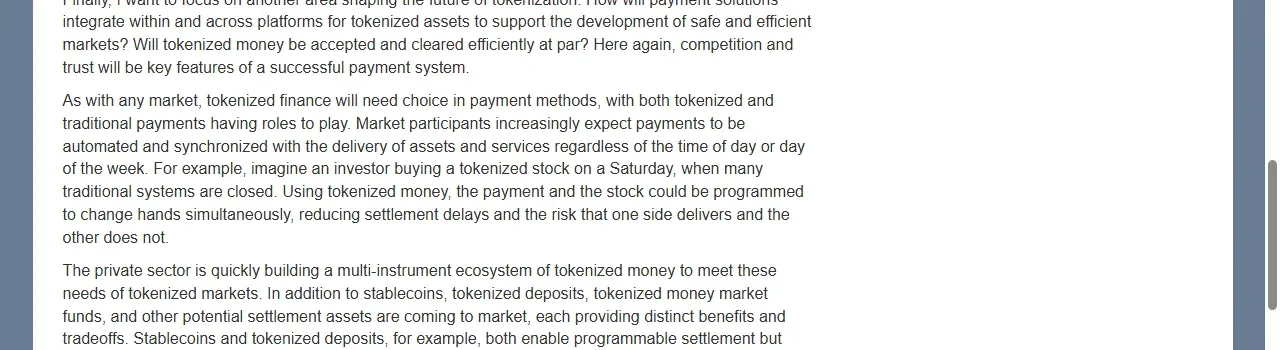
The payments section of the speech, with the Saturday tokenized stock example. Source: Federal Reserve Board.
The example Waller gives is that of an investor purchasing a tokenized stock on a Saturday, when many traditional systems would be closed. Since tokenized money can be programmed so the payment and the stock change hands at once, there is less delay and a smaller risk of one party delivering without receiving payment.
There are expected to be different types of tokenized money existing alongside each other. Stablecoins, tokenized deposits, and money market funds, while all providing programmable settlement, are distinct based on issuer models, regulation and reach.
Where the Fed wants to stay
The governor doesn't ask for one winner here. He states that atomic settlement is beneficial, but shouldn't be considered as the only one possible as net and batch settlements still save liquidity in large volumes.
Waller believes central bank money need not be used in every transaction, but "its presence at the foundation of the system is essential." Traditional payment rails are already used in transferring stablecoins on- and off-ramps, as well as tokenized deposit payments.
When it comes to federal reserve tokenization in the future, Waller notes AI-powered payment agents as an emerging phenomenon. Tokenization and AI can serve as triggers for each other - they are faced with the same set of challenges regarding trust, standardization, and openness vs. closure of networks.
The Fed's role in tokenization
In repeating a position he took in an identical presentation from two years ago, Waller says the public and private sectors have distinct, yet complementary, roles, and that the private sector is ideally situated for solving problems through competition.
The Federal Reserve can help with this through its provision of the basic payment and settlement services infrastructure, risk analysis of financial stability and regular meetings with the industry, and the speech relies in part on those meetings including a meeting on innovations in payments recently.
For those monitoring bank side tokenization, this link to a 24/7 deposit solution between DBS and J.P. Morgan is a good illustration of the tokenized deposit process. The speech announces no federal reserve tokenization rule, no proposal and no timetable, so it signals thinking, not policy.
Related News
Fed Asks for Public Comment on Two Stablecoin Issuer Proposals
The Federal Reserve Board opened a 60-day comment period on two GENIUS Act proposals covering reserves, capital and applications for Board-supervised stablecoin issuers.
EU Crypto Sanctions Task Force Launches Without Size Or Powers
EU Crypto Sanctions Task Force was announced on November 6, but the European Commission statement gives no members, budget, start date or legal powers.
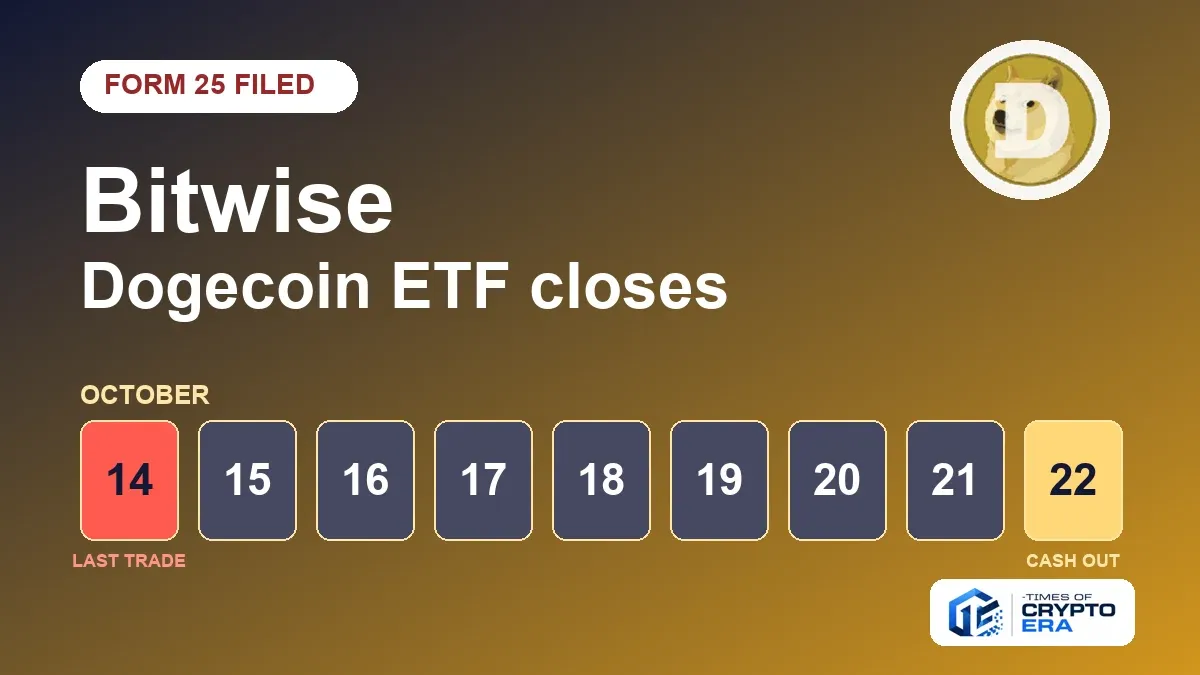
Bitwise Dogecoin ETF Files Form 25, Final Trading Day Is October 14
The Bitwise Dogecoin ETF filed Form 25 on October 13 to leave NYSE Arca. Trading ends October 14 and holders get cash on October 22, according to SEC filings.
Tether Kazakhstan MoU Studies a Tenge Stablecoin, Issues Nothing
Tether Kazakhstan MoU with the central bank covers a tenge stablecoin study and tokenization pilots. It names no chain, date or reserve rules. Read the details.