Filecoin Solstice Upgrade Went Live, Ending Fil+ For New Sectors
Filecoin Solstice upgrade went live October 19 at epoch 6470279: Fil+ datacap ends, new sectors get 10x power and block rewards split into three streams.

In this article+
Filecoin changed how its network pays for storage on October 19. The Filecoin Solstice upgrade, network version 29, switched on at epoch 6470279, which the Lotus release notes put at 12:59:30 UTC. We checked a public Filecoin node and found the chain reporting version 28 one epoch earlier and version 29 right after.
What the Filecoin Solstice upgrade does to Fil+
The headline change is that Fil+ is switched off. Filecoin Plus was the datacap program that let verified deals earn extra storage power. FIP-0118 deprecates it in full at the upgrade epoch, so no new datacap is minted and no new allocations or claims are possible.
Every new sector now gets ten times the quality-adjusted power by default, whatever data it holds. Existing sectors keep the power they already had. Operators who want the ten-times level on older sectors can call a new batch method, but they have to lock extra pledge when they do.
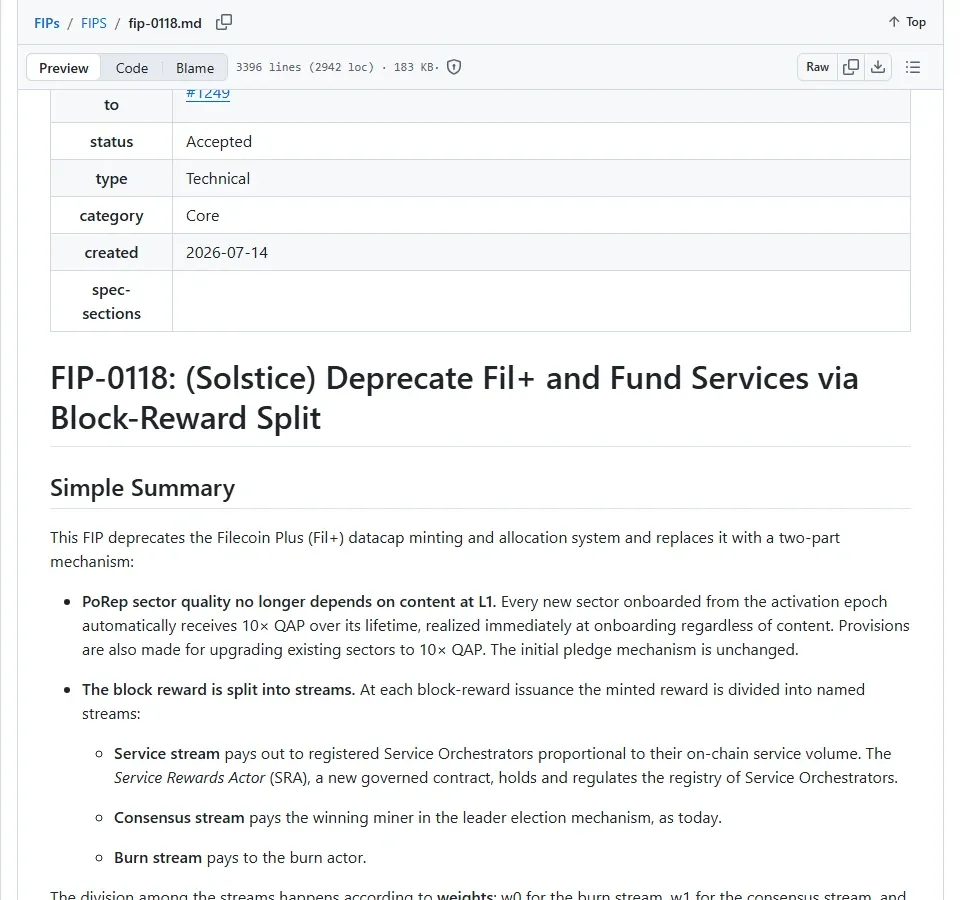
The summary of FIP-0118 on GitHub, with its status marked Accepted. Source: Filecoin FIPs repository.
How the Solstice block reward split works
The second half of the Filecoin Solstice upgrade changes who gets the minted FIL. Each block reward is divided into three streams. One goes to the winning miner as before, one pays registered service orchestrators according to their on-chain service volume, and the rest is burned.
A schedule sets the weights. Miners start with 95% of each reward and slide toward 50% over about nine quarters. Service providers start small and gain five percentage points a quarter, but only if Filecoin Pay volume clears a dollar target that quarter. Miss the target and the service share stays flat, with the leftover burned.
Two new governed contracts run this. A Service Rewards Actor keeps the registry of orchestrators, and a Stream Weights Actor holds the schedule and can change it later. Any change goes through a timelock, so operators get notice before new weights apply.
What Filecoin storage providers had to do
The mandatory release was Lotus v1.37.0, published on October 6. Every node and storage provider on mainnet had to run it before the activation epoch. The release notes list breaking changes too. The datacap commands retire. One pledge call returns an error from version 29 on, so tools built on it have to switch to a replacement.
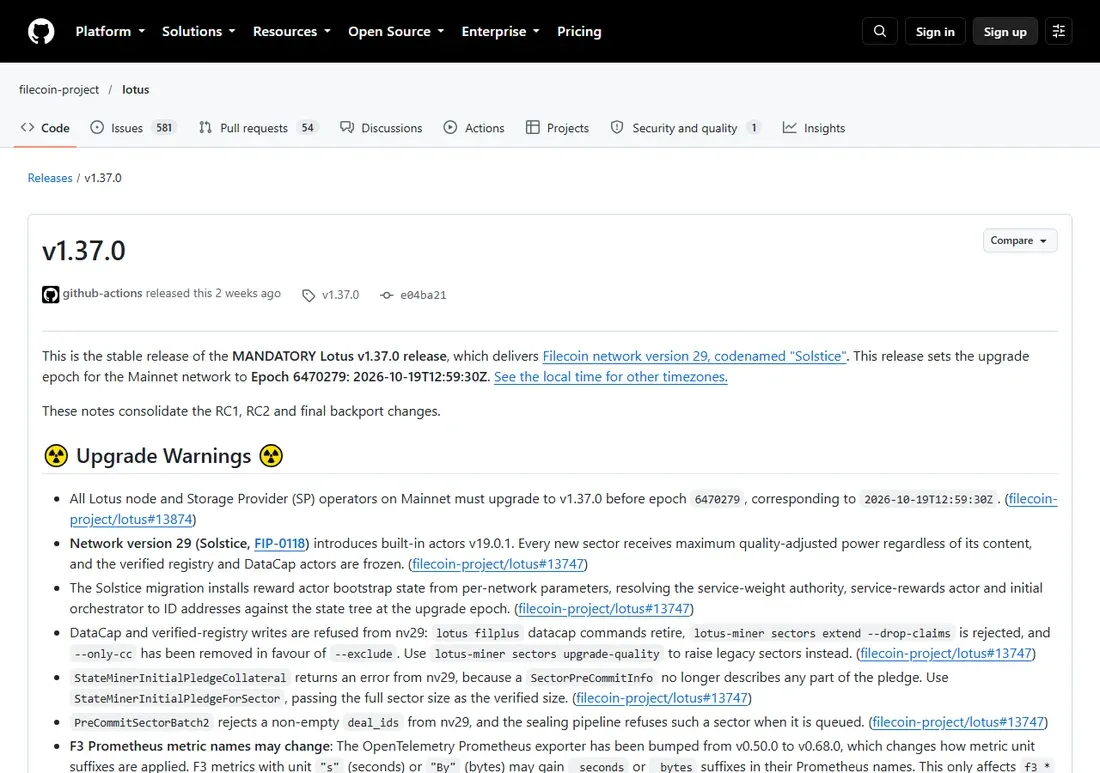
The release notes for Lotus v1.37.0, marked mandatory. Source: Lotus v1.37.0 release on GitHub.
Where the FIL price stood
Trading around the switch was quiet. FIL closed October 18 near $1.04 and October 19 near $1.02. By the morning of October 20 it sat close to $1.01, and trading had been thinner than on most days that week.
In the FIP's own words, the old incentives created network capacity but did not fully support services or paying demand. That is the gap the new reward streams are meant to close. Whether the new split fixes that will show in the Filecoin Pay volume each quarter, since that figure decides how fast the service stream grows. The FIP treats the first quarter as a bootstrap period.
Everything above describes rules that are already live on the network, and none of it is a forecast.
Loading…
Written by
Writer and editor at Times of Crypto Era. Covers Bitcoin, DeFi, and market structure.
View full profile →Related News

Celestia v10 Upgrade Went Live At Block 15,116,659, Adding Fibre
The Celestia v10 upgrade activated at block 15,116,659 on October 20, adding Fibre, a validator-served data availability protocol, plus node and RPC changes.

Sei DEX Volume Hits $15.9B All-Time, But One Venue Does 99% Of It
Sei DEX volume passed $15.9B all-time, but DefiLlama shows 30-day volume of $279M, about a fifth of the July 2025 peak, with Saphyre handling 99% of it.

Spark Risk Curation Vote: Curators Could Cut Risk Without A Poll
Spark risk curation vote SAEP-24 would let curators cut caps without a poll. It runs to October 22 beside a ratification of a Safe that differed from its poll.