Google Cloud Blockchain Node Engine Shuts Down December 15
Google Cloud will delete all Blockchain Node Engine nodes and Blockchain RPC endpoints on December 15, 2026 and points customers to Quicknode.

In this article+
Google Cloud Blockchain Node Engine will stop working on December 15, 2026. Every node and endpoint still running on it will be deleted that day. The date sits in the product's release notes, which Google updated on October 5. Teams that rent managed nodes from Google have 70 days from October 6 to move.
What The Google Cloud Blockchain Node Engine Notice Says
The notice covers two products, Blockchain Node Engine and Blockchain RPC. Google states that workloads depending on those resources will fail after the shutdown date. It names one destination, its partner Quicknode.
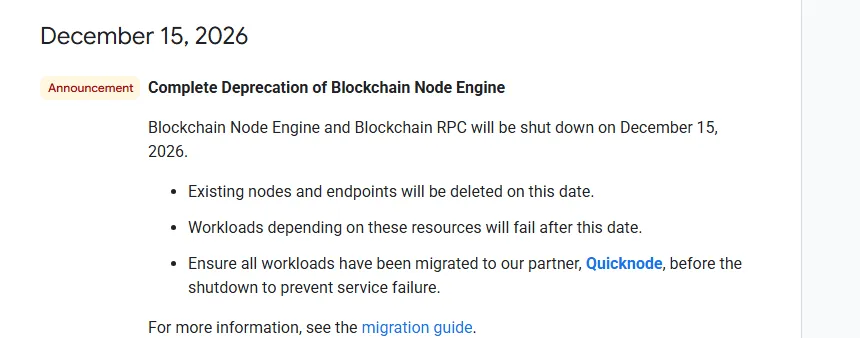
Google Cloud's release notes list the December 15 deprecation as an announcement.
The shutdown follows an earlier cut. On June 15, 2026, the same release notes moved the service into limited support. New node creation and new RPC endpoint provisioning were switched off, while existing ones kept running and receiving critical updates.
The history shows how quiet the product had become. Its release notes list a Solana node option from November 2023 and hard fork upgrades for Ethereum and Polygon in early 2024. After the March 19, 2024 Polygon update there is no entry until the June 2026 notice.
Blockchain RPC was still labeled a Preview product on its overview page. Ethereum was its first supported chain, and the free tier allowed up to 100 requests per second. Under Google's terms, Preview services may come with limited support.
How To Move Off Blockchain Node Engine
Google's migration guide for Blockchain Node Engine customers runs only a few lines. Teams stand up nodes or endpoints at Quicknode, either from its Google Cloud marketplace listing or on its own platform, and repoint their applications at the new URLs. Testing and cleanup of the old resources come after that.
Deletion works differently for each product. Customers must remove their own Blockchain Node Engine nodes in the Google Cloud console, while Google deletes Blockchain RPC endpoints itself on December 15. The marketplace route carries incentives, according to the guide, and customers are told to ask their Google sales representative for details. Quicknode's own migration page adds that billing can stay on Google Cloud Marketplace.
Quicknode says most teams are running in under an hour and that it covers every chain offered on the Google product, plus 75 more. Both are vendor claims that this site has not tested. Google's guide stays silent on node data, snapshots and custom settings after deletion, and offers no price comparison. Anyone running archive or validator-adjacent setups should ask Google and Quicknode directly before the date arrives.
What Teams Running Managed Nodes Should Check
Plenty of wallets and dashboards never run a node of their own and simply rent access. When the provider leaves, they inherit its calendar. The first signal came on June 15, when Google moved the product into limited support, so the runway to December 15 is long for a forced migration.
Grep your repositories, environment files and scheduled jobs for the Google hostnames. Staging services and old cron jobs are the ones people forget, and they break first.
Swapping a URL takes minutes. The harder questions are request limits, supported methods and price on the new side. The guide lists deletion last so the old nodes can stay up until traffic runs clean.
Solana's new settlement program for banks shows where demand is heading. Institutional pipelines run on node access, and Google has now handed that part of the stack to a specialist.
Nothing here is investment advice. Dates and steps come from Google Cloud's pages, so read them again before you change a production system.
Written by
Samiran is a well-known crypto writer and founder of Pressefy and News Coverage Agency, and a contributor at Hackernoon. He covers the crypto and blockchain industry with a focus on emerging projects, market trends, and the business side of Web3.
View full profile →Related News

Binance Stock Perpetuals Reach 217 Contracts, 24% Of Volume
Binance added McDonald's, Akamai, Viking Therapeutics and StablecoinX perpetuals on October 6. Exchange data shows how many TradFi contracts it now lists.

OKX Money Offers Up To 10% On USDG, With Tiers And Few Details
OKX Money offers up to 10% APY on eligible USDG. Here is what OKX, the USDG issuer and a spokesperson say about tiers, markets and what is unpublished.

Grayscale Hyperliquid ETF Adds BitGo As Second Custodian
An October 5 filing is about custody, not a new fund. Grayscale added BitGo beside Anchorage Digital for HYPG, which has traded on Nasdaq since June.