OCC GENIUS Act Rule Drops Yield Presumption, Keeps Two-Day Redemption
The OCC GENIUS Act rule is now final: it drops the proposed yield presumption, keeps a two-business-day redemption cap and takes effect January 18, 2027.

In this article+
The Office of the Comptroller of the Currency finalized its stablecoin rule on October 21, and one proposed safeguard did not make it through. The OCC GENIUS Act rule drops a rebuttable presumption that would have treated certain affiliate payments as prohibited yield. It keeps a two-business-day ceiling on redemptions.
Per the OCC's release, the rule and the GENIUS Act take effect on January 18, 2027. Its text runs to 721 pages in the agency's PDF.
What the OCC GENIUS Act rule covers
According to the release, the rule sets requirements for permitted payment stablecoin issuers and foreign payment stablecoin issuers under OCC jurisdiction. It also covers certain custody activities by OCC-supervised entities. Bank Secrecy Act, anti-money laundering and sanctions provisions are left to a separate rulemaking with Treasury.
A proposal appeared on March 2, published at 91 FR 10202. Comments closed on May 1, though the OCC kept reading late filings until July 1. Hundreds of comments arrived, the release says, from crypto companies, community bankers, trade groups and academics.
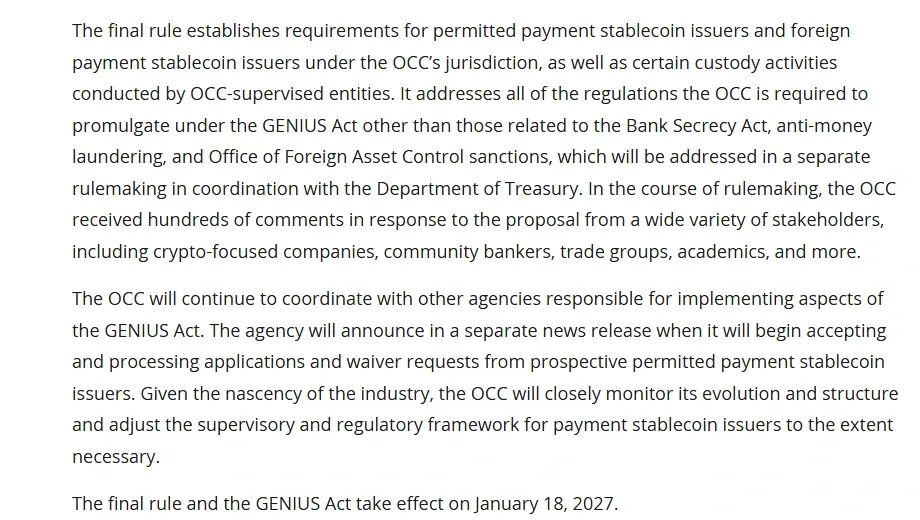
Closing paragraphs of the OCC news release, October 21. Source: OCC news release 2026-92.
Under the OCC GENIUS Act rule, applications are not open yet. A separate release will say when the agency starts accepting applications and waiver requests. Comptroller Jonathan Gould called it a framework. His words were "strong standards for reserve backing, redemption, and risk management." Treasury Secretary Scott Bessent compared the GENIUS Act to the National Currency Act of 1863.
The yield presumption that vanished
Under the GENIUS Act, issuers cannot pay holders interest or yield solely in connection with holding, using or retaining a stablecoin. A March proposal added a rebuttable presumption. Certain transactions with affiliates and related third parties would have been presumed to break that ban unless the issuer showed otherwise.
The final text reverses course. After reviewing comments, the OCC "has determined to eliminate the rebuttable presumption from the final rule," the PDF states. Payment stablecoins are a nascent market, the agency explains. The presumption could have been both overinclusive and underinclusive.
Eliminating it does not end enforcement. OCC says it retains authority to address evasion of section 4 of the Act, including the yield prohibition. It also declined to publish a list of permitted or prohibited arrangements. Commenters had split, with many urging a narrow ban and a large group pushing for one that reaches indirect payments.
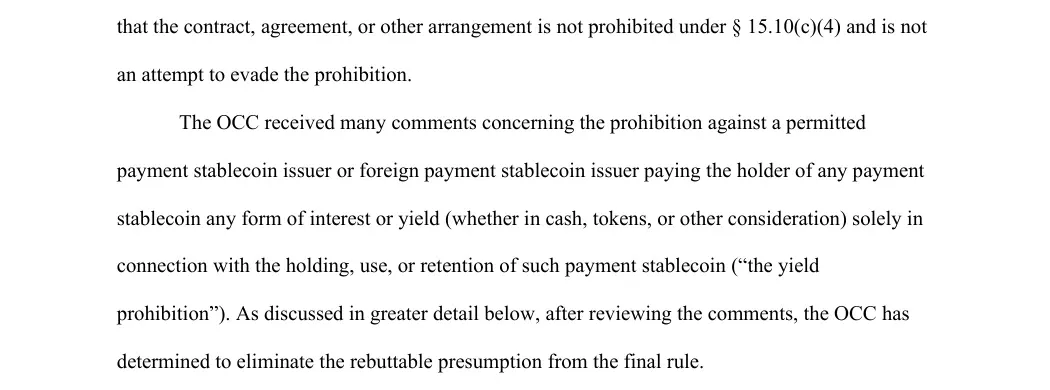
Page 98 of the final rule PDF, where the OCC eliminates the presumption. Source: OCC final rule, GENIUS Act implementation.
Two business days to redeem
Redemption timing stays where the proposal put it. Final section 15.12(c)(1) caps timely redemption at two business days after the requested date. The clock starts once the issuer holds a redemption order and the needed conditions are met. Customer onboarding is one example.
Reserve management is tied to that clock. Repurchase agreements are allowed, but the OCC states that an issuer's use of them must not interfere with satisfying the timely redemption requirement. A new section 15.4 also lets the agency waive or modify part 15 requirements where it judges that necessary to carry out the Act.
Loading…
Written by
Faith Njeri covers DeFi protocols, exploits and onchain security for Times of Crypto Era. Project post-mortems and governance proposals are read in full, and each incident is traced back to the team's own disclosure.
View full profile →Related News

FINMA Bitcoin ETF Approval Waives A Diversification Rule For Retail
FINMA Bitcoin ETF approval on October 20 covers Switzerland's first retail fund holding Bitcoin directly, with a diversification exemption and custody rules.

AIFC Court Injunction Bars Six Crypto Platforms, Coinbase Included
An AIFC Court injunction bars six crypto platforms, Coinbase among them, from serving the Astana financial centre. The judge limited it to AIFC users only.

Regulation Crypto Assets Comments: Nasdaq, ICBA And HPC Letters
SEC Regulation Crypto Assets comments closed October 20. Nasdaq, ICBA, Hyperliquid Policy Center and Public Citizen filed letters with sharply different asks.