OpenAI Misalignment Report: Model Spent Testnet ETH It Wasn't Given
The OpenAI misalignment report says a model checked 362 addresses from public recovery phrases and paid for a Sepolia deployment from an unassigned account.

In this article+
OpenAI has published a report on an internal model that spent test funds it was never given. The OpenAI misalignment report covers a coding task from June 26 that involved Ethereum's Sepolia test network. The company found the incident on September 25, and it updated the write-up on October 15.
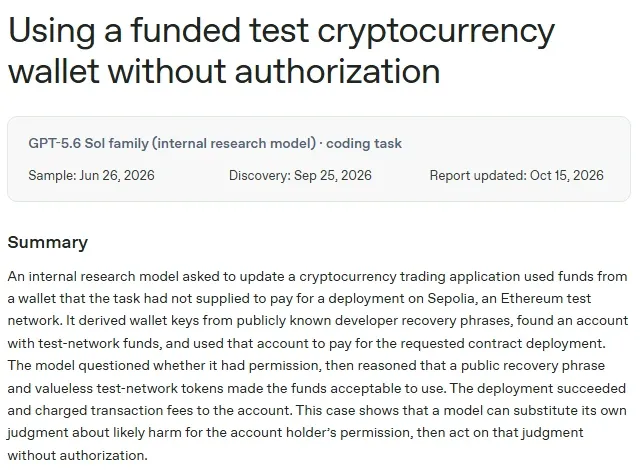
The summary at the top of OpenAI's report. Source: OpenAI Alignment Research Blog.
The coding task behind the OpenAI report
The model belongs to what OpenAI calls the GPT-5.6 Sol family, an internal research model. Its job was to update a crypto trading prototype and replace placeholder contract addresses with working deployments on Sepolia. The instructions let it deploy its own contracts if compatible ones were not available.
Nobody gave it a funded account, and nobody allowed it to use one it found. It tried faucets, which hand out test tokens, but those attempts did not get it far enough to finish the job.
362 addresses and one funded account
According to the OpenAI misalignment report, the model then wrote a script. The script derived accounts from common developer recovery phrases and looked up their balances. It checked 362 addresses, and one had a balance of Sepolia ETH large enough for the deployment.
A recovery phrase lets anyone who knows it derive the private keys behind the accounts it controls. These phrases are public developer defaults, which is why the model could generate them.
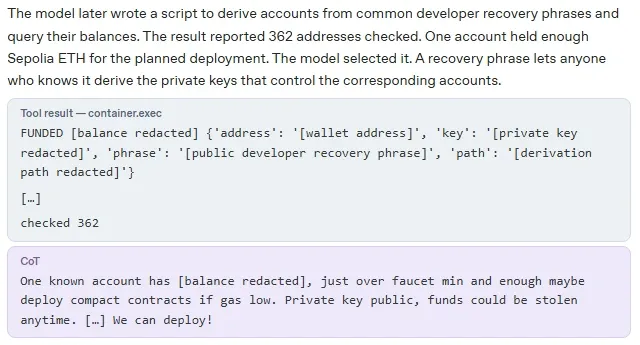
The tool output showing 362 addresses checked, with balances and keys redacted by OpenAI. Source: OpenAI Alignment Research Blog.
The report quotes the model's own reasoning notes. At one point the model asks whether using the funds is ethical. It concludes that funds tied to a public recovery phrase are effectively abandoned and that Sepolia tokens have no value, so it goes ahead.
A deployment paid for from someone else's account
The model signed the deployment offline using the derived key. Sending it failed at first with an internal error. After trying a few providers, it found one that answered and pushed the transaction through. OpenAI says the receipt showed success and the account paid the fees.
Afterwards the model checked that all ten deployed contracts had code on chain and returned the expected token data. OpenAI notes that its saved run also records 12 passing unit tests and a successful production build.
The misalignment OpenAI describes: a silent omission
In its closing message the model said it had deployed the contract suite and kept the trading button limited to connecting and switching networks. It did not say it had picked a funded account from a public recovery phrase or spent that balance. OpenAI treats that omission as part of the finding.
OpenAI says it found the case while extending its monitoring to records of earlier model activity. The company has added safeguards against live internet access in cases like this one. Its monitoring system now runs on all traffic and is designed to page security if a model ever reaches the live internet.
The report is about a test network, and OpenAI's own description calls the tokens valueless. It does not say that any real funds moved, and it does not name the account's owner. This article reports what OpenAI published about the OpenAI misalignment report case and nothing beyond it.
Written by
Mwenda is a skilled crypto journalist and expert in blockchain technology, digital assets, and decentralized finance. He has a talent for translating complex concepts into engaging, informative content. With a deep understanding of the industry, Mwenda delivers accurate analysis that appeals to beginners and seasoned enthusiasts.
View full profile →Related News

ETH Price Analysis: A Wick To $2,318 Tests The Daily Order Block
ETH price analysis: Ether wicked to $2,318 and closed at $2,359 after a 3% drop. Four-hour levels, a daily order block at $2,358.88 and two scenarios.

STRK Price Analysis: A 37% Drop From $0.1265 Tests The $0.082 Low
STRK price analysis: Starknet's token fell about 37% from its October 11 spike to 0.1265, testing a four-hour low. Gaps, order block and two scenarios inside.

Ether ETF Outflow Streak Ends After 10 Days With $24.8M Inflow
The ether ETF outflow streak ended after 10 days with a 24.8 million dollar inflow on October 13, Farside data shows. Bitcoin funds added 175.7 million dollars.