Osmosis Validator Set Vote: 70 To 30 Seats, Fee Split Changes
The Osmosis validator set could shrink from 70 to 30 and community pool fees could go to stakers. See both proposals, the live tally and what changes.

In this article+
Osmosis holders have until October 14 to settle two questions that change who gets paid and who gets to validate. One proposal would cut the Osmosis validator set from 70 seats to 30. The other would send the community pool's slice of trading fees to stakers instead. Both opened for voting on October 9 and both lead by a wide margin on the chain's own tally.
Proposal 1051 and the Osmosis validator set
Proposal 1051 changes a single staking parameter, setting the maximum number of active validators to 30. It follows two earlier cuts, from 120 to 100 in proposal 976 and then to 70 in proposal 1017. The author says Osmosis is refocusing on a secure venue for cross-chain liquidity and wants fewer operators sharing the revenue. The text names Cosmostation, Informal Systems, Forbole, Nansen and Sentinel as validators that stopped operating on Osmosis this year.
The decentralisation trade-off for the Osmosis validator set is spelled out in the proposal itself. Today five validators together hold a third of the stake, and with a 30-seat set that would be four. Seventeen validators hold two thirds now, against thirteen after the change.
Validators outside the top 30 would lose their seats. The proposal puts their combined stake at about 20.6 million OSMO. A read of the chain's validator list on October 13 gives a slightly smaller figure, near 19.6 million OSMO or 11.5% of everything bonded. Delegators there stop earning rewards when the change executes, but they can move to an active validator at any time with no unbonding wait.
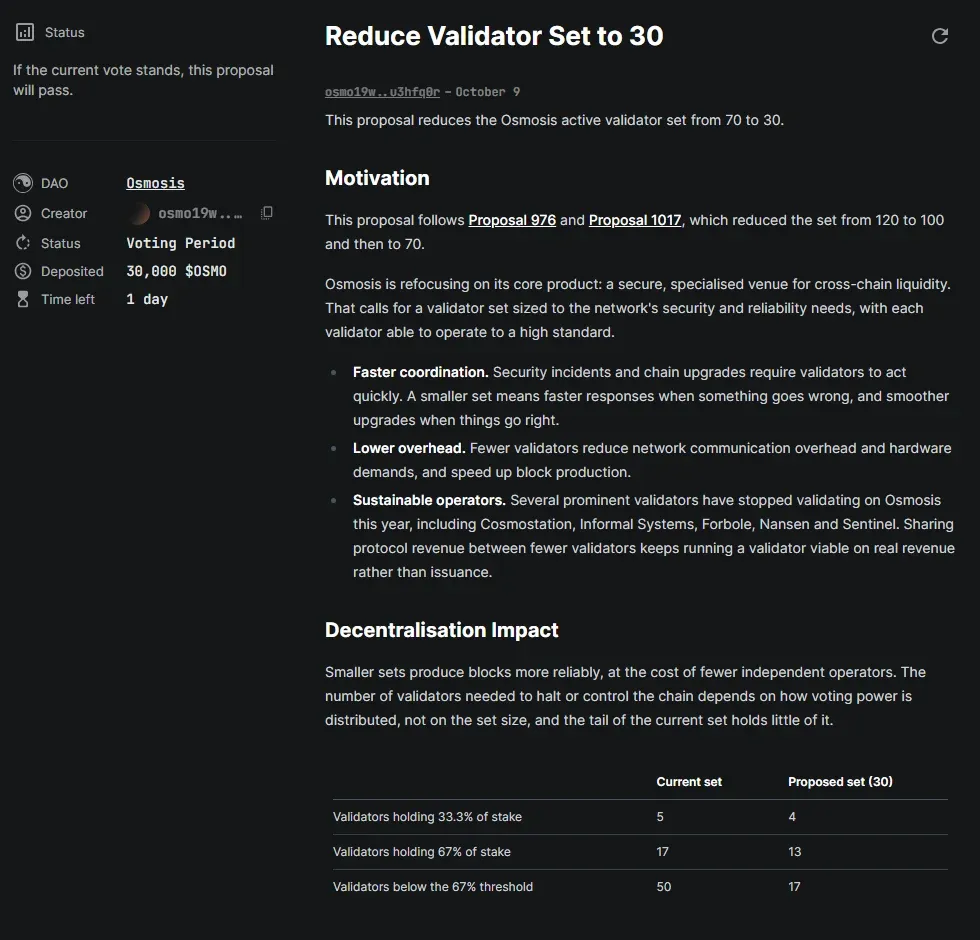
DAO DAO's page for proposal 1051, showing the proposal text and the status line that the vote would pass as it stands. Source: DAO DAO.
Proposal 1052 and the taker fee split
Proposal 1052 deals with fees that Osmosis collects in tokens other than OSMO. Today 22.5% goes to stakers, 25% goes to the community pool and 52.5% is bought back and burned. The new split would give stakers 47.5% and the community pool nothing, with the burn share left at 52.5%. Fees paid in OSMO keep their existing split of 30% to stakers and 70% burned.
The reasoning is that the community pool's reserve already exists. The proposal says the DAO holds about $1.8 million in non-OSMO assets, mostly USDC and BTC. That is after setting aside BTC committed to restore Alloyed BTC's backing. It estimates stakers would receive about 8,300 OSMO a day extra at recent volumes, or roughly 1.7 percentage points of staking yield.
The community pool still earns from other sources, including ProtoRev, the Top of Block Auction and pool creation fees. Only the taker fee flow would change.
Where the vote stands
A request to the tally endpoint of an Osmosis node on October 13 showed both proposals well ahead. On proposal 1052, roughly 75 million OSMO had voted yes while only about 31,000 had voted no. Proposal 1051 was less one-sided, with about 50.7 million yes against 5.3 million no. About 8 million OSMO sat in abstain on each.
With around 170 million OSMO bonded and a quorum of 30%, turnout is near half on 1052 and a little under 40% on 1051. Voting stays open until October 14, and a passed proposal executes on-chain by itself, so a smaller Osmosis validator set would need no further step.
The token has been moving as well. OSMO traded about 38% higher over 24 hours to $0.0505 on Binance, on roughly $9 million of volume. Neither proposal mentions price, and this article does not link the two.
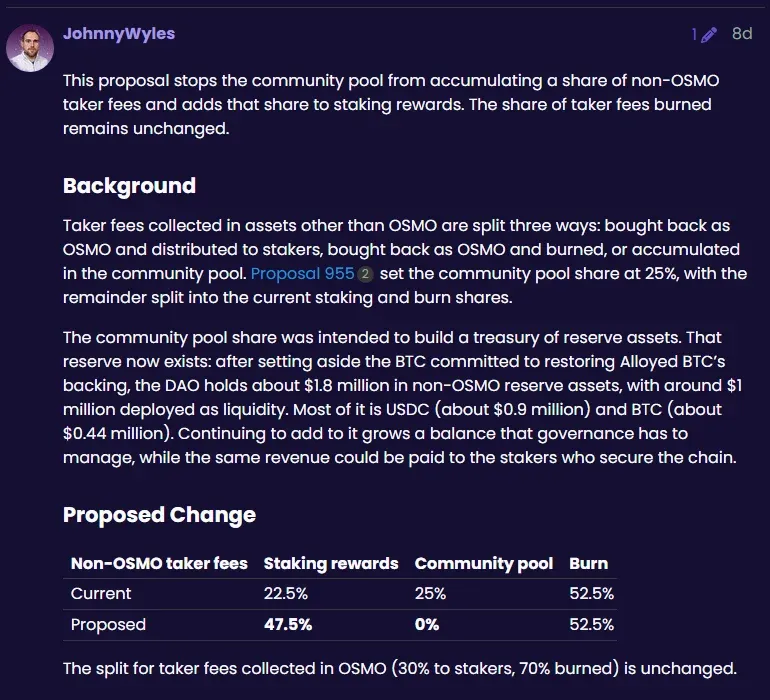
The forum thread for proposal 1052, with the current and proposed fee tables. Source: Osmosis forum.
Written by
Faith Njeri covers DeFi protocols, exploits and onchain security for Times of Crypto Era. Project post-mortems and governance proposals are read in full, and each incident is traced back to the team's own disclosure.
View full profile →Related News

GTC Price Analysis: Upbit Listing Spike Hits $0.393 Then Fades
GTC price analysis after the Upbit listing: an hourly spike to $0.393 on $9.5M volume, the fair value gap it left, and two scenarios with clear triggers.

Blur Frontend Shutdown Set For November 12, BLUR Falls 30%
The Blur frontend shutdown is set for November 12, 2026. See what happens to Blend loans, how BLUR traded after the post, and what the lending data shows.

Aptos Encrypted Mempool Is Live On Mainnet, Hides Payloads Only
The Aptos encrypted mempool is live on mainnet as an opt-in feature. See what AIP-144 hides, what it costs in gas, and what stays visible to everyone.