South Korea's FSC Unveils Roadmap to Put Stocks, Bonds and Funds Onchain
South Korea's Financial Services Commission published a three-phase roadmap to tokenize stocks, bonds and funds starting February 2027, confirmed directly via the regulator's own press release.

In this article+
South Korea's financial regulator just put a real date on tokenized securities. The Financial Services Commission confirmed a three-phase plan to bring conventional securities onto distributed ledger infrastructure, starting February 2027.
Cointelegraph first surfaced the story for crypto audiences. It described South Korea as moving its capital-markets infrastructure onchain, letting stocks, bonds and funds be issued, traded and settled digitally. The core claim traces back to an actual government document. The FSC's own press release, published September 4 on its official site, confirms the plan in detail. It includes specific dates, dollar caps and legal citations.
What the FSC Actually Announced
The regulator held its third private-public consultative meeting on securities tokenization and laid out what it calls key policy directions. A three-phase roadmap was adopted for securities firms and the Korea Securities Depository to build out tokenized issuance infrastructure together.
Phase one begins February 4, 2027, the date an amendment to South Korea's Electronic Registration Act takes effect. That law change legally recognizes security tokens as a digitized form of securities for the first time. The initial phase covers privately pooled money market funds, institutional bonds, unlisted stocks through trust structures, and publicly offered fractional investment products.
Phase two widens the scope to every publicly offered security type. Phase three aims to build onchain payment rails linked to stablecoins, letting investors settle tokenized trades without leaving the blockchain layer. The FSC was explicit that phases two and three stay flexible, depending on how phase one performs and how stablecoin legislation develops.
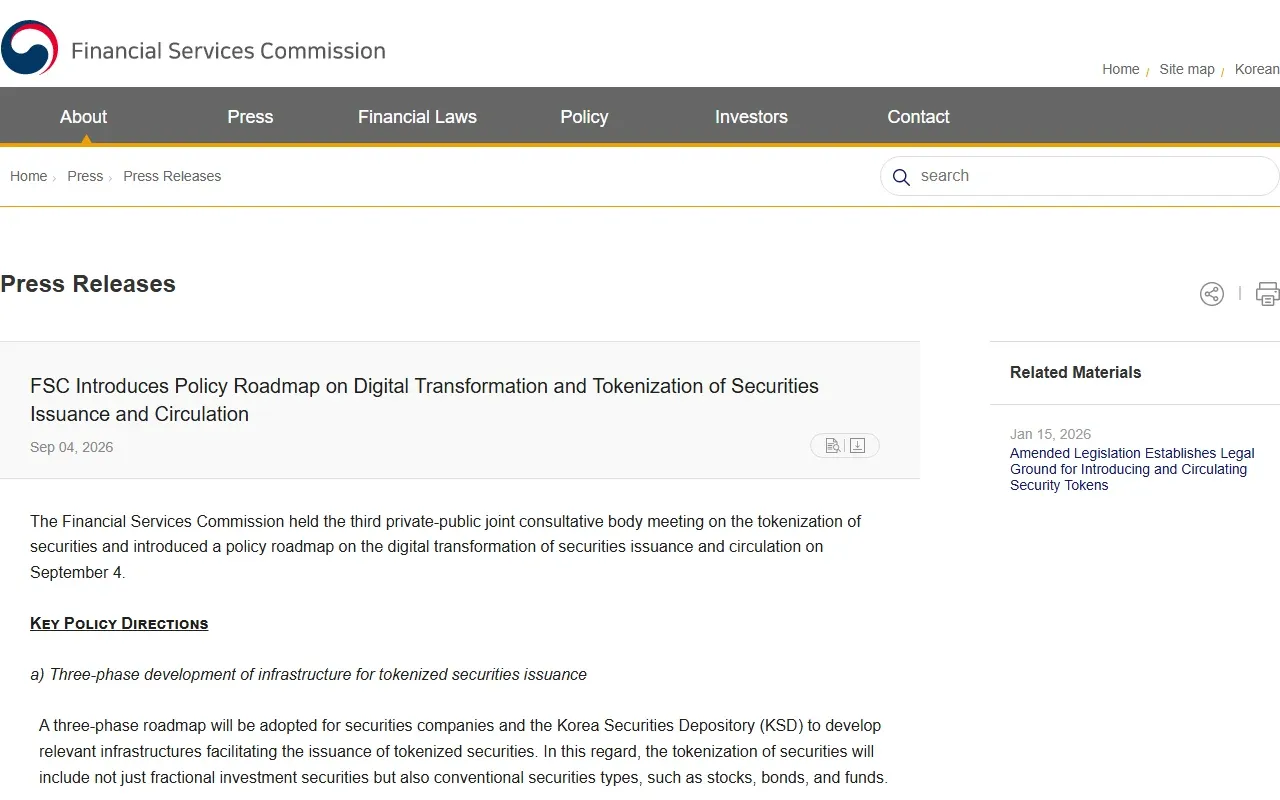
South Korea's Financial Services Commission press release on its tokenized securities roadmap, screenshotted October 15, 2026.
Guardrails Built Into the Plan
Retail investor protection shows up throughout the document. Individual subscriptions to fractional offerings are capped at the smaller of roughly 30 million won, about $22,000, or 5% of total issuance volume. Entities that manage tokenized securities accounts for customers will need at least 4 billion won in equity capital and dedicated IT and cybersecurity staff.
The Korea Securities Depository is also preparing formal screening criteria for the distributed ledger systems securities firms plan to connect to its registry. That includes contingency planning for system outages, a requirement any serious financial infrastructure needs before institutional money moves through it.
Where Avalanche Fits, and Where It Doesn't Yet
Cointelegraph's post specifically named Avalanche as the chain underpinning this shift. That detail does not appear anywhere in the FSC's own press release, which stays deliberately chain-agnostic throughout. The Korea Securities Depository has separately been reported as hiring Samsung SDS to build the actual tokenized securities platform. That detail is not mentioned in the FSC document either.
What is independently verifiable is that Avalanche has real, growing footprint in Korean finance already. Mirae Asset Global Investments, the country's largest asset manager, signed an MOU with Ava Labs to explore tokenized funds on Avalanche. That deal is documented on Avalanche's own company blog. Whether that relationship extends into the FSC's national roadmap remains an open question the primary source does not answer yet.
A Regulator Moving Deliberately
What stands out is the caution baked into the timeline. Legislation needs to take effect first. Infrastructure needs building second. Only then does actual tokenization begin, with the riskiest phase, stablecoin-linked settlement, held for last. The FSC plans to publish detailed subordinate legislation by the end of September.
This article discusses tokenized securities and blockchain infrastructure that could affect crypto asset prices. Cryptocurrency and securities markets are volatile and this is not financial advice. Always do independent research before making investment decisions.
Written by
Mwenda is a skilled crypto journalist and expert in blockchain technology, digital assets, and decentralized finance. He has a talent for translating complex concepts into engaging, informative content. With a deep understanding of the industry, Mwenda delivers accurate analysis that appeals to beginners and seasoned enthusiasts.
View full profile →Related News

ASIC Digital Asset Rules Consultation Runs Until November 27
The ASIC digital asset rules draft opened on October 15. Platforms and custody firms have until November 27 to respond, and the new laws start April 8, 2027.

VanEck Lido ETF Withdrawal Comes 363 Days After The S-1
VanEck asked the SEC on October 14 to withdraw its Lido staked ether trust after 363 days. The VanEck Lido ETF letter, what it says and what it does not say.

USDC MiCA Status: EU's First Significant E-Money Token
USDC MiCA status is now official: the EBA named it the first significant e-money token on October 14, and from November 12 it takes over key duties from France.