Spark Risk Curation Vote: Curators Could Cut Risk Without A Poll
Spark risk curation vote SAEP-24 would let curators cut caps without a poll. It runs to October 22 beside a ratification of a Safe that differed from its poll.

In this article+
A Spark governance vote could let risk managers cut exposure without waiting for a poll. The Spark risk curation proposal, SAEP-24, went to a Snapshot vote on October 19 and runs until October 22 at 16:16 UTC. It sits next to two other Spark votes opened in the same minutes.
What the Spark risk curation vote changes
SAEP-24 comes from Phoenix Labs, a nested contributor to Spark. It amends the Spark Risk Curation Framework in four ways. Curators would get standing approval for a closed list of actions that only lower risk, namely cutting a cap, removing an account from a role that can allocate funds, and cancelling a pending change.
Today every change a curator makes needs a poll first. The proposal says that rule forces a curator to wait even when exposure to a weakening market should shrink fast. A cut made by mistake costs some yield or idle liquidity, while a cut made late can cost depositors a loss.
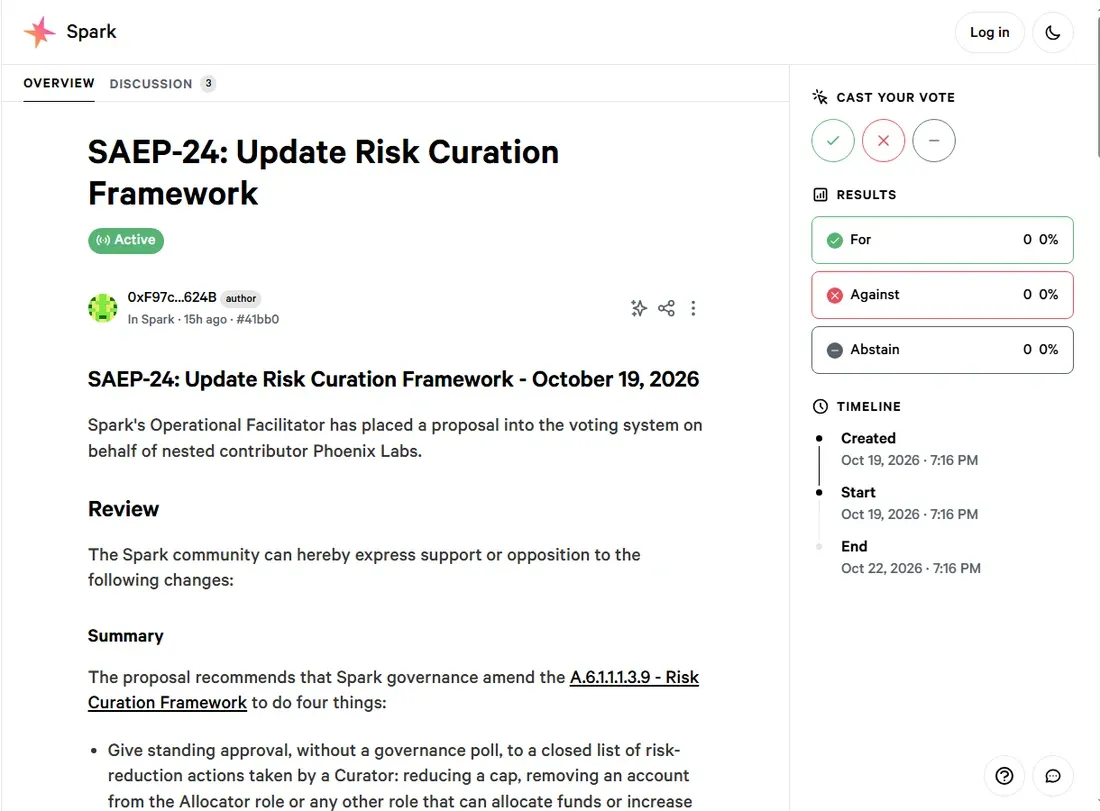
The SAEP-24 vote page on Snapshot, opened October 19 with no votes cast yet. Source: Snapshot, Spark space.
Limits inside the Spark risk curation text
The list is closed on purpose. Raising a timelock is left out because a longer timelock would also delay the next cut. Removing a guardian or sentinel is left out too, since those holders exist to cancel changes or reduce exposure. Anything bundled with a listed action still needs a poll.
Every risk-reduction action would be reported within 24 hours, naming which listed action was used, and it could be reversed through a normal poll. A holder of cancellation powers could cut a cap or move funds out only for reasons the framework already recognises. The proposal does not change any contract, timelock value or cap value on chain. Phoenix Labs first posted the text in the Spark Prime category of the Sky forum on October 16, and it moved to Snapshot three days later.
Timelocks and a retired Spark vault
The text also settles a clash with Sky's rules. The framework sets a three-day minimum timelock, but Sky requires no delay for allocator changes and the force-deallocate penalty. Under SAEP-24 the Sky requirement wins for every Morpho vault function it covers. We reported on the matching technical vote in our earlier Spark piece.
SAEP-24 also removes the Spark USDS Morpho Vault from the approved list. The proposal says the Spark Liquidity Layer can no longer deposit into or withdraw from it, with a leftover balance of about 22 USDS that would cost more to recover than it returns.
A Spark Safe that did not match its poll
The third vote asks Spark to ratify its curator Safe. A rotation polled on October 5 and executed on October 13 left the curator Safe set up differently from what the poll described. The poll said two signers matched a Soter Labs Safe. What was deployed is a 2-of-2 between a Spark Safe and a Soter Labs Safe.
Phoenix Labs says the executed setup is what Spark and Soter Labs agreed and meets the curator requirement. SAEP-24 depends on that ratification passing, because it corrects the curator named for three vault records.
Both outcomes are open until the votes close. Any change to the Spark risk curation framework would then be written into the Sky Atlas through a pull request. and the Snapshot page shows zero votes at the time of writing. Votes pass on more than 50% of ballots cast, excluding abstentions.
Loading…
Written by
Faith Njeri covers DeFi protocols, exploits and onchain security for Times of Crypto Era. Project post-mortems and governance proposals are read in full, and each incident is traced back to the team's own disclosure.
View full profile →Related News

Phala Cloud Attack: Post-Mortem Shows 17.5 Hours Before Detection
Phala Cloud attack post-mortem: attacker read some customers' logs and secrets for hours before detection. Here is what Phala says was and wasn't reached.

OSMO Price Analysis: A $0.0649 Sweep Fades On A 138M-Token Day
OSMO price analysis: a $0.0649 sweep on October 19 faded to $0.0543 on 138.4M tokens. Levels, two Osmosis votes and four-hour scenarios for the next move.

Visa Mesh Stablecoin Spending: 175M Locations, But No Launch Date
Visa Mesh stablecoin spending would reach 175 million merchants, per Mesh's October 19 release. No platform, launch date or device list has been named yet.