Ajna V2 Loses $775K As Oracleless Lending Protocol Gets Drained
Ajna v2 lost roughly $775,400 across seven Ethereum pools after an attacker exploited internal liquidation accounting, not an oracle. With no governance, the immutable protocol's only response was to ask users to withdraw.

In this article+
Ajna v2 lost roughly $775,400 across seven Ethereum pools this week, and the protocol's own design made this exploit unusual. Ajna runs without any price oracle at all.
The Team's Warning
Ajna's official account posted the warning at 7:58 AM UTC on August 29. “Ajna v2 is aware of an exploit and is investigating unusual movements,” the team wrote. “Please withdraw all funds, repay loans, and refrain from interacting with the protocol.”
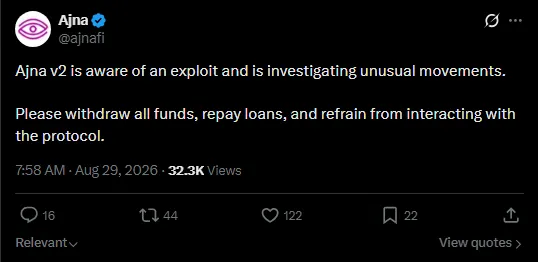
Ajna's official X post confirming the exploit, screenshotted Aug 29, 2026.
That blunt instruction is not just caution. Ajna v2 is immutable and has no governance, so a live code patch is not an option. Asking users to exit is the only response tool the design leaves the team.
Attack contracts were deployed around 15:16 UTC on August 28. The first extraction landed roughly an hour later on the cbETH pool, in block 25854888.
The losses split unevenly across seven paired-collateral markets. The syrupUSDC pool absorbed the largest hit at $173,700, followed by wstETH at $159,800. rETH lost $127,400 plus a second extraction of $15,600, and cbETH lost $124,800 plus $12,100 across two separate transactions.
WBTC saw $101,800 walk out, WETH/USDC lost $42,000, and sDAI closed the list at $18,000. Every affected pool paired one collateral type against a single asset. No stablecoin-only or exotic-collateral pool appeared on the loss table.
How Ajna Works
Ajna's pitch has always been oracleless price discovery. Lenders deposit into discrete price buckets. Liquidations then run through internal primitives called kick, take, bucketTake, and settle. Those reference the pool's own Lowest Utilized Price rather than an external feed like Chainlink or Pyth.
There is nothing external to spoof. But the internal accounting has to hold up against manipulation from within a single transaction, and this week it did not.
Inside The cbETH Extraction
On the reconstructed cbETH transaction, the attacker flash-loaned WETH from Balancer. They called bucketTake on a sitting auction, then removeCollateral to pull tokens against freshly minted LP. A follow-on settle call with zero quote repaid let roughly 46.5 cbETH leave the pool on that single step. The Balancer loan got repaid, and the attacker kept the collateral.
Two Theories, No Answer Yet
Independent researchers have not reconciled on a single root cause yet. One theory holds the attacker simply harvested an auction that was already sitting underpriced on the book. A competing theory argues the attacker manufactured the setup in one atomic transaction. That opened a liquidation against a position made to look undervalued at that exact instant.
Security firm Defimon said its detection stack flagged the prepared attack more than an hour before the first exploit transaction landed. A Discord alert sent to the Ajna team, Defimon said, went unactioned. The firm published the full pool-by-pool breakdown several hours after the team's own public acknowledgment.
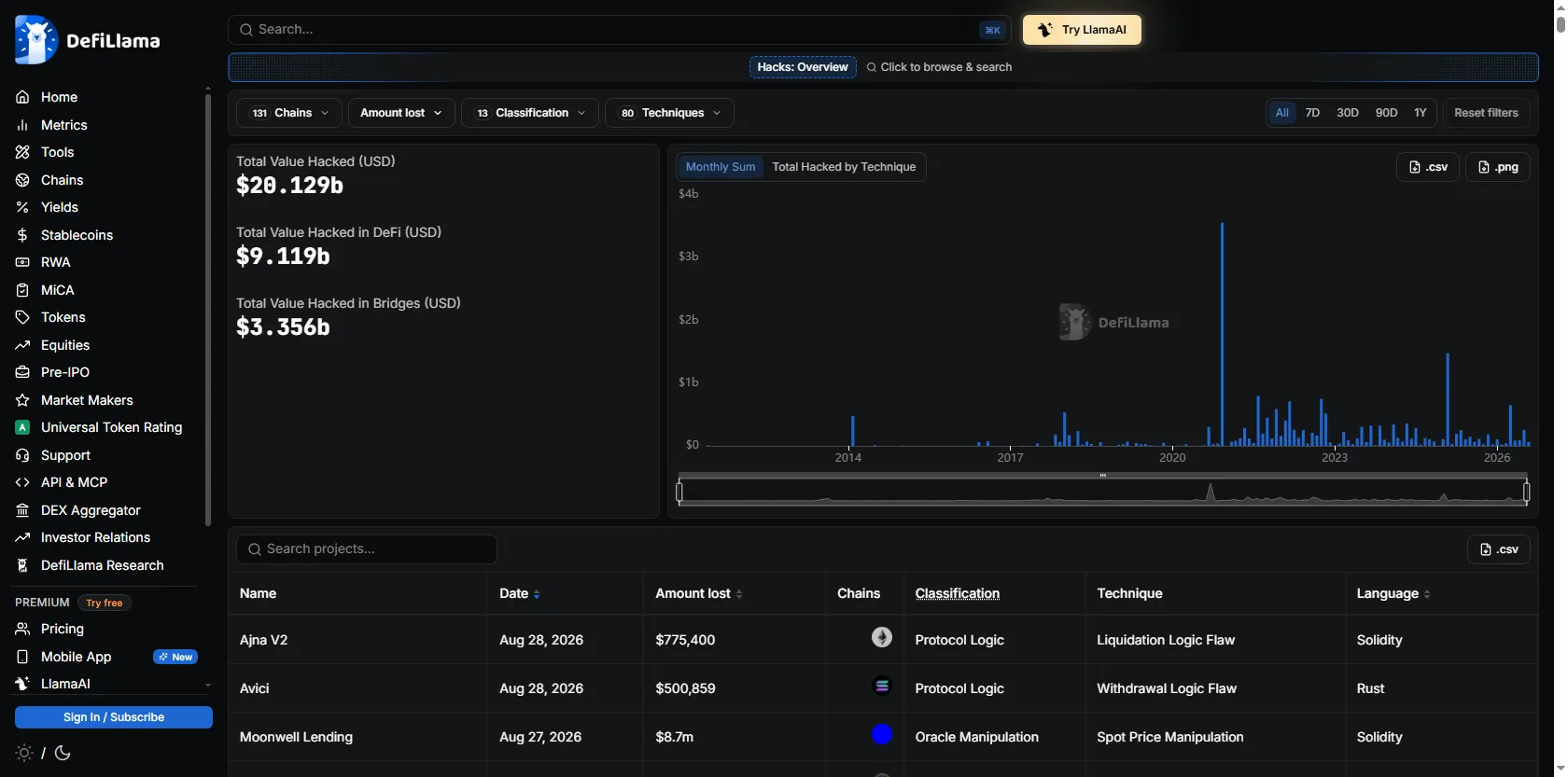
The Ajna V2 entry on DeFiLlama's hacks tracker, screenshotted Aug 29, 2026.
Not Ajna's First Warning
Older audit literature had already flagged risk in this general neighborhood. Ajna's own audit repository contains prior findings on spurious kicks and LUP manipulation through quote-token removal. Those are categories of risk, not proof this exact 2026 exploit chain repeats any single earlier bug.
Ajna has been here before. In 2023, the team asked users to withdraw funds after spotting a potential exploit path in the pre-v2 version. That earlier warning reads strikingly similar in tone to this week's statement.
DeFiLlama's own hacks tracker classifies the incident as a liquidation logic flaw under the broader protocol logic category. It sits alongside a run of smaller exploits across multiple chains this same week. As of publication, no funds have been returned. No official post-mortem has confirmed which of the two competing theories is correct.
Written by
Samiran is a well-known crypto writer and founder of Pressefy and News Coverage Agency, and a contributor at Hackernoon. He covers the crypto and blockchain industry with a focus on emerging projects, market trends, and the business side of Web3.
View full profile →Related News

Bitfinex ETH Longs Reach 283K, The Highest Since August 2022
Bitfinex ETH longs jumped from 96K to 304K in two days and sit near 283.5K, the highest since August 2022. See the sampled data and the price backdrop.

STRK Price Doubles In Three Sessions After Starknet L1 Question
STRK price more than doubled in three sessions after StarkWare CEO asked if Starknet should become a layer 1. See the chart, volume, unlock date and caveats.

Binance ETH Reserves Hit A Six-Month Low As Withdrawals Spike
Binance ETH reserves fell to 3.47M ETH, a six-month low, as CryptoQuant counts a record 320,000 withdrawals on Oct 6. See the data next to ETF outflows.