Binance Hack Seizure: DOJ Gets Court Order For $1.2B
Binance hack seizure: DOJ got court authorization to seize or restrain over $1.2 billion stolen by North Korea, part of $2.7 billion frozen, its release says.
In the Binance hack seizure announced by the Department of Justice on November 12, 2026, the department has obtained court authorization to seize or restrain in excess of $1.2 billion worth of cryptocurrency stolen from the exchange Binance. According to the department, this amount is part of more than $2.7 billion worth of cryptocurrency frozen to date involving all relevant parties. In other words, this Binance hack seizure is the court-approved portion of a larger freeze.
The press release, number 26-1356, identifies the culprits as North Korean military hackers identified as TraderTraitor by the Federal Bureau of Investigation (FBI). As per the announcement, the cybercriminals stole in excess of $6 billion worth of cryptocurrencies from the Binance exchange around October 29. Binance's own loss estimate is not mentioned in the press release.
What the Binance hack seizure figures measure
The notice separates two figures behind the Binance hack seizure. Joint governmental and private sector efforts have thus far frozen over $2.7 billion. Out of this total, the department has already obtained court approval to seize or restrain over $1.2 billion. Using simple math, the figure with court approval is about 44% of the frozen total, while the frozen total is about 45% of the total theft of $6 billion.
The above percentages are simply our calculation from the rounded figures given in the notice. These figures are not given in the notice. However, the notice cites the following statement by Assistant Attorney General A. Tysen Duva regarding the Criminal Division's involvement in halting "about half of this historic breach."
The offices that assisted in the interdiction of the assets were the National Security Division's National Security Cyber Section, the Criminal Division's Computer Crime and Intellectual Property Section, and the U.S. Attorney's Office for the District of Columbia. The release says that these offices worked alongside virtual asset service providers to interdict the stolen assets.
Laundering has not stopped
The department also adds that actions to track, freeze, seize, and forfeit the stolen assets are still in process. As per the department, the actors behind the crime are still using crypto bridge services, mixers, and exchanges for laundering of their stolen money. In that list of actions, the seizure and restraint action comes before the forfeiture action.
In the week preceding the announcement, the FBI along with the U.S. Secret Service and IRS-Criminal Investigation released a Cyber Alert that attributed the hack. In the alert, it is said that service providers should take steps to stop any transactions with or derived from addresses used by the actors involved in the laundering of the Binance funds. From the point of view of the compliance team of an exchange, this implies the addresses mentioned in the list.
Another case is announced within the same announcement. That is, according to the U.S. Attorney's Office for the Central District of California, the cloud infrastructure of a FaceStealer criminal syndicate has been disrupted. The FBI alleges that the syndicate has stolen more than $400 million worth of cryptocurrencies in the past 18 months. In addition, the FBI says agents seized over 900 videos from victim webcams.
It operates through video chats. Hackers send an invitation using an account compromised by the hackers previously, record the targeted person's webcam, and show the target a pre-recorded video of someone the target knows. They simulate a fake technical error and ask the target to fix it by clicking on the provided link, which installs malware. The FBI released a report and established fbi.gov/facestealer website for the victims.
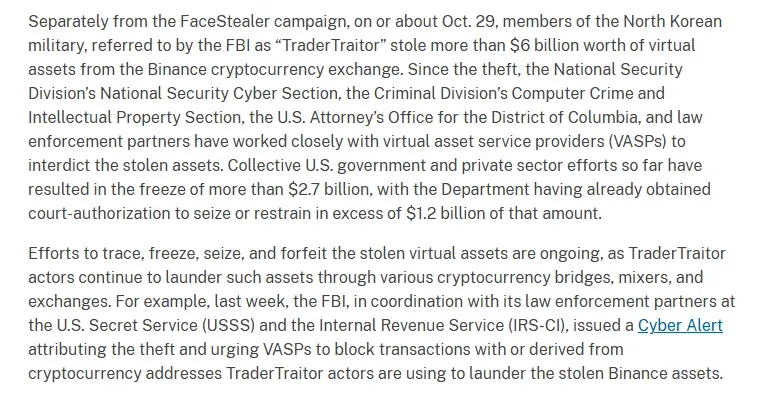
The Justice Department press release of November 12, 2026, showing the more than $2.7 billion freeze and the more than $1.2 billion court-authorized seizure or restraint. Source: U.S. Department of Justice, press release 26-1356.
Anyone can just visit the release on justice.gov to check the Binance hack seizure amounts that are listed there. The amounts mentioned above are the verbatim language used by the department itself, while the percentage is our own calculation.
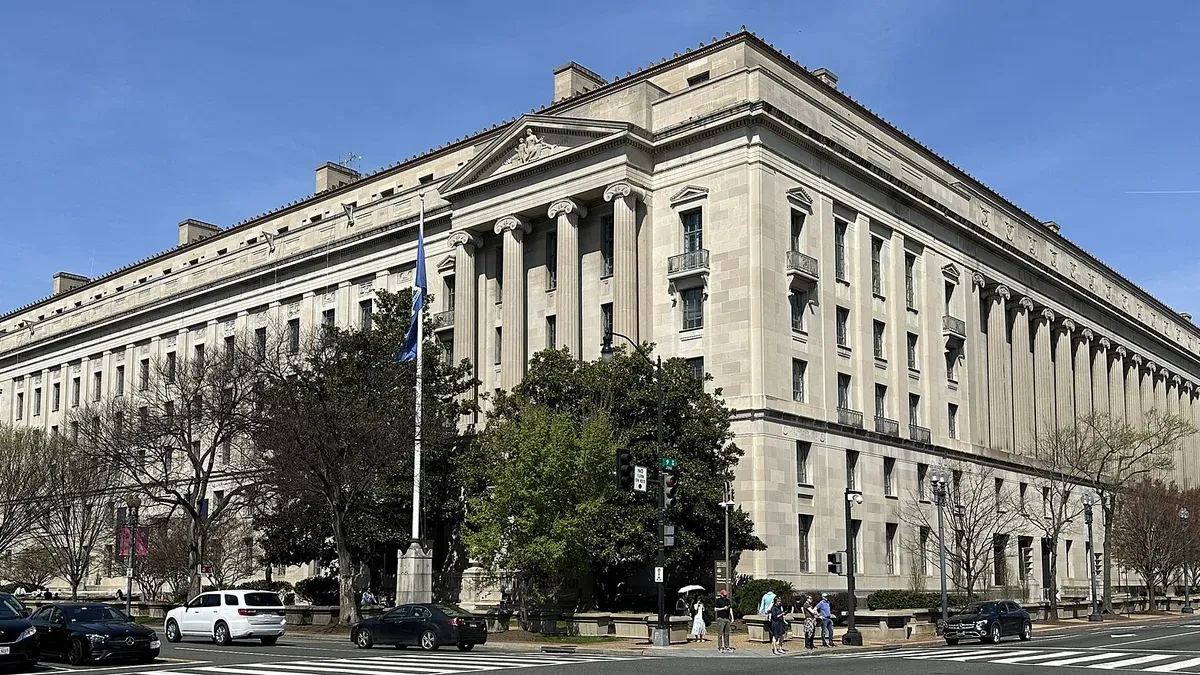
Featured image: Robert F. Kennedy Department of Justice Building by APK, licensed CC BY 4.0, via Wikimedia Commons.
Related News
Mashinsky Ban: New York Secures Up To $35M From Ex-Celsius CEO
The Mashinsky ban is permanent in New York, and the ex-Celsius CEO faces up to $35M in conditional payments. See what the attorney general's deal requires.
Qian Zhimin Bitcoin Case: High Court Applies Chinese Law
The Qian Zhimin Bitcoin case ruling says Chinese law governs victims' claims on 61,000 BTC. See what the High Court decided and what it left open for later.

BIS Chief Tells Jackson Hole: Stablecoins Are Not Real Money
BIS general manager Pablo Hernandez de Cos told the Jackson Hole symposium that stablecoins do not credibly function as money at scale, backing tokenized bank deposits instead.
USDC MiCA Status: EU's First Significant E-Money Token
USDC MiCA status is now official: the EBA named it the first significant e-money token on October 14, and from November 12 it takes over key duties from France.