PAXGy On Aave: LlamaRisk Backs Gold Vault, Flags Loan Risk
PAXGy on Aave: LlamaRisk backs a tokenized gold vault listing but flags borrower concentration and unverified loan statements. See the proposed limits.

In this article+
LlamaRisk, a risk adviser that assesses many Aave listings, has recommended putting PAXGy on Aave as collateral. PAXGy is a yield-bearing share over Pax Gold, a tokenized gold product. The assessment sits in a thread on the Aave governance forum and covers two placements on the Aave V4 Global Dollar Hub. It also says where the real risk sits, and that is not in the smart contracts.
What PAXGy on Aave would look like
PAXGy is an ERC-20 vault share, operated by Paxos Labs, that holds deposited PAXG and earns a return from lending that gold to institutions. The return shows up in the exchange rate, which stood at about 1.0017 PAXG per share in the report's October 8 data. As of that date 265.53 PAXGy were outstanding across Ethereum and X Layer.
LlamaRisk proposes two spokes. The first is the existing Gold Spoke, borrowing USDG against PAXGy at a 70% collateral factor and a 7.50% maximum liquidation bonus. The second is a new Gold Correlated Spoke, borrowing PAXG itself at 85% and 4%. Each would have an add cap of 480 PAXGy.
Why the on-chain side looks sound
LlamaRisk has few complaints about the code. Every change waits behind a 24-hour delay that only a 3-of-5 Safe can start, and the token also has a dedicated audit and a bug bounty. An operator writes the share price about once a day. The contracts cap how far one update may rise, refuse any fall, and halt the accountant if a value looks wrong.
You can see the effect in the numbers LlamaRisk quotes. The rate began at exactly one PAXG per share in mid-September and had reached about 1.0017 by early October. That slow climb is the vault's return, and over a full year it would come to something close to 3%. LlamaRisk builds its suggested rate model around that same figure.
The off-chain risk
The weak point is the lending book. Paxos Labs targets about 80% of the vault for loans to four borrowers, and the largest takes nearly two thirds of capacity. Paxos Labs also produces the borrower statements that value those loans, and no third party verifies them.
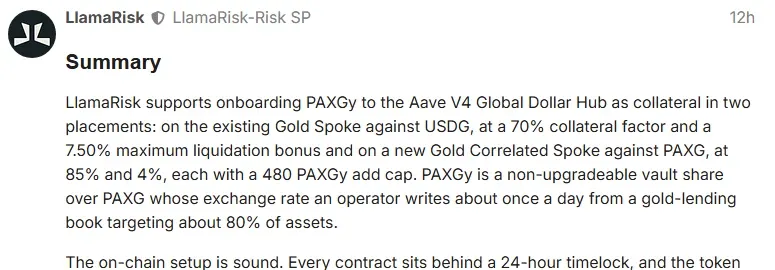
The summary of LlamaRisk's assessment on the Aave governance forum. Source: Aave governance forum.
The report notes that Paxos Labs says every loan is fully collateralised and none runs longer than 30 days. It also notes that insurance does not cover a default. Any uncovered loss would pass to all PAXGy holders through a lower exchange rate. That drop would only arrive after a timelocked markdown at least 24 hours later, and until then the price and liquidations are frozen.
Redemption is a second constraint. Direct redemption is open only to whitelisted institutions, so most holders would exit through market pools instead. LlamaRisk makes its support conditional on liquidity being live at listing time. That means $2 million in a Uniswap pool against PAXG and $1 million in a PAXG/USDC pool. It also recommends that Paxos Labs disclose a cap on how much any single borrower can take.
None of this is a vote yet. The thread is an assessment of PAXGy on Aave, and the usual proposal and governance decision still have to happen before anything is listed. The numbers come from the report as published, and they are one adviser's recommendation, not a decision by Aave.
Loading…
Written by
Writer and editor at Times of Crypto Era. Covers Bitcoin, DeFi, and market structure.
View full profile →Related News

BOME Price Analysis: A 29% Daily Drop After A Failed Sweep
BOME price analysis after a 29% daily drop: the failed push above $0.00117, the 200-day average at $0.000767 and two scenarios with clear 4-hour triggers.

Osmosis Validator Set Vote: 70 To 30 Seats, Fee Split Changes
The Osmosis validator set could shrink from 70 to 30 and community pool fees could go to stakers. See both proposals, the live tally and what changes.

GTC Price Analysis: Upbit Listing Spike Hits $0.393 Then Fades
GTC price analysis after the Upbit listing: an hourly spike to $0.393 on $9.5M volume, the fair value gap it left, and two scenarios with clear triggers.