Prediction Market Ban For Officials Is An Option, House Memo Says
The House Oversight memo of Nov 13, 2026 says Congress could pursue a prediction market ban for officials or limit contracts. See the cases and firms it names.
On November 13, 2026, the House Oversight Committee released a memorandum from committee staff to the Majority members of the Committee on Oversight and Government Reform. The staff memorandum tells Congress to consider a prediction market ban for federal officials. But the memo does not demand that Congress adopt one.
Congress "must consider additional reforms to prevent public corruption," according to Chairman James Comer, a Kentucky Republican. The chairman was quoted when the memorandum was released. The document is a briefing paper for Committee members and not a bill.
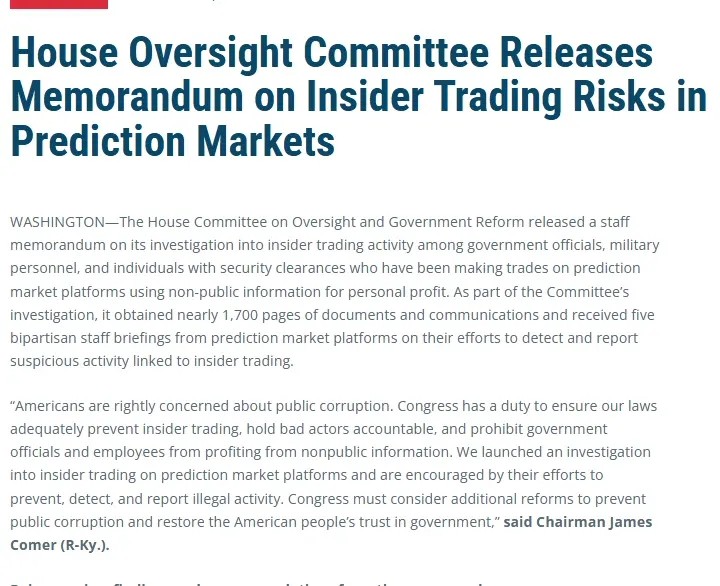
The Committee's November 13, 2026 release on the prediction markets memorandum. Source: House Oversight Committee.
A prediction market ban or a narrower limit
According to Section III of the memo, Congress may wish to legislate against participation in event contract markets for federal personnel, Members of Congress and congressional staff even when no one holds nonpublic information. At the very least, government personnel should not trade contracts tied to government actions or political outcomes, according to the memo.
The memo leaves lawmakers a plain choice. They could write a prediction market ban that prohibits any trading in these markets, or limit participation of only a certain subset of contracts including government-related ones. Either way, a prediction market ban or a limit would reach officials across the board.
The Senate has been the first one to do so. According to the memo, the Senate has passed a resolution on April 30, 2026, S. Res. 708, prohibiting Senators and their staff from participating in the prediction markets. Additionally, the memo mentions the memo issued by the Department of War that repeats the limitations imposed on service members.
Cases the staff cite
These include a number of individuals. An indictment filed in federal court on April 24, 2026, alleged that Army Master Sergeant Gannon Ken Van Dyke used classified information about the operation that captured Venezuelan President Nicolas Maduro to make more than $409,000 on Polymarket. An indictment is an allegation, and there was no verdict mentioned in the memo.
The memo also lists action taken by the Commodity Futures Trading Commission that began with information from the platforms. On May 27, 2026, the CFTC filed a complaint against Michele Spagnuolo, an engineer at Google, alleging profits of $1.2 million from trading on Google's non-public search data. On July 31, the CFTC ordered George Santos, the former Congressman, to pay $35,000, while on August 28, it ordered Gabriel Perez, a White House teleprompter operator, to pay $172,000.
Five platforms, four answers
The study began on May 22, 2026, with letters sent to Kalshi and Polymarket. The Committee added Hyperliquid Labs, Crypto.com, and PredictIt which is owned by Aristotle Exchange on September 29. The Committee considered almost 1,700 pages of materials and five bipartisan staff briefings.
Four out of the five platforms provided substantial documentation or briefing about their controls. According to the memo, Hyperliquid informed the Committee that it does not have the type of records requested for identity verification. The memo further states that most reported insider trading incidents were first detected and reported to regulators by the markets themselves.
Polymarket is specifically mentioned. It hired a former law enforcement expert to run its detection team and uses a surveillance tool called PolyGraph, built with Chainalysis.
What a prediction market ban would reach
The memo is not a piece of legislation. It is two pieces of advice: that Congress should consider the above restrictions and the need for the exchange and regulatory bodies to exchange necessary information in order to implement them. No legislative language and no voting are scheduled in the memo.
Moreover, it makes a distinction, which matters for crypto readers. Polymarket US is a CFTC-registered contract market based in New York. Polymarket.com is a blockchain-based exchange headquartered in Panama and is not registered with the CFTC, according to the memo. Any rule aimed at US officials would reach the first through its registration and the second only through those officials.
The full memorandum can be read here.
Related News
CFTC Event Contracts Proposal Puts Sports Bets Under Swap Rules
The CFTC event contracts proposal would class sports, politics and weather bets as swaps while casino wagers stay out. See the rules, comment steps and volume.
Backpack CFTC Approval: US Perpetuals Plan, And What CFTC Never Named
Backpack CFTC approval was announced Nov 16, 2026 for a US derivatives exchange. See what the CFTC statement says, what it leaves out and the waitlist.
CFTC Crypto Rules: Who Could Lend To Retail Traders
The CFTC asked for comment on rules for retail crypto bought with loans. Here is who could lend, who would hold the coins and how losses would be handled.
CFTC 24/7 Trading Roundtable Agenda Names Tokenization, Stablecoins
CFTC 24/7 trading roundtable on Dec 15, 2026 now has an agenda. See the three sessions, the stablecoin and tokenization questions and what is unnamed.