WalletConnect Staking APY Vote: 4-Week Rate Rises To 5%
WalletConnect staking APY vote: P4 would lift the 4-week rate from 0.78% to 5.00% and the 104-week rate to 24.52%. See the live tally and the caveats.

In this article+
Holders of the WalletConnect token are voting on a reset of the WalletConnect staking APY, and early results favour the change. Proposal P4 swaps the old linear reward formula for a power-law curve and adds a second measure called RewardWeight. On Snapshot it has drawn 295 votes. About 69% of the voting power is in favour and about 31% is against.
What proposal P4 changes
The proposal was posted by pedrogomes.eth, who appears with an admin tag on the WalletConnect Network space. It starts from a complaint about how the WalletConnect staking APY works today. Someone who locks WCT for four weeks earns well under 1% a year, while the longest lock pays about 26 times more. The linear formula also runs down to zero once enough people stake.
Two changes are on the table. First, a power-law curve would let yields rise when few people stake and ease off as more join. Second, RewardWeight would decide rewards only, and StakeWeight would keep deciding locking and votes. According to the text, nobody's existing balance, history or governance rights would be rewritten.
The WalletConnect staking APY table, before and after
The proposal includes a table of indicative yields, and it is worth a close look. The shortest lock would jump from under 1% to 5%. At the other end, the 104-week lock would climb from about 20% to about 24.5%. All the lengths in between gain a similar four points or so. The ladder gets much flatter, with the top rate under five times the bottom instead of 26 times.
Reward weight tilts the same way. In the proposal's example, 1,000 WCT locked for four weeks would carry about 101 units of reward weight, up from around 19 of stake weight. The extra shrinks as locks lengthen and disappears at the 104-week end. Every rate is labelled indicative, so the final values would need to be exact on-chain, and the authors say the executable proposal must carry them.
Timeline and caveats
The WalletConnect staking APY vote began on October 12 and runs to October 19. The space sets no quorum for it.
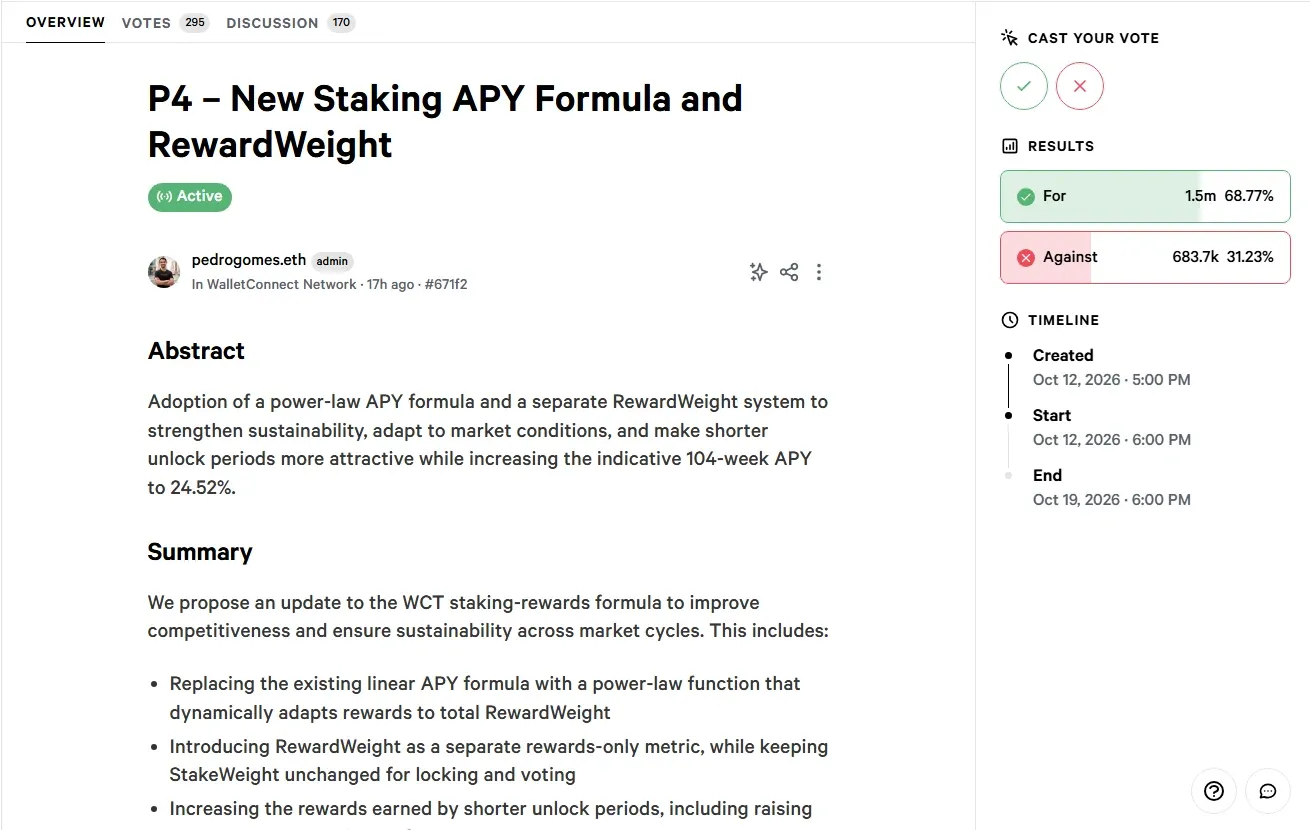
The P4 vote on Snapshot, with the live result and the timeline. Source: Snapshot.
Passing would not flip a switch, because the proposal lists more work first. That means contract testing, a migration check and an outside audit, then a frontend update and a final payload for the community to check again. When it does go live, it would start at a future Thursday reward period, and rewards already settled stay as they are.
One more caution applies to the comparison table. It sets the old and new systems at the same illustrative network total, though total stake weight and total reward weight are different measures. Read it as the shape of the new curve and not as a forecast.
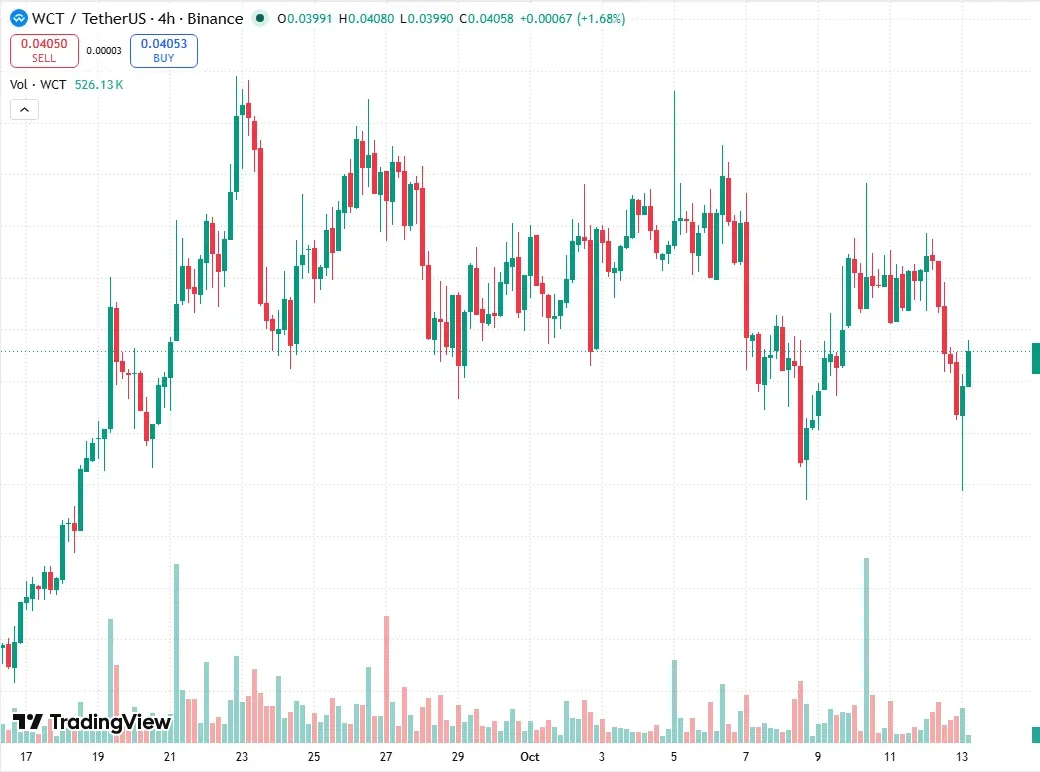
WCT/USDT four-hour chart on TradingView. Chart by Faith Njeri.
On the market side, WCT trades near 4 cents on Binance after a 4% fall over 24 hours. The proposal never mentions price, so this article does not link the two, and none of it is investment advice.
Loading…
Written by
Faith Njeri covers DeFi protocols, exploits and onchain security for Times of Crypto Era. Project post-mortems and governance proposals are read in full, and each incident is traced back to the team's own disclosure.
View full profile →Related News

PAXGy On Aave: LlamaRisk Backs Gold Vault, Flags Loan Risk
PAXGy on Aave: LlamaRisk backs a tokenized gold vault listing but flags borrower concentration and unverified loan statements. See the proposed limits.

BOME Price Analysis: A 29% Daily Drop After A Failed Sweep
BOME price analysis after a 29% daily drop: the failed push above $0.00117, the 200-day average at $0.000767 and two scenarios with clear 4-hour triggers.

Osmosis Validator Set Vote: 70 To 30 Seats, Fee Split Changes
The Osmosis validator set could shrink from 70 to 30 and community pool fees could go to stakers. See both proposals, the live tally and what changes.