Wholesale CBDC Settlement: MAS And Bundesbank Test Simbolon
MAS and the Bundesbank tested wholesale CBDC settlement between separate ledgers in Project Simbolon on Nov 16, 2026. See the zero-knowledge proof design.
The Monetary Authority of Singapore and the Deutsche Bundesbank have connected the test environments of their digital asset settlement systems. They both announced this achievement on November 16, 2026, as a step in wholesale CBDC settlement. The project is referred to as Project Simbolon. It is the first major milestone under a memorandum of understanding that they signed on November 13, 2025.
What the wholesale CBDC settlement test covered
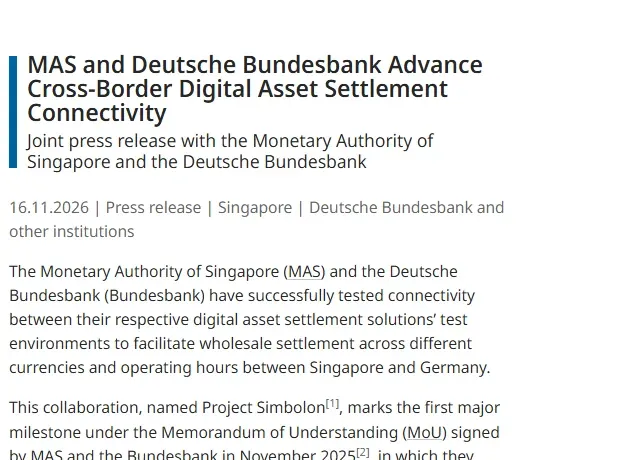
Joint press release of MAS and the Deutsche Bundesbank, dated November 16, 2026. Source: Deutsche Bundesbank.
DBS and Deutsche Bank participated as commercial banks, with Partior as their technology partner. The experiment involved payment-versus-payment (PvP) settlement of euro and Singapore dollar foreign exchange transactions using wholesale central bank digital currencies, a form of wholesale CBDC settlement. Payment-versus-payment settlement entails that each currency leg becomes final if and only if the other leg becomes final.
Zero-knowledge proofs link two central bank ledgers
Both of the central bank ledgers were kept separate. The zero-knowledge proof mechanism enabled both environments to prove that the requirements for the settlement were satisfied without integrating the two ledgers technologically. The press release defines a zero-knowledge proof as a proof that a claim is valid. It does this without disclosing any private information necessary to prove the claim.
The proofs enabled coordination of the two settlement legs across the ledgers. So this was a test of wholesale CBDC settlement between two separate ledgers. The name Simbolon derives from the Greek word symbolon, which means a token of recognition made of two halves.
Liquidity use cases and what comes next
Another matter explored in the project was the funding and liquidity needs of institutions that work between Singapore and Germany. Securities transactions and intraday liquidity management are the examples that the release gives. In the words of the release, liquidity could be obtained and committed closer to when it is needed.
The release says Simbolon also complemented the wider Project Guardian, a MAS initiative launched in May 2022 to improve efficiency in tokenised financial markets. The Bundesbank has been a member of the Guardian Policymaker Group since November 2024. Below are two more documents. The Insights Note was published on November 16. The report entitled Cross-Border FX Settlement Connectivity Across Independent Digital Infrastructures will appear on both central banks' websites in due course.
The statements were made by Mr Leong Sing Chiong of MAS and Dr Sabine Mauderer of the Bundesbank. Leong is MAS Deputy Managing Director for Markets and Development. He said that as financial markets become increasingly tokenised, financial infrastructures will need to interoperate effectively across borders. According to Mauderer, First Deputy Governor of the Bundesbank, Project Simbolon "paves the way for eliminating settlement risk in global foreign exchange transactions."
The press release talks about connectivity between test environments. The further work could involve settlement performance and issues related to wider use, including legal, regulatory, operational, and governance matters. MAS and the Bundesbank say they will keep working with industry partners on interoperable cross-border digital asset settlement. Previous TOCE coverage concerned USDC supervision transfer to the EBA and the 30-day stablecoin supply decline.
Related News
SEC's Peirce Urges Regulators to Stop Collecting So Much KYC Data
At SIFMA's Digital Assets Conference, SEC Commissioner Hester Peirce argued that mass KYC data collection fails and pointed to zero-knowledge proofs as an alternative.
Qian Zhimin Bitcoin Case: High Court Applies Chinese Law
The Qian Zhimin Bitcoin case ruling says Chinese law governs victims' claims on 61,000 BTC. See what the High Court decided and what it left open for later.

BIS Chief Tells Jackson Hole: Stablecoins Are Not Real Money
BIS general manager Pablo Hernandez de Cos told the Jackson Hole symposium that stablecoins do not credibly function as money at scale, backing tokenized bank deposits instead.
USDC MiCA Status: EU's First Significant E-Money Token
USDC MiCA status is now official: the EBA named it the first significant e-money token on October 14, and from November 12 it takes over key duties from France.