Aave V4 Tempo Proposal: One Hub, Two Spokes And OUSD Borrowing
The Aave V4 Tempo proposal asks for one liquidity hub, two spokes and OUSD, cbBTC and PRIME. A July Temp Check drew 392,686 in voting power for, none against.

In this article+
Tempo wants Aave V4 on its payments chain, and the formal proposal landed on October 16. The Aave V4 Tempo proposal sets out one liquidity hub, two spokes and three assets. It is a request for comment, so a Snapshot vote and an onchain vote still have to follow.
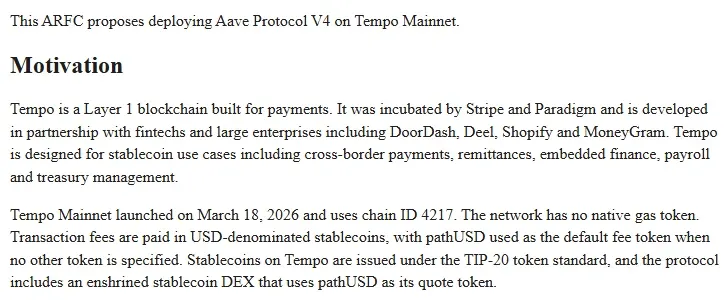
The summary and motivation of the Aave governance post. Source: Aave Governance Forum.
What the Aave V4 Tempo proposal describes
The post was published under the Tempo account at 00:04 UTC on October 16. It describes Tempo as a Layer 1 built for payments, incubated by Stripe and Paradigm. It names DoorDash, Deel, Shopify and MoneyGram among the fintechs and enterprises it works with.
Tempo mainnet launched on March 18, 2026, and uses chain ID 4217. The post says the network has no native gas token. Fees are paid in dollar stablecoins, and pathUSD is the default fee token when none is specified.
Stablecoins on Tempo follow the TIP-20 standard. The chain also has a built-in stablecoin exchange that uses pathUSD as its quote token.
One hub and two spokes
The plan activates Aave V4 with a single Tempo Core Hub. Three assets sit in that hub: OUSD, cbBTC and PRIME. Two spokes draw on it.
The Main Spoke accepts cbBTC and OUSD as collateral. The RWA Spoke accepts PRIME, which the post groups with real-world assets. In both tables the borrowable asset is OUSD.
One detail differs between the text and the tables. The prose says pathUSD and OUSD can both be borrowed against collateral, yet the tables list only OUSD as borrowable. The post does not explain the gap.
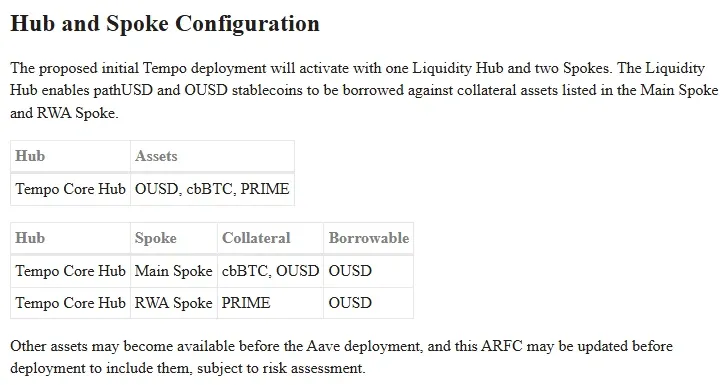
The hub and spoke tables from the proposal. Source: Aave Governance Forum.
The initial token list and risk settings are not final. The post says they will be updated after Aave's risk service providers finish their analysis, and that more assets may be added before deployment.
The earlier vote and the next steps
This proposal follows a Temp Check on Snapshot that ran from July 24 to July 27. Aave's Snapshot page shows 392,686 in voting power in favor, none against, and 76 voters. The Temp Check text from July 23 set out the path from here.
An Aave Request for Comment goes to a Snapshot vote after discussion. A successful vote leads to an onchain proposal for the deployment itself. The October post lists two near-term steps: gather feedback and finish the LlamaRisk analysis, then escalate to the Snapshot stage.
The July Temp Check also said Tempo would incentivize pathUSD deposits on Aave at around the SOFR rate for the first year after launch. That promise sits in the Temp Check, while the October post leaves incentives out. The new text does not mention it.
What the Aave V4 Tempo proposal leaves open
The Aave V4 Tempo proposal gives no dates for the Snapshot vote or the onchain vote. It also gives no supply caps, borrow caps or collateral factors. TOCE covered a smaller step earlier, in Aave Risk Stewards cut USDtb cap 67% and close LDO deposits. There the risk team moved numbers within existing rules.
This article reports a proposal under discussion. It does not say the vote will pass, and it does not forecast when Aave V4 would go live on Tempo.
Loading…
Written by
Faith Njeri covers DeFi protocols, exploits and onchain security for Times of Crypto Era. Project post-mortems and governance proposals are read in full, and each incident is traced back to the team's own disclosure.
View full profile →Related News

FIL Price Analysis: A Sweep To $0.9999 Reverses To $1.2013
FIL price analysis: a sweep to $0.9999 on Oct 15 reversed to a $1.2013 high, and FIL sits near $1.13. A bullish gap at $1.0804 to $1.1317 is below price.

XRP Price Analysis: A Sweep To $1.2840 Fades Back Toward The Low
XRP price analysis: two sweeps under $1.3112 on Oct 15 reversed, then XRP slid to $1.296. A four-hour gap at $1.3448 to $1.3620 caps price, with $1.2840 below.

Spark Morpho Vault Timelocks: Zero-Delay Allocator Changes From Oct 26
The Spark Morpho vault timelocks plan cuts allocator and penalty delays to zero on two vaults and raises adapter delays to 3 and 7 days. Poll runs Oct 19 to 22.