Bank of Russia Crypto List Opens Bitcoin, Ether And USDT To Retail
Bank of Russia crypto rules let non-qualified investors buy Bitcoin, Ether and USDT from November 17, capped at 300,000 rubles per intermediary each year.
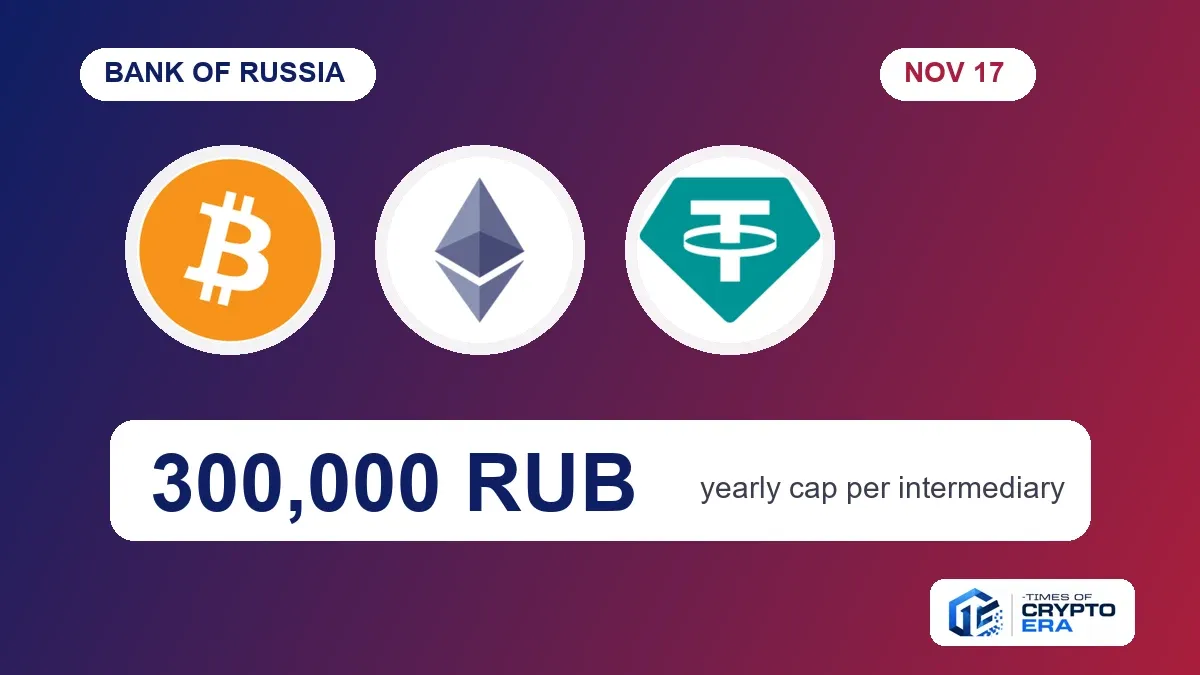
Bank of Russia crypto rules will let investors without qualified status buy Bitcoin, Ether and USDT from November 17. The central bank said on November 6 that it has approved the list of cryptocurrencies open to non-qualified investors.
It is a narrow door, and the central bank built it that way on purpose. The release says the approach is meant to reduce risk for people without professional status. Only three assets are on the list. A yearly cap limits how much one person can buy, and everyone must pass a test first.
The Bank of Russia release is short, so each detail counts.
Why the Bank of Russia chose three assets
The bank says it chose the most liquid assets that meet criteria written into law. It looked at market capitalisation, average daily trading volume and pricing history on foreign exchanges. That history had to reach back at least five years.
The stated purpose is to limit the risks of cryptoassets for non-qualified investors. Bitcoin, Ether and USDT cleared the bar. A coin with less than five years of trading on foreign exchanges cannot meet the stated test.
A 300,000 ruble ceiling on retail crypto buying
These investors can buy through intermediaries such as brokers, trust managers or crypto exchange offices. Both exchange and over-the-counter markets are allowed. Money moves under a yearly limit. For each intermediary an investor uses, the cap is 300,000 rubles.
Qualified investors get wider access. The release says they can reach all cryptoassets without restrictions. Whatever their status, every investor must pass the relevant test and read about the risks before a transaction.
The law behind the Bank of Russia ordinance
The ordinance follows a crypto law that the central bank described when the State Duma passed it in its second and third readings. That law takes effect on September 1, 2026. It sets up crypto exchanges and digital repositories as new regulated players, alongside brokers and management companies.
The central bank's earlier release adds that investors will also be able to swap crypto for securities and digital rights issued under Russian law. The requirements for cryptocurrencies are set to apply to foreign stablecoins too, which matters because USDT is one. Crypto exchanges will buy and sell the assets, while digital repositories will record who holds the rights.
Some limits stay. Using cryptocurrency for payments inside Russia is still prohibited. Exporters and importers may use it in cross-border payments without limits. Russian residents may deal in crypto abroad only through foreign bank accounts. They must report holdings recorded abroad to tax authorities.
The November 17 start date
From that day the three assets may be publicly traded on exchanges. Firms have until July 1, 2027 to obtain licences and bring operations into line with the law. That window runs well past the start date.
So the first retail purchases under the Bank of Russia crypto ordinance can begin before every provider holds a final licence. Each intermediary decides when to add the assets.
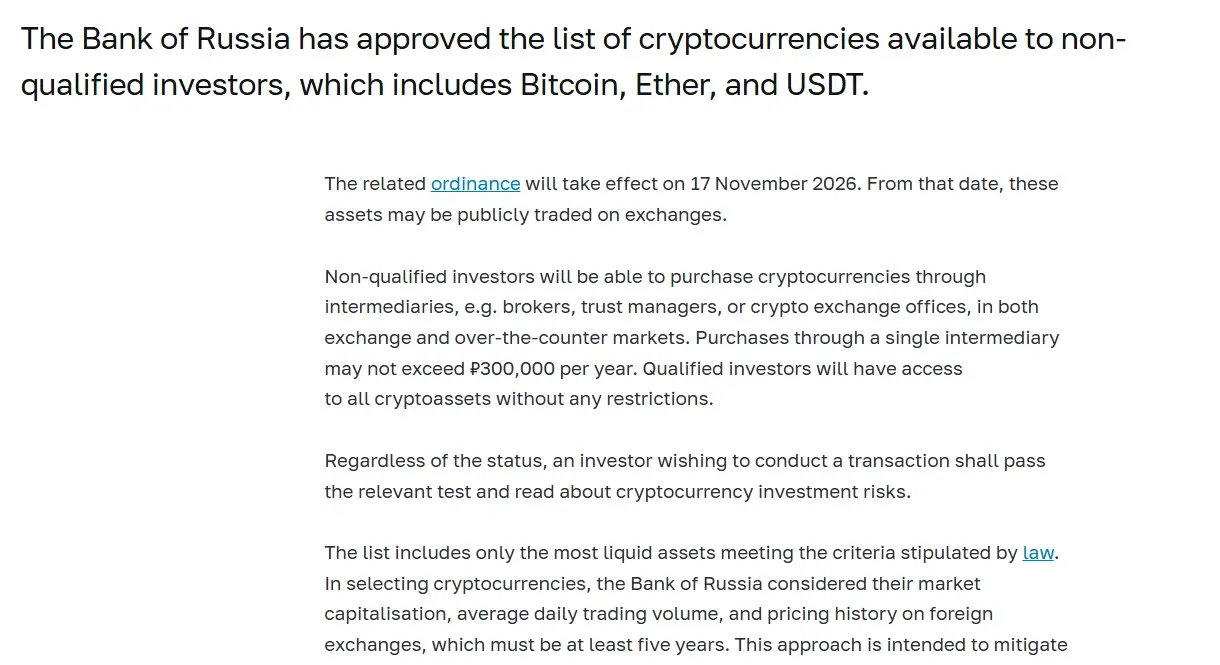
The central bank's announcement of the ordinance. Source: Bank of Russia, 6 November 2026.
Related News

CFTC Lets Futures Brokers Invest Customer Funds in Tokenized Assets, Keep Records on a Blockchain
The CFTC updated its crypto FAQs on September 24, letting futures brokers invest customer funds in tokenized assets and keep required records on a blockchain.

SEC Proposes Regulation Crypto Assets For Token Sales
The SEC has proposed Regulation Crypto Assets, a new rule creating two registration exemptions for crypto token offerings and a conditional safe harbor from securities law.

BIS Chief Tells Jackson Hole: Stablecoins Are Not Real Money
BIS general manager Pablo Hernandez de Cos told the Jackson Hole symposium that stablecoins do not credibly function as money at scale, backing tokenized bank deposits instead.
CFTC Crypto Rules: Who Could Lend To Retail Traders
The CFTC asked for comment on rules for retail crypto bought with loans. Here is who could lend, who would hold the coins and how losses would be handled.